THE
DOSAGE
Sri Lanka · the worldColombo · MelbourneEdition 01 · Coming soon
Reality, unfiltered.
Read the latest stories
Top stories
Get the issue →
The Latest Covers
Access the vault →
Edition 01 · Coming soon
The Dosage is back, in print
One story per edition, told in full. Printed to keep, with everything else a scan away.
Be first to know →
THE
DOSAGE
Edition 01
Coming
soon.
Edition 01 · Coming soon
Issue 01 · December 2015
Watch
All films on YouTube ↗Follow on TikTok ↗
 The Dosage: Trailer #1
From the archive · The original issue
Where it all started
The trailer for the very first issue of The Dosage: the cyclists, bodybuilders, therapists, nurses and doctors who filled its pages.
Read the original issue →
Films · Dassa Vlogs
Editor’s Travels
While The Dosage was on hold, our editor kept filming. Two stories from 2020, now with full write-ups.
All Editor’s Travels →
Colombo · Melbourne
All stories →
65,152Sri Lanka-born people living in Greater MelbourneABS, 2021 Census $8.07bnsent home by Sri Lankans abroad in 2025, a recordCentral Bank of Sri Lanka 78,000older Australians expected to drop private cover after the rebate cutABC News Mar 2027when Sri Lanka’s $3 billion IMF programme endsIMF
The Dosage
Stories
News, explainers and dispatches from the making of Edition 01. Every number is sourced.
Films · Dassa Vlogs
Editor’s Travels
While The Dosage was on hold, our editor kept filming. Two stories from 2020, now with full write-ups.
All Editor’s Travels →
Topic
Melbourne
Melbourne and Victoria: the decisions, services and events that shape daily life for our readers.
Colombo · Melbourne
Colombo
News from home and the trip there: prices, health, sport, culture and travel in Sri Lanka, for readers in Colombo, Melbourne and beyond.
Getting there
Checked 27 Oct 2026
Melbourne to Colombo
MEL → CMB
SriLankan Airlines flies direct, 10 times a week since 2 August 2026. The daily UL605 leaves Melbourne at 4:10 pm and lands in Colombo at 10:25 pm; UL609 leaves at 6:00 am on Mondays, Wednesdays and Fridays and lands at 12:15 pm.
Official travel advice
Sri Lanka: Exercise a high degree of caution, due to the threat of public demonstrations and security risks.
Singapore: Exercise normal safety precautions.
Before you go
- Going home? What to know about dengue and the new vaccine
- Vap Poya and Deepavali: two holidays coming up
- Australia is Sri Lanka’s fourth-biggest source of visitors this October
Travellers’ guide: visa, flights, eSIM
Partner links: some links on this page may be partner links, and The Dosage may earn a commission if you book through them, at no extra cost to you. It never affects what we report or recommend.
Travel advice: Department of Foreign Affairs and Trade's Smartraveller website - www.smartraveller.gov.au (CC BY). Advice can change at any time; check it before you travel. Flight details from SriLankan Airlines.
Topic
Health
Health and fitness you can use, from Melbourne clinics to dengue season in Sri Lanka. Every number is sourced.
Topic
Money
Prices, rates, budgets and the big questions, explained simply for households in Melbourne and Colombo.
Topic
Lifestyle
Fashion, culture, travel and the way we live, from City Square to the runways of the world.
The Dosage
Sport
Cricket, community sport and the games our readers play, from Melbourne to Colombo. Every number is sourced.
All sportThe Crease · Cricket
The Dosage
Arts
Theatre, dance, music and the people who make them, across Melbourne and Victoria. Reviews from our critics, news from the stage and a guide to where it all happens.
All arts
News
From the stage
What’s on
Dates from each company
Red Stitch Actors’ TheatreCARBONChapel Street, St Kilda East11 Nov – 6 Dec 2026 Malthouse TheatreAll About EveMerlyn Theatre, Southbank20 Nov – 12 Dec 2026
Venues & companies
Melbourne
Theatres & arts centres
- Arts Centre MelbourneMelbournePerforming arts centre on St Kilda Road, home to the Theatres Building and Hamer Hall.
- Ian Potter State TheatreArts Centre MelbourneThe largest stage in the Theatres Building, used for ballet, opera and musicals.
- PlayhouseArts Centre MelbourneMid-size theatre in the Theatres Building.
- Fairfax StudioArts Centre MelbourneStudio theatre in the Theatres Building.
- Hamer HallArts Centre MelbourneConcert hall and home stage of the Melbourne Symphony Orchestra.
- Southbank TheatreSouthbankMelbourne Theatre Company’s home venue, including The Sumner.
- Melbourne Recital CentreSouthbankConcert venue with Elisabeth Murdoch Hall and the Primrose Potter Salon.
- Comedy TheatreMelbourneExhibition Street theatre run by Marriner Group.
- Her Majesty’s TheatreMelbourneExhibition Street theatre for musicals and touring shows.
- Princess TheatreMelbourneSpring Street theatre run by Marriner Group.
- Regent TheatreMelbourneCollins Street theatre run by Marriner Group, home to musicals and opera seasons.
- Forum MelbourneMelbourneVenue on the corner of Flinders and Russell streets.
- Athenaeum TheatreMelbourneCollins Street theatre built in 1924 inside the Athenaeum.
- Palais TheatreSt KildaLarge theatre on the Lower Esplanade, next to Luna Park.
Theatre companies
- Melbourne Theatre CompanySouthbankTheatre company performing mainly at Southbank Theatre.
- Malthouse TheatreSouthbankTheatre company and venue staging contemporary and reimagined classic works.
- Red Stitch Actors’ TheatreSt Kilda EastEnsemble company staging contemporary plays in an intimate theatre.
- ILBIJERRI Theatre CompanyCollingwoodFirst Peoples theatre company, creatively controlled by Indigenous artists, founded 1991.
Independent stages
- La MamaCarltonIndependent theatre with two venues: La Mama HQ and the Courthouse.
- fortyfivedownstairsMelbourneNot-for-profit arts space on Flinders Lane with a theatre and two galleries.
- Theatre WorksSt KildaIndependent theatre on Acland Street, also running the Explosives Factory.
- Chapel Off ChapelPrahranCity of Stonnington arts venue in a former 1858 church.
- Arts HouseNorth MelbourneCity of Melbourne program for contemporary art and performance, at North Melbourne Town Hall.
- Darebin Arts SpeakeasyNorthcoteDarebin Council’s program of independent theatre, dance, circus and live art.
- Gasworks Arts ParkAlbert ParkArts park with a theatre, galleries, cafe and bar.
- Meat MarketNorth MelbourneHistoric hire venue managed by the City of Melbourne.
Dance, opera & music
- The Australian BalletMelbourneAustralia’s national ballet company, founded 1962 and based in Melbourne.
- Opera AustraliaMelbourne seasonsNational opera company with Melbourne seasons at the Regent Theatre and Arts Centre Melbourne.
- Victorian OperaMelbourneVictoria’s state opera company.
- Chunky MoveSouthbankContemporary dance company founded 1995, based at Chunky Move Studios.
- Melbourne Symphony OrchestraHamer HallVictoria’s orchestra, performing at Hamer Hall.
Festivals
- Melbourne International Comedy FestivalAutumnComedy festival founded in 1987, running three and a half weeks each autumn.
- RISINGFestivalMelbourne festival of music, dance, theatre, installations and film.
- Melbourne FringeFestivalOpen-access, multi-arts festival for independent artists, founded 1982.
- YIRRAMBOIBiennialArts festival presented by the City of Melbourne. See its site for the next program.
- Midsumma FestivalSummerAnnual queer arts and culture festival.
Venue details from each organisation’s own website, checked 28 October 2026. Spot something out of date? Email info@thedosagemag.com.
**Media releases and invitations.**Companies and publicists: send media releases and invitations to info@thedosagemag.com.
The Dosage
Food
Sri Lankan food in Victoria and beyond: the kitchens, the cooks behind them and the dishes worth travelling for, from Melbourne to Colombo.
**Tell us where to eat.**Know a Sri Lankan kitchen, food truck or home cook we should visit? Tell us at editor@thedosagemag.com.
Sport · Cricket
The Crease
Women’s and men’s cricket, the Big Bash and Sri Lanka’s game, for Melbourne’s cricket-first families.
All sportThe Crease · Cricket
Players from the eight clubs at the WBBL|12 launch in Sydney. Photo: Jason McCawley / Getty Images via Cricket Australia.
Weber WBBL|12Opening night · Melbourne
Thu 29 Oct · Junction Oval
Double-header under lights
- 1Melbourne RenegadesSydney Thundervisitors
- 2Melbourne StarsHobart Hurricanesreigning champions
Week one ends: Hurricanes v Renegades, Ninja Stadium · Source: Cricket Australia, 23 Oct 2026
Read: what to know before the first ball →
THE
DOSAGE
Edition 01
Coming
soon.
The Dosage in print
Edition 01
Coming soon.
Follow The Dosage to be first to know when it's out.
Be first to know →
The Dosage in print · From the archive
Issue 01
December 2015.
The first Dosage: Sri Lanka’s first digital video magazine, built around health, fitness and the way we live. Ten stories, most of them filmed by our video team as we reported it. Read them again here, with the films beside them.
Read the stories ↓Flip the originalFrom the archive: The First Ride
Editor’s note, 2015
Editor’s note
“What we seek to do with Dosage is to create a space for novelty.”
We seek to create a cusp at which to convene information from various aspects of lifestyle and health, so you don’t have to seek it; it comes to you. At a time when the progressive world keeps us en pointe in everything we do and we seldom have time to assess the things that really matter (our health and our outlook on this existence we call life), that is what we at Dosage do best.
We hope you enjoy the read and stay with us on this journey we are beginning, because we are beginning it together.
Svetlana De Fonseka Abeysekara · for Team Dosage
In this issue
10 stories · 23 films
FeaturedBorn and bred in music
The sound that is Ryan De Mel. The 21-year-old singer on Voiceprint, his trademark cover, and why music heals.
pp. 08–11
▶ 1 film
FeaturedThe psychology of music
How music moves us, reflects our moods, and sometimes says what people cannot.
p. 12
No film
Fitness & wellnessCrossFit with Andy Andrews
Certified the fittest in Sri Lanka in the 2015 Reebok CrossFit Games Open, the golfer-turned-trainer explains the sport of fitness.
pp. 14–18
▶ 3 films
Fitness & wellnessThe Gym Review: Vaaj Fitness Centre
Inside the gym that wanted to be a full fitness centre: assessments, a sports doctor, a dietician, and a CEO with a system.
pp. 20–27
▶ 2 films
Fitness & wellnessMuscle Motivation, Episode 01
Bodybuilder Harintha Tillekeratne on gaining his first 15 kilos, supplements and consistency. Plus four towel exercises with trainer Shawn Roache.
pp. 28–30
▶ 1 film
Health insiderOccupational therapy for you
At the Ragama Rehabilitation Hospital, therapists use sport, art, music and drama to help patients rebuild their lives.
pp. 32–33
▶ 3 films
Cover storyTailgating a trailblazer
A day with Yasas Hewage, banker turned pro-cyclist and founder of the Wroom community, Spinner Café and Sri Lanka’s first bike-fit lab.
pp. 34–49
▶ 3 films
Health administrationDesigning a rocket or a hospital?
Dr. Kithsiri Edirisinghe on why building a hospital is harder than sending a rocket to Mars.
pp. 50–53
▶ 3 films
EducationNursing is more of an art
At IIHS in Welisara, a UK-trained nurse on why nursing is a global passport, and why not everyone can do it.
pp. 54–56
▶ 4 films
Sex & Sri LankaSex and Sri Lanka
Sexuality education from a psychological perspective, with Sarah Soysa, Dakshitha Wickremaratne and Nivendra Uduman.
pp. 57–61
▶ 3 films
Behind the issue
 The Dosage: Trailer #1
 Blooper reel
Flip the original
All 33 pages, as printed
If the reader doesn’t load, open the magazine in a new tab ↗
Team Dosage, 2015
ISSN 2465-6283
- Eashaan DassanayakaManaging Editor
- Svetlana De Fonseka AbeysekaraEditor
- Ovindu ColonneHead of Design and Publications
- Pulasthi BandaraHead of Photography
- Aravinda DevapriyaVideographer
- Udara JayawardenaWeb Designer
- Sayuri DevapriyaCoordinator
- K Don VimangaWriter
- Nidula AthulathmudaliWriter
- Darshan KanagarajWriter
- Panchali IllankoonWriter
- Lochana De AlwisMarketing Consultant
- Sanjay MatsudaMarketing Consultant
The views shared by the professionals interviewed are their own, not the publisher’s. No part of this magazine may be reprinted without written consent from The Dosage or the respective author.
← Issue 01 · December 2015
FeaturedIssue 01 · pp. 08–11
Born and bred in music
The sound that is Ryan De Mel. The 21-year-old singer on Voiceprint, his trademark cover, and why music heals.
The DosageFirst published December 2015
▶ Watch Music is healing with Ryan De Mel
From the stirring rendition of Marvin Gaye’s hit single “Sexual Healing,” which has become his trademark cover, to spontaneously rapping out his mother’s grocery list, 21-year-old Ryan De Mel is one of Sri Lanka’s fast-rising musicians. Both a solo artist and a member of the local band Voiceprint, Ryan has made a niche for himself in the island’s music scene as a strong competitor who is here to stay for years to come. Dosage sat down with this budding star, whose personality is as much a compliment to his incredible talent as it is to the magnanimous human being behind the music.
What’s new with you, musically?
A year ago I joined Voiceprint. It’s taken a lot of my time and been keeping me busy. I’m also working on a solo project. I’m doing some covers and I’ll be releasing them individually on my YouTube channel sometime soon.
You’ve been singing since you were a child. How did it all begin?
I’d say I could sing before I could talk. Both my parents come from a musical background and they both sing, so I was born and bred in music. I wasn’t forced into it; it was just something I wanted to do. When I was ten, my mom enrolled me in professional voice training with Marianne David and I’m still continuing to train.
What do you think about your progression from a solo singer to a group singer?
I’ve actually been a group singer from a small age. I sang for the choir, and even though we sang as a group we were trained as soloists. So I wouldn’t say I’ve progressed, but I do see a progression in the genres I choose to sing. Switching from classical to contemporary was hard because they have different techniques. But once I got into it, I was able to go from acoustic to classical and vice versa.
What are your biggest influences, and how has music affected your personality?
My first influence would be my parents. Once I got into music, the artists I follow, like Michael Bublé, Pharrell and Chris Brown, became a huge influence. Music is pretty much my personality. And the artists I like are pretty versatile, so I find influence in jazz, pop and R&B.
You got pretty famous for your cover of Marvin Gaye’s “Sexual Healing.” What’s the story behind it?
Ha! You know how most songs have some deep meaning behind their origin? This one was pretty straightforward. I was practising for a gig with a friend and we wanted to do something that wasn’t so mainstream. When we narrowed it down, we decided on this song. It really paid off and became this huge hit. Now I have to perform it at every gig.
Is it safe to say that music is healing?
Definitely. There are some illnesses doctors can’t figure out, but music can heal. When you’re feeling a little down or lonely, you don’t really need medication. You need music; you need lyrics you can connect with. You’d be amazed how the right song can change your mood at the snap of a finger.
When you’re feeling a little down or lonely, you don’t really need medication. You need music.
What’s one of the funniest things that has happened to you onstage?
(Laughs) I have so many funny stories, but one stands out. I was doing a gig at Gateway, singing “Sexual Healing” (a song I’ve sung a million times) when all of a sudden I blanked on the second word. So I spontaneously rapped out my mom’s grocery list. And the best part was that no one noticed. They were so into it, I was so into it, it didn’t matter that I was rapping about tomatoes, milk and carrots.
Next in Issue 01The psychology of music →
← Issue 01 · December 2015
FeaturedIssue 01 · p. 12
The psychology of music
How music moves us, reflects our moods, and sometimes says what people cannot.
The DosageFirst published December 2015
Music as an expression, as an art or simply as a way of life, is therapeutic to all who behold it, in its simplicity as well as its complexity. It’s a sense of belonging, or a longing to belong, whichever we are seeking, that connects us to music.
Music undoubtedly affects human emotion. From the classical tones of Bach and Beethoven to contemporary independent genres or the heavier tones of rock, metal or grunge, we tend to listen to what best reflects our moods.
Many people cite music as a route out of distressing times in their lives. And so it is. Music not only reflects but affects temperament, and may help alleviate low moods.
An almost telepathic connection that music has with its listeners is its ability to communicate feeling. Music has emotional components in its nuances that can reflect and draw out sensations ranging from deep, moving sorrow to inexplicable elation, to unsettling fear and even irrepressible anger. Cinema has used this for aeons to move its audiences. It is also the element that makes our hairs stand on end and our hearts flicker with delicious emotion. Music moves. It can move one to tears. This power can thaw almost any cold disposition, and by that argument music can alleviate anger and depression, or help someone see things from your perspective when the need arises.
Sometimes music can speak human emotion in a way that humans cannot.
In a most clichéd retelling of a classic tale, I have had many a friend (and a personal experience) who, unable to express herself to a significant other, sent him a song she had recently heard. After months of silent misunderstanding, neither had been able to communicate their deep-seated needs to the other as that song did. This is something we can all relate to. Whether we choose to share that song or not, it is undisputed that sometimes music can speak human emotion in a way that humans cannot.
From the seven-year-old girl who woke to an Adele song after a week in a coma following a freak accident, to Sam Carter, aged 60, who was given a 30% chance of waking from a coma after severe anaemia but awoke to the Rolling Stones’ “(I Can’t Get No) Satisfaction,” music has proven through the years that its healing powers transcend the conscious.
From going to sleep with Simon and Garfunkel in your head to waking up six hours later with the same song, it is music that defines our very existence. Psychology and physiology are made that much more magical by our relationship with, and response to, the therapeutic phenomenon with a universal language and communicating power that is music.
Next in Issue 01CrossFit with Andy Andrews →
← Issue 01 · December 2015
Fitness & wellnessIssue 01 · pp. 14–18
CrossFit with Andy Andrews
Certified the fittest in Sri Lanka in the 2015 Reebok CrossFit Games Open, the golfer-turned-trainer explains the sport of fitness.
The DosageFirst published December 2015
▶ Watch Cross Fit with Andy Andrews
Andy Andrews is an internationally qualified CrossFit trainer currently working at Vaaj Fitness Centre, and a professional golfer who aims to play a vital role in the fitness revolution in Sri Lanka. Andy was certified as the fittest in Sri Lanka in the 2015 Reebok CrossFit Games Open.
What is the story behind CrossFit, and what motivated you to be part of it?
I have played golf all my life, and strength and conditioning is a very important factor in becoming a successful golfer. I came to Sri Lanka a few months ago looking for a good fitness centre to work out at. That’s when I came across Duminda, and he asked me to fill in for some classes. It grew from there, and I still haven’t left. Sri Lanka has a huge gap in developing healthy individuals into healthy athletes, and since our lifestyles and food patterns have changed, people pay less attention to physical fitness and are more prone to conditions like high cholesterol and high blood pressure.
CrossFit at Vaaj: what is special here?
It is the only one in Sri Lanka. A lot of people claim to do it, but we are the only licensed ones.
Are your clients genuinely conscious about their health, or do they want to be part of a trend?
Good question! A lot of people come and tell us they want to lose weight or get their stomachs smaller. CrossFit is a performance-based training programme: we look at what your body can do, not what it looks like. Both people who are genuinely health-conscious and people who want to be part of a trend come, but what matters most is that you remain fit and healthy.
CrossFit is the sport of fitness.
We were told CrossFit is a sport. What do you have to say about that?
Initially, CrossFit was just a training programme. Generally, people go to the gym and spend hours working out, which is totally unnecessary. The element of time was introduced to CrossFit, and that changed things: you had to complete the tasks as fast as possible, or do as many as you could in a given time. That made it competitive and created the hunger to perform better. The first CrossFit Games were held in 2007, and now it is a multi-million-dollar event held every July in California. What’s special is that the workouts are ones anybody with a foundation level of fitness could do.
A physiotherapist’s view
Asanga Jayalath, physiotherapist
What do you think of CrossFit and the exercises involved, from a physiotherapist’s perspective?
This programme strengthens muscle through activity; the important aspect is that the movements are not isolated. With the rise in non-communicable diseases, people need to bring exercise into their lives. CrossFit is one way of improving fitness and health, and it helps increase the mobility, strength and coordination of one’s body.
If CrossFit is a sport, and all sports involve injuries, what kinds of injuries do you see?
CrossFit is for all ages, so instructors should be especially responsible when training kids. Children in the 13–14 age group are still developing their muscles, so heavy weights can cause ligament and tendon tears. Instructors should know the limits.
Middle-aged women often join these programmes to keep fit and lose belly fat. What’s your advice to them?
Women, especially after menopause, should know that oestrogen is a vital hormone in strengthening bones, and after menopause its secretion drops, which can lead to osteoporosis or osteoarthritis. These conditions can cause bone damage during strenuous exercise, so it’s important to get proper advice from medical professionals and your instructors, and to know your limits.
Injuries are inevitable, but ladies love to squat?
Squatting helps build well-toned back muscles, but women, especially those carrying belly fat or recovering from surgery or childbirth, should brief their instructors before signing up, because weightlifting puts pressure on ligaments and rotator cuffs and can cause injuries. Lifting can even put pressure on the bladder or uterus, which may prolapse and cause bleeding, which can be very dangerous.
“As a physiotherapist, what I suggest is that you get proper professional advice and educate your personal instructor about your body, so they know exactly what you need and can train you without injury.”
More films from this story
 CrossFit client at Vaaj Fitness Centre
 Injuries are inevitable but ladies love to squat: Asanga tells you how to avoid them
Next in Issue 01The Gym Review: Vaaj Fitness Centre →
← Issue 01 · December 2015
Fitness & wellnessIssue 01 · pp. 20–27
The Gym Review: Vaaj Fitness Centre
Inside the gym that wanted to be a full fitness centre: assessments, a sports doctor, a dietician, and a CEO with a system.
The DosageFirst published December 2015
▶ Watch The Gym Review: Vaaj Fitness Centre with Mr. Mothilal Jayathilake
Mothilal Jayathilake
CEO, Vaaj Fitness Centre · Rugby coach and trainer
What’s your clientele like here?
We have close to 500 members.
As a strength and conditioning instructor, which groups do you train, and are there specific programmes for each?
We cater mostly to people doing strength and conditioning for sport. The problem in Sri Lanka is that people don’t know the difference between fitness training and sport training.
The problem here in Sri Lanka is that people don’t know the difference between fitness training and sport training.
Take rugby players. How does their training differ from a normal person’s?
Sports demand many physical qualities. In rugby you need to be bigger, stronger and faster, which means strength, power and endurance. In tennis you need agility and speed. So training differs from sport to sport. But you need basic training from childhood, like periodisation plans, so you can plan your training.
What is your opinion on supplements?
Internationally, in countries like the USA and UK, athletes spend a lot on supplements because high-intensity training requires the correct proteins, vitamins and carbohydrates in the right quantities. The food we find in Sri Lanka often doesn’t have sufficient nutrient content, so you need supplements.
For someone like me (Darshan), would you recommend supplements?
Yes. First training, then nutrition, then supplements.
What would you like to say about Vaaj from your experience so far?
Here we have everything under one roof, and a system I introduced. When you become a member, we start with a fitness consultation and a fitness assessment. Then we do a health screening and tell you where you stand. For the first six weeks we normally work on balance and posture, because in Sri Lanka we need a lot of balance and posture correction, which is a type of functional screening. After another six weeks we test again to identify your strengths and weaknesses, then work on maintaining the strengths and brushing away the weaknesses.
Duminda de Silva
Personal trainer and director
You changed the name from “Glory” to “Vaaj.” What’s the story?
When we first started Glory we had healthy demand, and we wanted to expand as much as we could. Along the way we met Mr. Vaaj, who became one of our main investors, so we gave his brand name priority.
What motivated you to become a fitness instructor?
At school I was a sportsman who trained a lot to maintain fitness and stamina. After my professional sports career ended, I saw that many gyms in Sri Lanka didn’t have well-trained, qualified people to cater to their members. So I got qualified internationally and started my own gym.
What is the concept behind Vaaj?
Vaaj is a one-stop place for healthy living and fitness, unlike any other gym, because it is a fitness centre. From the day you join, we do a fitness assessment and give you a schedule. A doctor specialising in sports medicine does a health assessment, and a dietician recommends a diet programme. After a period of training, we look at where you have improved and where you should improve further.
Do people come because they are genuinely fitness-conscious, or to be part of a trend?
Both, to be honest.
So what is different at Vaaj?
Having trained people in many different countries, I can say this place gives you the total solution: periodic reviews, a doctor’s assessment and a dietician’s advice. In Sri Lanka, people usually start working out on their first day at the gym without any fitness assessment, which we conduct here.
Mr. Waruna
CrossFit client at Vaaj Fitness Centre
What do you think about CrossFit here?
I got into CrossFit a few months back. It’s different from weight training, which is monotonous. CrossFit combines gymnastics and powerlifting against the clock. I love the challenge and try to push my limits every day. Long term, I want to get into the CrossFit Games.
How has the process been since the beginning?
At the start I found it difficult because it is strenuous, but as you go on you see the improvement in stamina and strength. I think I have improved a lot, and I have seen the results.
How often do you train, and what do you do?
About three days a week, though I plan to increase that. Sessions run from half an hour to about 45 minutes, mostly bodyweight training and powerlifting. I try to eat healthy food, with more protein and fewer carbs. At the end of the week, my goal is simple: I want to get fitter.
The medical team
Nirosha Gallage, dietician · Dr. Thushantha Wijesinghe, sports medicine consultant
How does the medical side work at Vaaj?
At Mr. Duminda De Silva’s request, we screen clients when they join, checking for issues in the cardiovascular, locomotor and respiratory systems before any exercise, and we also look at injuries such as musculoskeletal ones. We assess fat percentage and body mass index (BMI).
When a client joins, what red flags do you look for?
We first look at their history for non-communicable diseases such as diabetes and hypertension, and at their social and family history to understand their lifestyle. Then we examine the cardiovascular, locomotor and respiratory systems and give the client a training plan that suits them best.
What happens if a client is injured during a routine?
Instructors are trained to manage the client at the time of injury. The doctor then reassesses the client and decides whether further tests, like an MRI or CT scan, are needed. If physiotherapy is required, the client is referred to the physiotherapist, who refers back to the doctor.
Is there a magic formula for weight loss?
There are no shortcuts. It takes a lot of time. You should not undergo a dramatic drop in weight because it affects your health badly. One way to maintain your weight is to eat on time and have a balanced diet.
What is your opinion on supplements, and are they dangerous?
Supplements are useful, but they are meant for bodybuilders and weightlifters, not ordinary gym-goers, and people should seek professional advice on what, how much and which brands. Everything has pros and cons; it depends how you use them. Overconsumption can damage the kidneys. For athletes, we recommend supplements and nutrition plans depending on their events, with hydration and carbohydrate intake the two main things we consider.
More films from this story
 Duminda unveils the benchmark of Vaaj Fitness Center
Next in Issue 01Muscle Motivation, Episode 01 →
← Issue 01 · December 2015
Fitness & wellnessIssue 01 · pp. 28–30
Muscle Motivation, Episode 01
Bodybuilder Harintha Tillekeratne on gaining his first 15 kilos, supplements and consistency. Plus four towel exercises with trainer Shawn Roache.
The DosageFirst published December 2015
▶ Watch Muscle Motivation Episode 1 with Harintha Tillekeratne
When you started bodybuilding, did you set any targets?
I started going to the gym because I had to row for my college. I was 55 kilos at the time, which wasn’t a good weight class for rowing, and I had to gain 10 to 15 kilos. Within a couple of months I saw results.
Do competitive bodybuilders do it to look good, or are there other motivations?
For bodybuilders, bodybuilding is their life, just like it is for me. It makes you look good, but that is not the ultimate goal. The goal is to achieve something more than normal: to build mass and burn fat at the same time.
Do you use supplements?
When I started I took protein supplements. After my rowing career ended in 2012, I took whey protein and went on to creatine. Multivitamins and fish oils are also essential.
Is it hard to maintain what you have achieved?
Maintenance is the hardest part. You can gain muscle easily, but consistency is very challenging.
Maintenance is the hardest part. You can gain muscle easily, but consistency is very challenging.
How has bodybuilding affected your self-image and relationships?
A lot of people say there is a bit of intimidation around me. As for relationships, it depends on the person, and for me it is going all right.
At what age should a youngster start weightlifting and bodybuilding?
Lifting weights, ideally around 16. Bodybuilding takes you to a rougher side, with supplements, a controlled diet and heavier weights, so I would advise starting after 18.
What have you got to say to the youngsters out there?
Bodybuilding moulds you into a person who doesn’t care about others’ opinions. Training is vital. Try not to miss or cut any sessions, be honest with yourself, and you will see a change.
Workout with Shawn
Personal trainer Shawn Roache gives you easy-to-do exercises that help you stay fit
Overhead squat with towel. Stand with your feet slightly wider than shoulder-width apart, toes turned out slightly. Grab a rolled-up towel with an overhand grip, hands shoulder-width apart, and raise it overhead so your shoulders are roughly in line with your heels, elbows slightly bent. Squat as far as possible without letting your knees jut past your toes, then return to standing. Keep your shoulders stacked (draw your shoulder blades down). Works your quadriceps, hamstrings, calves, core and deltoids; the towel keeps your shoulders aligned.
Towel sit-up. Hold the towel between your hands about shoulder-width apart and keep as much tension on it as possible throughout. Lift your head and chest off the floor; the more you push your chest out, the more effective it is. Start with your arms fully extended, then pull the towel back towards your chest and out to full extension again. Keep your glutes firm. Focuses on your back and chest.
Hip hinge to trunk extension. Not to be confused with a squat. Start with your hips hinged backwards and abdominals engaged; your lower back should be adequately arched and your neck not overly extended. Arms extend slightly beyond the trunk, feet flat. In the final phase, explode upwards, raising your arms overhead with hips and knees extended, weight on the balls of your feet. Keep your abdominals tight so you don’t over-arch your lower back. Works your core, glutes, quadriceps, hamstrings and calves.
Next in Issue 01Occupational therapy for you →
← Issue 01 · December 2015
Health insiderIssue 01 · pp. 32–33
Occupational therapy for you
At the Ragama Rehabilitation Hospital, therapists use sport, art, music and drama to help patients rebuild their lives.
The DosageFirst published December 2015
▶ Watch Occupational therapy for a healthy life with Mr. Yapa
Occupational therapy is a branch of medicine in which therapists and their assistants help people through three phases of physical and mental learning: building, recovering and maintaining. Common interventions help children and adults do activities that would otherwise be beyond them, or regain motor and cognitive skills lost to physical or psychological damage. It doesn’t give anyone superhuman abilities; it helps them reach the potential that exists or, more commonly, has been lost.
Joining us for this discussion was Mr. P.D. Yapa, a veteran of occupational therapy with over 35 years of experience, and secretary of the Sri Lanka Occupational Therapy Association. Under his guidance, many have overcome life-changing trauma.
We help them regain the motor and cognitive skills lost due to physical or psychological damage. Mr. P.D. Yapa
What does the therapy process involve?
At the Ragama occupational therapy unit, where Mr. Yapa worked, each patient is evaluated individually and the therapist sets immediate goals. Customised interventions then improve the patient’s ability to do everyday activities, and the therapist checks that the goals are met.
After a patient is discharged, how important is follow-up?
“Following up is very important because it lets us see the patient’s improvement. But because we lack therapists, home visits to observe progress are difficult, and most of the time there are fewer funds available than we need for follow-ups.”
Mr. Yapa recently published a book on occupational therapy for the general public. It covers conditions such as strokes, arthritis, spinal injuries and geriatric care, and was written to help people manage these situations at home and in their communities.
Occupational therapy units exist in most major hospitals in Sri Lanka. Most psychiatric disorders are treated at Angoda, while physical disorders are treated in most hospitals. Mr. Yapa believes occupational therapy isn’t restricted to hospitals: its principles apply to workplaces, schools and training institutes, wherever someone can be helped to improve their quality of life.
Inside Ragama
While visiting the centre we met Mr. Jayaweera, chief occupational therapist at the rehabilitation hospital in Ragama. “As occupational therapists, we use specially selected activities to give patients the opportunity to regain their lost abilities. These include physical exercise, sport, music, art and drama.”
Therapists here help people affected by trauma, illness or disability through movement and exercise, manual therapy, training and advice, and they offer psychological support so patients can stay in employment and remain independent for as long as possible. They work, for example, with soldiers disabled in the war, helping them live daily life with a degree of normality while preparing them psychologically to return to society.
Some traumatic incidents cause partial or total loss of speech. Ms. Kalyani Madawala, a speech and language therapist at the hospital, works hand in hand with the occupational therapy department to help adults and children with cognitive and physical disabilities improve their language and communication. Treatments are tailored by age: children, for example, might be trained using toys.
We also met children with autism and Down syndrome being helped through interactive therapy, free of drugs and the discomfort of diagnostic tools. The equipment is modern, and we saw a calmness in patients we had never seen before. The hospital sits in green, quiet surroundings, ideal for patients under stress. The whole institution gives off a vibe of healing that no amount of words can fully express.
More films from this story
 Mr. Jayaweera on occupational therapy at Ragama Rehabilitation Hospital
 Ms. Kalyani, speech therapist
Next in Issue 01Tailgating a trailblazer →
← Issue 01 · December 2015
Cover storyIssue 01 · pp. 34–49
Tailgating a trailblazer
A day with Yasas Hewage, banker turned pro-cyclist and founder of the Wroom community, Spinner Café and Sri Lanka’s first bike-fit lab.
By Svetlana De Fonseka AbeysekaraFirst published December 2015
▶ Watch How to Spin-Start Your Day: official trailer
It’s like the principle of life. Work hard towards your goal. Have the guts to climb the hill. Yasas Hewage
Allowing a dream to take tangible form is often a risky affair, especially when that dream is one no one has dreamt before you. In pro-entrepreneurial Sri Lanka we are on the slow upward climb. As with any enterprise, the climb has been a challenge, the bumps rough and the journey long, perhaps more so in this venture. Dosage spent a day in the shoes of entrepreneur-extraordinaire Yasas Hewage, a marketer and banker by profession but an ardent cyclist first.
He is the founder of Spinner Café and Bike Fit Lab, which caters to a cycling-oriented audience, a first in the country. Yasas also founded Wroom, a community of cycling enthusiasts who meet in their mutual love of this unusual pastime, sharing ideas and gathering at first light to ride the island’s serpentine roads.
“Cycling-oriented” is not as limiting as one might think. Quite the opposite: anyone who steps into Spinner finds the embrace of this unlikely place endearing. You would be surprised how easily it sells the idea to strangers who drop into the café for a bite.
The Bike Fit Lab
The Spinner Bike Fit Lab is a novelty. From measuring visible attributes like your height to the reaction of your pulse, it uses patented technology to customise your bike for you. “The simple principle is that you can’t just go out and buy a bike and expect it to give you that experience,” Yasas says, showing us the racing bike at the centre of the lab. “Everyone’s body is different. Your heights might be the same, but your upper-body length, your arm and leg length may differ. Some of us have leg-length differences in the same body! The lab uses Retül bike-fit technology, the best in the world, to tailor a bike to your body geometry. In simple words, it’s like tailoring a suit.”
The lab performs a rigorous analysis of each rider using 3D motion-analysis technology. “First you need to understand the bike geometry,” says Yasas, presenting his racing bike. Sensors and cameras collect rider and bike data into a computer system, and, much like an ECG, a cyclist may do a motion analysis that monitors key parts of the anatomy while riding. “All these changes are implemented through a scientifically based system analysing the data. You can’t just perform them either. You need to be certified,” he says, having received his certification from Retül in Singapore.
The 5.30 am ride
Earlier that day, Dosage joined the Wroom family as they gathered outside Spinner at 5.30 am to catch the first rays of sun. After a few good hours of trailblazing through the dawn, the fifteen to twenty riders returned to Spinner Café for a hot cup of traditional green-herb soup (kola kenda) and some social banter.
“I joined the Wroom community in 2013,” says Sonali. “As a female cyclist, cycling in Sri Lanka is really difficult when you’re riding alone. Riding with a group gives me security, and the camaraderie of riding with people who think like I do. We want to enjoy the freedom of the road and the physical experience of getting your heart rate high and having a good time! There are a few more female cyclists now, and I hope I speak for them when I say Wroom has really improved my riding.”
Nishan, a young cyclist in the community, says: “I am a student of Yasas, studying CIM, and I used to sit in class listening to all these cycling stories and think, this guy is crazy! But then he inspired all of us. The twelve-hour, 280-kilometre ride to Trincomalee changed my life, because we realised the impossible could be done.”
The interview
Entrepreneur and pro-cyclist: you seem to have found your middle ground. Why cycling?
Four years ago I bought an affordable bike and decided to cycle cross-country, for fun. It grew into a bigger passion, and I wanted to bring more of an outdoor lifestyle into other people’s lives because I enjoyed it so much. We started the Wroom community in 2012, which was all about “wrooming” around on a bicycle, and it has grown into a fairly large community. On a personal level, I began performance cycling. Then, nine months ago, I left my day job (I worked for two banks over fifteen years) and put together the things I love, cycling and the café, and that gave birth to Spinner.
Do you prefer to be defined as a cyclist?
For the last eight years I have also run a marketing school, Strategy, with a friend. So I am a marketer by profession who worked in banking. But at some point you realise you can define who you are by your passion rather than what you do, and my passion is cycling, so I am undoubtedly a cyclist.
What exactly is the Wroom community?
Wroom was an idea. I started to enjoy cycling and thought it would be great to share. The philosophy that emerged is that Sri Lanka is growing on one side, but about ten percent of the country suffers from diabetes because of our lifestyle. We eat, we sleep, we get in our cars and watch a lot of television. We live in a country with beautiful weather 365 days a year, so why not energise Sri Lanka to enjoy the outdoors? Now people get in touch every day saying they want to take up cycling. We have members from sixteen to fifty. Cycling has become a fairly big industry, and it’s growing.
So Wroom is all about health and fitness?
We don’t promote the paranoid “I want to be healthy, I don’t want to eat” mentality. We all want our biscuit pudding. Our concept is simple: “Eat it and burn it.” We rode forty miles this morning; you get hungry, you have to eat. We have seen people come down from 150 kilos to 90, because it’s also fun. Wroom is for anyone. This morning there were people on their first ride, and others who have ridden 1,400 miles around the country. At the heart of Wroom is also road safety: our Blinking Lights project gives reflectors and lights to everyday commuters across the country.
Was Wroom born of Spinner, or Spinner of Wroom?
Wroom was the inspiration. “Spinning” is fundamental to cycling: it’s how you spin a pedal. (Usually the Sri Lankan spinner is a cricketer, he adds, laughing.) As long as you keep spinning, you can balance. Cycling early in the morning, there was no place to have a cup of coffee, so I started a café. And as cyclists we get obsessed with speed and improvement, so the bike fit came from that. Next we want to start a service centre, what we call a winkalé, which is a dying trade because no son wants to join the father’s business. But bike maintenance is highly technical, professional work, and we want to uplift it so more tech graduates come into it.
Do you have a daily cycling routine?
I race professionally, so I train seven days a week. That doesn’t mean riding hard every day: there are strength days and power days. The time I save not going to the bank, I spend on the bike.
What are the most gruelling challenges you’ve faced?
Climbing Kadugannawa for the first time was a big one; also Nuwara Eliya, Radella and Rabboda. My hobby is climbing. The ride to Nuwara Eliya was 152 kilometres non-stop, in 8 hours 52 minutes. On one off-road ride from Mullaitivu to Point Pedro, I fell and badly injured my hand, and had to ride one-handed for fourteen hours. I could have given up, but I didn’t. This bike has been around the country twice, and from Colombo to Arugam Bay in one day, in eleven hours. We’re running out of climbs in Sri Lanka, so in August we’re doing the Himalayas.
It’s a gruelling effort, but you find your glory at the top. Given the choice, I’d hit the hills.
Is the Yellow Jersey a goal?
For someone else, for sure. The Yellow Jersey at the Tour de France is the edge of pro-cycling, a decade of work. I would love to be part of someone else’s journey someday. To see a Sri Lankan get there would be amazing.
You are also a qualified cycling coach. What does that involve?
As a marketer I am a teacher, and I love teaching. When I wanted to improve my own cycling, there was no professional coach in the country, so I qualified through the British Cycling coaching programme. I hope to help more young competitive cyclists, and someday see a Sri Lankan on a Tour de France team. Endurance is something Sri Lankans have no excuse against: we are built for it. Our goal is to see that Olympic gold some day. Through one of our initiatives, the community also raised over twelve million rupees for a thousand wheelchairs for children with cerebral palsy. The community is pretty powerful.
More films from this story
 How to Spin-Start Your Day, Part 1, featuring Yasas Hewage
 How to Spin-Start Your Day, Part 2: Tailgating a Trailblazer
Next in Issue 01Designing a rocket or a hospital? →
← Issue 01 · December 2015
Health administrationIssue 01 · pp. 50–53
Designing a rocket or a hospital?
Dr. Kithsiri Edirisinghe on why building a hospital is harder than sending a rocket to Mars.
The DosageFirst published December 2015
▶ Watch Designing a hospital, part 1, with Dr. Kithsiri Edirisinghe
In Sri Lanka, population growth is well below the replacement rate, which means a fast-ageing population alongside a high-risk young population. Older people tend to get more non-communicable diseases, while the young are at risk from drugs, alcohol and unprotected sex. Either way, there is great pressure on the healthcare system.
Dr. Kithsiri Edirisinghe is a medical administrator, an expert in hospital project management, and deputy chairman of the International Institute of Health Sciences (IIHS) in Welisara. According to Dr. Kithsiri, “Building a hospital is more difficult than sending a rocket to Mars.”
He told us there is only one hospital in Sri Lanka with no gate or boundary at its entrance. “A hospital needs to be open for anyone to come in. A hospital should be open 24/7, so gates are irrelevant.” The hospital is a place of healing and should be open to all.
The question is: why is it so difficult?
For a rocket, the slightest miscalculation can destroy the entire ship, but the maximum fatality would be ten or twelve. In a hospital where work is done on viruses, if a room isn’t properly sealed or ventilation is directed to the wrong place and a pathogen gets into the air, it would be a national disaster.
Building a hospital is more difficult than sending a rocket to Mars. Dr. Kithsiri Edirisinghe
The smallest detail matters. Administrators must take precautions against hospital-acquired infections, which can be averted by using materials that maintain a germ-free environment. Hospitals are meant to be a safe haven, so being germ-free should always be a top priority.
“There are many architectural monuments in this country. Even some hospitals are considered architectural monuments,” says Dr. Kithsiri. But regardless of interior or exterior design, the most important questions are: is the hospital universally accessible? Is it designed for people with disabilities? Is the environment calming? Is the building convenient and comfortable?
How important is a well-trained staff?
“When you’re building a hospital, the healthcare workers should be educated. If you’re designing a hospital, you have to professionally train nurses and medical administrators to run it smoothly and efficiently.” At IIHS, he says, they have already designed programmes with large industries that need healthcare workers. “We always try to match international standards. Because of the demand for nurses, it’s essential to train our students to be professional and excellent in their fields.”
More films from this story
 Designing a hospital, part 2
 Designing a hospital, part 3
Next in Issue 01Nursing is more of an art →
← Issue 01 · December 2015
EducationIssue 01 · pp. 54–56
Nursing is more of an art
At IIHS in Welisara, a UK-trained nurse on why nursing is a global passport, and why not everyone can do it.
The DosageFirst published December 2015
▶ Watch Nursing is more of an art than a profession: interview
Nursing in the international arena is a whole new ball game: just like doctors, nurses play a vital role. Some say nursing is a skill that comes with practice, but training nurses is not an easy process. Sri Lanka’s healthcare system has its ups and downs in professionalism and pay, but internationally there is huge potential for people who work as nurses.
A high-functioning hospital cannot run for a moment without nurses. Patients need 24-hour monitoring, and doctors are rarely available to give the constant care required.
We visited IIHS in Welisara and met Mrs. Dilum Weliwita, an internationally qualified nurse. We asked what qualities they look for in someone who comes to study nursing. She explained that nursing is an art, because when you deal with a human life you need the passion to meet the demands of the job. Not everyone can become a nurse: if you can’t treat patients as your own, you can’t be in this profession.
Nursing is like a global passport. Mrs. Dilum Weliwita
On where nursing stands internationally: “There are plenty of opportunities, because nursing is like a global passport. You can go anywhere in the world and work and be your own boss, because the qualification opens many doors.”
Comparing our health sector with others, she drew on twelve years in the UK: “We can’t compare the international level to Sri Lanka, because in the UK or Australia the system values nurses much more and pays them good salaries, and the system is more responsible. I think the change has to come from our culture itself. I’m sure in ten years we can expect a gradual change here in Sri Lanka.”
“I joined IIHS just after my O-levels and have been here for three years. I’ve had lots of good experience, especially the clinical placement at Asiri Central Hospital, which helped me gain a lot of life experience.” Ms. Puneesha Pasqual, past pupil, Faculty of Nursing, IIHS
More films from this story
 Why be a nurse?
 Student feedback: nursing at IIHS
 Demonstration inside the physiotherapy lab at IIHS
Next in Issue 01Sex and Sri Lanka →
← Issue 01 · December 2015
Sex & Sri LankaIssue 01 · pp. 57–61
Sex and Sri Lanka
Sexuality education from a psychological perspective, with Sarah Soysa, Dakshitha Wickremaratne and Nivendra Uduman.
The DosageFirst published December 2015
▶ Watch Sexuality education in Sri Lanka, part 1: Sarah Soysa
Sarah Soysa
Social worker and educator
Speaking with Sarah Soysa was one of the easiest interviews we’ve done. On a taboo topic, her outgoing, cheerful personality helped. The topic? Sex education. Although it is said to be well covered in schools, there is still a large lack of openness in Sri Lanka, to the point that many are uneasy about sharing their problems “down there.”
A former member of the YWCA and a consultant at the FRIDA Young Feminist Fund, which supports feminist causes around the world, Sarah has vast experience in this field.
The first thing that came to light was that there is no formal curriculum for sex education. Most schools aim to cover it at some point, but there is no standard approach, which often makes the lesson ineffective, since the teacher has only their own idea of what you need to learn. On how it helps prevent abuse and violence, Sarah’s idea was systematic: it should start early. Even in year one, a child can learn the difference between “good touch, bad touch,” and information should grow with the child’s maturity, not with a set age.
On the internet, Sarah says there is more information available to this generation than ever, which leads to inaccurate information. Among peers who share the same sources, when enough people believe a lie, the lie becomes the truth.
When a large number of people believe the lie, the lie becomes the truth.
So how do you give the “birds and the bees” talk? It shouldn’t be tied to an age but to a level of maturity. Being able to talk to your child, or your parent, is the most important thing to establish. That kind of openness goes a long way, not only in overcoming issues but in bonding as a family. Sarah’s parting wisdom: have an open conversation, whether you are the parent or the child. Don’t judge, and be available to explore every avenue together. There is no rule about who has to start the conversation. Just ease into it.
Dakshitha Wickremaratne
Counselling psychologist
The biggest hurdle in sexuality education, says Dakshitha, is the generation gap. Teenagers getting “the talk” often feel embarrassed and awkward, and parents feel uneasy too, because that unease was ingrained in them at a young age. That almost always leads to an ineffective transfer of information.
Schools approach the subject in many ways, with varying success. Some leave it untouched and foster ignorance, and he often notices those are the schools where students are least open to discussing their problems and questions.
Another hindrance is the belief, among parents, teachers and policymakers, that if children learn about sex they will engage in it. The drawback is that children then find out by other means, which can lead to unsafe sex. In Dakshitha’s view, comprehensive sexual-health education ensures young people understand what is happening in their bodies and can make educated choices, because parents can’t be there in every situation. He recommends UNESCO’s guidance on sexuality education, which parents can use, especially if they are uncomfortable having the conversation themselves. Dakshitha travels the country delivering sexual-health workshops, and his passion and depth of knowledge are striking.
Nivendra Uduman
Counselling psychologist
How does a relationship work? What do you feel, think and, most importantly, do when faced with rejection? How do you manage the feelings and urges that come with sexual maturity? These should carry equal weight in sexuality education, says Nivendra Uduman, a counselling psychologist attached to the King’s College London resource centre for mental health in Colombo, who also practises privately. Teaching the mechanics of sex is no longer enough, he says; attitudes have changed drastically, and many no longer recognise the painful emotions that can follow in the wrong situation.
He takes a bold but educated stance on the taboo. In earlier centuries, he notes, people were more open about the human body: some of the greatest art, from Michelangelo’s David to Raphael’s Three Graces, depicts the nude. Over time, he argues, we have misread our own culture and heritage and turned mild amusement into shame. That is the taboo that exists today.
The notion this gives is that sex is a “dirty” thing to talk about, and it is often an avoided topic.
We have also mystified information about sex. Learning it only as “reproduction” in biology makes it seem wrong or undesirable to talk about, and psychologically gives the notion that it is “dirty.” The internet adds to the mystification, with misinformation that young people raised in our culture may take as normal.
So yes, there should be comprehensive sexuality education in schools, but the effort should start at home. Be open, and never show disgust, scorn or even discomfort, because those small signals go a long way in a child’s mind. If you are uncomfortable, books and factual programmes can help. The most important thing is to start, and to start as soon as possible.
More films from this story
 Sexuality education in Sri Lanka, part 2: Dakshitha Wickremaratne
 A psychological approach to sexuality education in Sri Lanka
Next in Issue 01Born and bred in music →
Where it started
Archive
The first issue
DOSAGE
The First Ride
Before cycling was a movement in Sri Lanka, there was one small group riding the island together. The Dosage was there first, in print and on film, with a video behind every story.
That idea, a magazine you can step inside, is back. Now the technology finally matches it.
Read the original magazine →Read the archive note →
About us
The Dosage
An independent newsroom connecting Colombo to Melbourne. News, explained simply, every day, and one story told in full in every printed edition.
Since 2015
Reality, unfiltered.
The Dosage began in Colombo in December 2015 as Sri Lanka’s first digital video magazine on health, fitness and lifestyle. Every story in its first issue came with a film, shot by our own video team. You can still read it, and watch it, in The Original.
Today The Dosage is an independent newsroom based in Victoria, linking two cities and the people who move between them.
What we cover
We report every day on the stories that matter between Colombo and Melbourne, and explain them simply:
- Melbourne and Victoria: local news, transport, councils and community life.
- Sri Lanka: what’s happening at home, from politics to the weather.
- Australia and the world: politics and policy that affect our readers.
- Business and the economy: prices, rates, jobs and the cost of living.
- Health, science and tech: what the evidence says, without the jargon.
- Entertainment, culture and sport: film, music, food, festivals and cricket.
The editions
Each printed edition follows one story all the way through, instead of fifty short pieces. It’s slim and made to keep. Point your phone at a page and the story opens up: the film, the voices, and the numbers explained.
Edition 01 is coming soon. Follow us to be first to know.
Our newsroom
Eashaan Dassanayaka, Managing Editor. Eashaan has been Managing Editor since our first issue in 2015 and is responsible for everything we publish.
Our stories are written and checked by our editor and a small group of contributors. Every story carries a byline, so you always know who wrote it. Join us →
Independence
The Dosage is independently owned and a registered Australian business (ABN 22 864 977 367). No political party, government, advertiser or sponsor has any say over what we publish.
We’re a member of the Local & Independent News Association and bound by the Standards of Practice of the Australian Press Council. Read our editorial standards →
Contact
News tips, story ideas, corrections, advertising and partnerships: info@thedosagemag.com
Media releases: add info@thedosagemag.com to your distribution list.
Freelancers and creatives: see Careers.
← About
Editorial standards
How we report, check and correct our stories, across news, politics, business, health, tech, entertainment and sport. If we fall short of these, tell us.
Updated 17 October 2026
Who we are
The Dosage is an independent publication and a registered Australian business (ABN 22 864 977 367). Our Managing Editor is Eashaan Dassanayaka, who is responsible for everything we publish.
Accuracy
We check every fact, figure and date against its original source before we publish. When a number comes from a report, we name the report. When we can’t confirm something, we leave it out.
Sources and credit
We write our stories in our own words. When we rely on another outlet’s reporting, we say so in the story and link to it in the sources at the end. We never copy another publication’s work or present it as our own. Quotes are short, exactly as said or reported, and always credited.
We prefer primary sources: official statistics, government and central bank releases, court and parliamentary records, and people speaking for themselves.
Labels
- News: what happened, and why it matters to you.
- Explained: background that helps you understand a big topic.
- Opinion: one person’s view, clearly marked and never presented as fact.
- From the archive: stories and films first published earlier, shown with their original date.
- Sponsored: work paid for or supported by a partner, always named.
Fairness
In news stories we don’t take sides. When a story involves a dispute, we give each side’s position in its own words. If a story makes a claim about a person or organisation, we give them a fair chance to respond.
Politics and elections
We don’t support or endorse any party or candidate. We report what politicians say and do, check their claims, and give each side a fair hearing. Paid political content is clearly labelled and carries the authorisation the law requires.
Crime and courts
We report charges as allegations, not facts, and we don’t name people accused of crimes until police or a court has made it public. We follow suppression orders and the rules on reporting cases before the courts. We take particular care with victims, children and families.
Anonymous sources
We name our sources whenever we can. We grant anonymity only when there’s no other way to get important information, when the editor knows who the source is, and when we can explain to you why they can’t be named.
Health and money
Our health stories draw on official health bodies and qualified experts. Our money stories explain what is happening and what it could mean for you. Both are general information, not personal medical or financial advice.
Sensitive topics
We report suicide, self-harm, mental illness and family violence with care, following the Mindframe guidelines. We avoid detail that could cause harm, and we include support services, such as Lifeline on 13 11 14, with these stories.
People and pictures
Private individuals we feature have agreed to be in the story. Public figures and organisations are reported on when it’s in the public interest, and are given a chance to respond. We take extra care with children and with anyone in a vulnerable situation. We use our own photos and film, or pictures we have permission to use, and we credit the photographer.
Reviews, tech and entertainment
When a product, ticket, meal or trip was given to us for free, we say so in the story. Whoever provided it has no say over what we write and doesn’t see the story before it’s published.
Contributors and conflicts of interest
Everyone who writes, photographs or films for us follows these standards. Contributors must tell us about any personal, financial or political interest in a story, and they don’t cover organisations they work for.
Translations
When we publish a story in Sinhala or Tamil, a fluent speaker checks it against the original, and we say it’s a translation.
Use of AI
Our stories are reported, written and checked by people. We sometimes use AI tools for research and for design elements such as illustrations. Anything an AI tool gives us is checked against the original source, illustrations made with AI tools say so in their caption, and we never use AI to alter real photos, video or audio. When AI plays a significant part in a story, such as an illustration or data analysis, we say so in a note at the end of the story.
Independence and advertising
Advertisers and sponsors have no say over what we report. Ads on this site are clearly separate from our stories, and any sponsored work is labelled with the sponsor’s name. Some travel guides contain partner links that may earn us a commission; they are always labelled and never appear in our news. Read our partner links policy.
Corrections
If we get something wrong, we fix it as soon as we know and add a note at the end of the story saying what changed and when. We don’t quietly edit mistakes away.
Complaints and contact
To report an error, make a complaint or ask about a story, email info@thedosagemag.com. Tell us which story and what you think is wrong. We read every message and reply as quickly as we can.
The Dosage is a member of the Local & Independent News Association (LINA) and is bound by the Standards of Practice of the Australian Press Council. If you’re not happy with our response, you can make a complaint to the Council in writing at www.presscouncil.org.au or on 1800 025 712.
← About
Careers · Open now · Australia
Freelancers: write, shoot or film with us
We’re building a team of contributors in Melbourne and across Australia. Expressions of interest are open now.
Posted 17 October 2026Open until filled
The Dosage is an independent newsroom connecting Colombo to Melbourne, covering news, politics, business, health, tech, entertainment and sport. We’re looking for freelancers who know their communities, wherever they are, and want to tell those stories well. Melbourne is our base, but you can work with us from anywhere in Australia.
Who we’re looking for
- News reporters and writers for Melbourne, Sri Lanka, politics, business, health, tech, entertainment and sport.
- Photographers for portraits, events and food.
- Video makers for short films and vertical video for Instagram, TikTok and YouTube.
- Sinhala and Tamil writers or translators to help us reach more readers in their own language.
You don’t need years of experience. You do need to be curious, careful with facts and reliable with deadlines. Students and early-career creatives are welcome to apply.
What we offer
- We’ll agree pay and terms with you before any work starts.
- A credit on every piece, and a portfolio you can show.
- Editing and feedback from our editor on every story.
- Work that’s published under the Australian Press Council’s Standards of Practice.
What we ask
- You live in Australia and have the right to work here. Most work can be done remotely; some shoots are in Melbourne.
- You follow our editorial standards: check every fact, credit every source, and never copy other people’s work.
- You tell us about any conflicts of interest, such as PR work for a company or group you might cover.
How to apply
Email info@thedosagemag.com with the subject line “Freelance EOI: [your role]”. Please include:
- Your name and where you’re based (suburb or city).
- The role or roles you’re interested in.
- Two or three links to your work (articles, photos, videos or social posts).
- The languages you speak or write.
- One story idea for our readers, in two or three sentences.
We read every application and will contact people whose work fits what we need. There are no staff jobs open right now; when there are, we’ll list them here.
Your details
We use what you send only to consider you for work with The Dosage. We don’t share it, and we’ll delete it on request. See our privacy page.
← Home
Privacy
What we collect, why, and how to get it removed. Plain English.
Updated 15 October 2026
If you subscribe
We keep your email address so we can send you new stories and news about The Dosage, usually once or twice a week. That’s all we use it for. We never sell or share it with advertisers. Every email has an unsubscribe link, and you can also email info@thedosagemag.com to be removed and have your address deleted.
Sign-ups are stored by our website host, Netlify. If we move to a dedicated email service to send the newsletter, your address will be stored there too, and we’ll update this page.
If you email us
We keep your message and contact details so we can reply, follow up a story or fix a correction. We don’t add you to the mailing list unless you ask.
When you visit the site
The site shows ads from Google AdSense, which help pay for our journalism. Google and its partners may use cookies to show ads, including ads based on your visits to this and other websites. You can turn off personalised ads in Google’s ad settings, and visitors in Europe and the UK are asked for consent first. Read how Google uses data for ads.
Our host keeps standard server logs, such as IP addresses, to run and protect the site. Fonts load from Google Fonts. Videos come from YouTube and only load when you press play; YouTube may then set its own cookies.
Counting visits
We count visits with Google Analytics. It uses cookies to tell us things like how many people read a story, how they found it, which country they’re in and what kind of device they use. We look at totals, not at individual readers. Google processes this data on its own servers, which may be outside Australia. You can stop it with Google’s Analytics opt-out add-on or by blocking cookies in your browser. Read how Google uses data from sites that use its services.
Who we are
The Dosage (ABN 22 864 977 367) works between Colombo and Melbourne. Questions about your data: info@thedosagemag.com.
← Home
Copyright and picture credits
Who owns the words and pictures on The Dosage, and how to tell us about a problem.
Updated 4 November 2026
Our own work
Stories, graphics and photos made by The Dosage are © The Dosage. Please ask before you republish them: info@thedosagemag.com.
Pictures from other people
Every picture we did not make is credited under it, with its source and licence (for example a photographer, an agency, a press kit, Creative Commons or public domain). If you own a picture we have used and think the credit or use is wrong, email info@thedosagemag.com and we will fix or remove it the same day.
AAP Disclaimer and Copyright Notice
AAP content is owned by or licensed to Australian Associated Press Limited and is copyright protected. AAP content is published on an “as is” basis for personal, non-commercial use only and must not be copied, republished, rewritten, resold or redistributed, whether by caching, framing or similar means, without AAP’s prior written permission. AAP and its licensors are not liable for any loss, through negligence or otherwise, resulting from errors or omissions in or reliance on AAP content. The globe symbol and “AAP” are registered trade-marks.
Editor’s Travels · Dassa Vlogs
While we were away
The Dosage went quiet after its first issue, but our editor, Eashaan Dassanayaka, kept filming. These are the stories he made on his own channel, Dassa Vlogs, in the spirit of The Dosage, with whoever was around to hold a camera.
Editor’s Travels · Dassa Vlogs Ep 11
The Sri Lankan Bartender behind Colombo's forbidden Love story
A chance meeting with an old school friend at a door in Colombo 7, almost six years after they last saw each other.
Photo: Sebastian Olegard
← Editor’s Travels
The Sri Lankan Bartender behind Colombo's forbidden Love story
Editor’s TravelsDassa Vlogs · Episode 11Eashaan Dassanayaka9 June 2020
From the archiveThis story is based on a film first published on Dassa Vlogs on 9 June 2020, while The Dosage was on hold. Names, places and details are as they were at the time of filming.
In March 2020, Eashaan Dassanayaka landed back in Sri Lanka. Weeks later, he walked up to the front door of a bar in Colombo 7 and found Vimuth Joseph standing there. The two had been at school together. The last time they’d seen each other was almost six years earlier.
The reunion
What started as a hello at the door turned into an evening of catching up, with a camera rolling.
▶ Watch the film
The Sri Lankan Bartender behind Colombo's forbidden Love story
The Sri Lankan Bartender behind Colombo's forbidden Love story : Dassa Vlogs ep 11
Almost six years apart, and then a hello at the door.
Eashaan on the night of filming. Photo: Sebastian Olegard
Behind the camera
Unlike his other vlogs, Eashaan invested real time in this one. He brought in a small crew so viewers could see the place and the people the way they deserved. A one-minute teaser went out on 4 June 2020, and the full 13-minute episode followed on 9 June.
It was a non-profit video, made for the love of the story.
 Dassa Vlogs Ep 11 Teaser
Credits
- Director and producer: Eashaan Dassanayaka
- Videographer: Panduka Malalanayake
- Camera assistant: Avishka Perera
- Photographer: Sebastian Olegard
- Production assistant and editor: Janith Dassanayaka
- Production house: Extract and Design
- Featuring: Vimuth Joseph
- Location: Love Bar, Colombo 7
- Music: YouTube Audio Library; teaser music by Quincas Moreira
A non-profit video, first published on Dassa Vlogs on 9 June 2020 (teaser 4 June 2020).
Editor’s Travels · Dassa Vlogs Ep 13
Breaking the status quo with Jeana De Zoysa
On the banks of Bolgoda, Jeana De Zoysa, activist, wildlife guide and old friend, explains why changing the world starts with changing what we treat as normal.
Photo: Extract and Design
← Editor’s Travels
Breaking the status quo with Jeana De Zoysa
Editor’s TravelsDassa Vlogs · Episode 13Eashaan Dassanayaka5 August 2020
From the archiveThis story is based on a film first published on Dassa Vlogs on 5 August 2020, while The Dosage was on hold. Jeana’s roles, projects and views are as they were at the time of filming.
The last time Eashaan Dassanayaka and Jeana De Zoysa properly caught up, she was leaving for Malaysia and he for Australia. Five or six years on, in the middle of 2020, they sat down beside Bolgoda lake in Panadura to fill in the gaps.
Five or six years later
A lot had happened. Jeana had finished a bachelor’s degree in arts and social sciences, majoring in global studies. She’d travelled, thrown herself into environmental activism, and helped organise campaigns and protests. By the time of filming she was working as a freelance field guide in Yala, running social media for the wild-cat conservation group SCAR, and helping launch Earthly, an app where environmental groups post their projects and find volunteers.
The lockdown, she said, had been hard on everyone. “I’m constantly having to remind myself that I’ve been in a really lucky and privileged position.”
Jeana De Zoysa and Eashaan at Bolgoda, Panadura. Photos: Extract and Design
Eco-feminist, anarcho-primitivist
Her Instagram bio describes her as both, so Eashaan asked what that means. Eco-feminism, she explained, links the way women are held down under patriarchy with the way nature is exploited under the same systems. Anarcho-primitivism is harder to sell. Anarchy, she says, isn’t chaos and looting: “Anarchy very simply is the antithesis of hierarchy,” a world of self-governance without class systems. The primitivism part is the belief that humankind needs to return to simpler ways of living. “That’s a pretty unpopular belief,” she admits.
Rebellion, Sri Lankan style
Extinction Rebellion began in the UK in 2018 and spread fast. Jeana had wanted to start a Sri Lankan branch, went travelling, and came back four months later to find one already running. She joined, became its spokesperson and later a national coordinator. The group ran reforestation drives, beach clean-ups, education work and protests.
Eashaan pushed her on a common complaint: plenty of people call themselves activists on Instagram without doing much. She agreed that people should “walk the walk”, but said it starts with talking. “It’s about trying your best and acknowledging the choices that we have, and making the most conscious and compassionate choice.” She’s honest about it, too: “I’m still a hypocrite in a lot of ways.”
We have to really unlearn and re-evaluate how we live our lives.
Going vegan
Jeana went vegetarian four years before the film and spent the following year phasing out dairy and eggs. For her it’s a whole lifestyle: food, products, clothes. Her reason was simple. “My whole life I absolutely loved animals. I deemed myself a conservationist,” she said. “There was just a moment when I woke up and realised I can’t call myself these things while I still contribute to these industries.”
“What’s the difference between a dog and a pig and a chicken or a cow or a leopard?” she asks. “They’re all sentient. They all value their lives.” She also points to the environmental case, arguing that animal farming is a major driver of emissions, water use and deforestation, and makes a health case too.
Eashaan shares his own story: he first heard the word “vegan” working in a restaurant in Australia, when a customer asked for a vegan platter. Curious, he ended up at a gathering of environmental activists around a fire, listening to punk rock and asking how they managed it all.
This film was sponsored by The Vegan Kade, which brought in vegan products that are hard to find in Sri Lanka and sold them through its Instagram and Facebook pages.
▶ Watch the film · 30 min
Breaking the status quo with Jeana De Zoysa
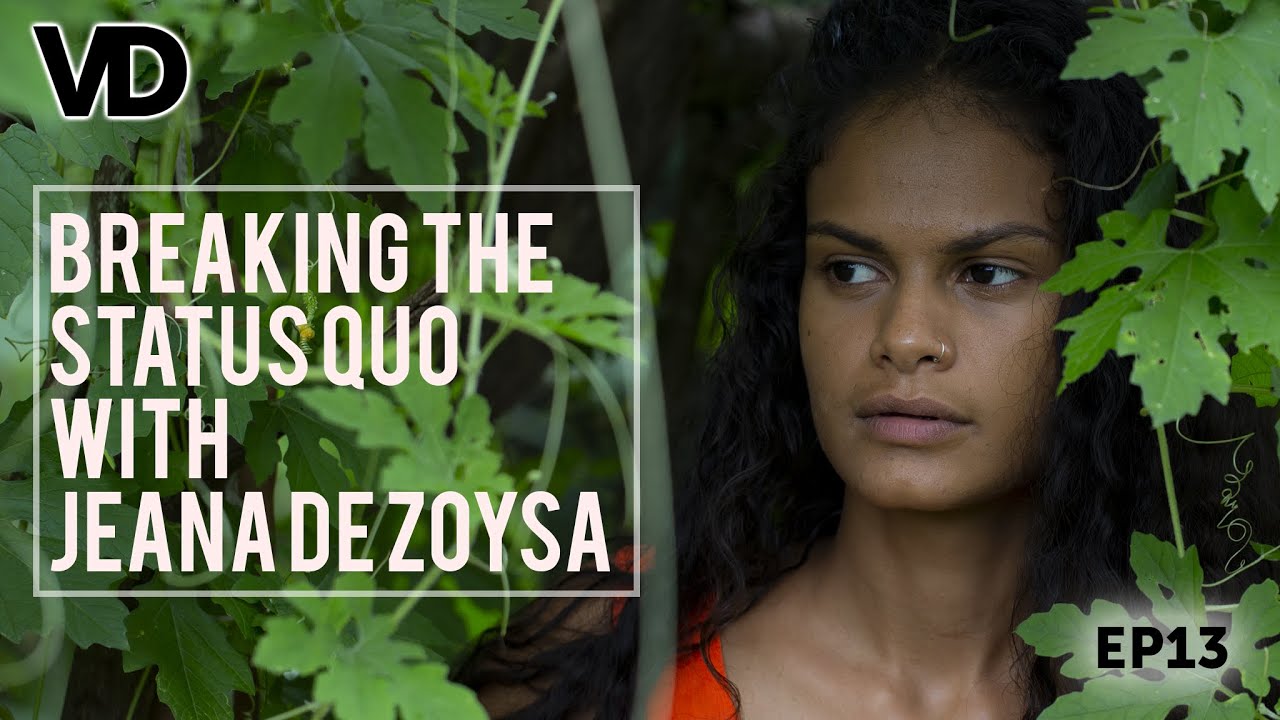 Breaking the status quo with Jeana De Zoysa : Dassa Vlogs EP 13
Zero waste and the dress from Grandma
Beyond diet, Jeana talks about zero waste (“you can’t do it overnight”), minimalism and buying local. Instead of a plastic bottle of Coca-Cola, she suggests, drink straight from a coconut. She hadn’t bought new clothes in about three years: her dress was a hand-me-down, altered by her grandmother. Eashaan points out his own shirt is his dad’s, 20 years old. “See, you can look cool and not be spending your money and destroying the environment.”
The animals with no protection
The conversation turns to animal welfare. Jeana had protested a Colombo plan to round up stray dogs into shelters, which she says leaves weaker dogs to be attacked and spreads disease. Bigger than that, she says, Sri Lanka’s animal-protection law dates back more than a century, and animal cruelty can be punished with a fine of just 100 rupees. An Animal Welfare Bill was drafted in 2006 and, as of the film, still hadn’t passed.
Update, 2026Cabinet approved a new Animal Welfare Bill in June 2026 and it was gazetted in July, with fines of up to Rs 250,000 and jail terms for cruelty. It still has to pass Parliament. Explainer · The bill
Three small cats
At SCAR, Small Cat Advocacy & Research, Jeana ran the social media. The group works to raise the profile of Sri Lanka’s three small wild cats, the fishing cat, the jungle cat and the rusty-spotted cat, which get far less attention than the leopard. On safari, she says, people chase the big five and miss everything else: “the flowers and the small dung beetles and the insect life, the bird life.”
She’s careful not to blame villagers for the snares that kill leopards. Many are farmers protecting their crops or catching bushmeat to feed their families, and, she says, part of the demand comes from “privileged people from Colombo” ordering wild meat on safari.
Changing the status quo
Asked about the future, Jeana wanted to keep guiding, to “spark that inner conservationist” in visitors, and to go back to study, this time science, to help fill the gaps in research on Sri Lanka’s wildlife.
In the end, she says, our power is in how we choose to live. “That inspires the people around us, and the domino effect.” Her closing line is an old one, but she means it: be the change you want to see in the world.
Causes in the film
- SCAR, Small Cat Advocacy & Research, protecting Sri Lanka’s small wild cats
- Earthly, Sri Lanka’s free app for environmental volunteering
- The Vegan Kade, the film’s sponsor
- The Vegan Society’s guide to going vegan
Credits
- Director and producer: Eashaan Dassanayaka
- Videographer: Chirantha Jayasinhe
- Camera assistant: Indika S Kumara
- Camera partner: ASD camera rent
- Production house: Extract and Design
- Talent: Jeana De Zoysa
- Sponsored by: The Vegan Kade
- Location: Bolgoda, Panadura
- Music: Mixkit and Purple Planet; stock footage from Mixkit
A non-profit video, first published on Dassa Vlogs on 5 August 2020.
← Stories
Wahoo win the first Swim GP as Harris and Armbruster star
Team Wahoo finished on 222 points after two nights of racing in Melbourne. Lakeisha Patterson, Flynn Southam and Kaylee McKeown also won on the final night.
SportThe Dosage16 November 2026
Photo: Delly Carr / Swimming Australia
Team Wahoo has won the first Swim GP, finishing two nights of racing at the Melbourne Sports and Aquatic Centre on 222 points, according to Swimming Australia. The final night, on Saturday 14 November, was in front of a sell-out crowd.
Team Wahoo celebrate with the Swim GP trophy and winners' cheque. Photo: Delly Carr / Swimming Australia
Final points
Wahoo led by 11 points after night one and pulled away on the closing night. Swimming Australia's final table:
- Wahoo: 222
- Tsunami: 173
- Kraken: 170
- KingTide: 149
Harris leads the winners
Swimming Australia says Wahoo were led by platinum athletes Meg Harris and Sam Short. Short won the men's 400m freestyle on night one. On Saturday, Harris won the women's 50m freestyle Elimination Skins, and Wahoo won the mixed 4x50m freestyle relay Grand Final.
Meg Harris celebrates in the pool. Photo: Delly Carr / Swimming Australia
"No one really knew what to expect coming into this," Harris said in Swimming Australia's video interview. She said "being part of history and the first team to win it at something like this, I think it's incredible, and I think it's definitely gonna be something that's part of the future of swimming."
She also said: "In 18 months' time we're gonna be in front of a whole different crowd … and I think that's gonna put a lot of pressure on us."
Armbruster and the skins
Ben Armbruster (Wahoo), the first pick in the draft, won the men's 25m freestyle on night one and the men's 50m Skins Champions Race on Saturday, with teammate Josh Collett second. Collett and Ella Ramsay won the men's and women's 50m breaststroke skins for Wahoo.
Ben Armbruster celebrates a win. Photo: Delly Carr / Swimming Australia
Kaylee McKeown (Tsunami) won the women's 50m Skins Champions Race.
Patterson swaps to butterfly
Triple Paralympian Lakeisha "Lucky" Patterson (Tsunami) opened the second night by swimming butterfly instead of her usual freestyle, and won the mixed 100m Multi-Class.
Lakeisha Patterson in the pool after her race. Photo: Delly Carr / Swimming Australia
"I think a lot of people underestimate me when they find out that I'm swimming something other than freestyle," Patterson said. "So I kind of use that to my advantage."
Southam and the crowd
Flynn Southam (KingTide) won the men's 50m freestyle Elimination Skins.
Flynn Southam raises his arms after winning. Photo: Delly Carr / Swimming Australia
"I feel like I'm losing my voice from cheering so loud," Southam said. "You know, that's gonna prepare us for LA, having a big crowd or just, like, you know, just swimming for something bigger than yourself."
He also had a line for Armbruster: "Ben Armbruster is an associate of mine. He is no friend."
Night two results
From Swimming Australia's night two results:
- Mixed 100m Multi-Class: Lakeisha Patterson (Tsunami)
- Men's 50m butterfly Elimination Skins: Ben Armbruster (Wahoo)
- Women's 50m butterfly Elimination Skins: Alexandria Perkins (Kraken)
- Women's 200m Mystery Medley: Ella Ramsay (Wahoo)
- Men's 200m Mystery Medley: Alex Quach (Tsunami)
- Mixed 100m freestyle Multi-Class: Madeleine McTernan (Kraken)
- Women's 400m freestyle Checkpoint: Jenna Forrester (Wahoo)
- Men's 400m freestyle Checkpoint: Charlie Hawke (Wahoo)
- Men's 50m freestyle Elimination Skins: Flynn Southam (KingTide)
- Women's 50m freestyle Elimination Skins: Meg Harris (Wahoo)
- Women's 50m Skins Champions Race: Kaylee McKeown (Tsunami)
- Men's 50m Skins Champions Race: Ben Armbruster (Wahoo)
- Mixed 4x50m medley relay Multi-Class: KingTide
- Mixed 4x50m freestyle relay Grand Final: Wahoo
Jenna Forrester celebrates in the pool. Photo: Delly Carr / Swimming Australia
Read our night one report: Swim GP night one: Pallister and McKeown win as Wahoo leads.
Sources: Swimming Australia media release, "Harris leads Wahoo to victory in front of sold out Swim GP crowd", 14 November 2026; Swimming Australia video news release, race day 2 (interviews).
Sources: Swimming Australia media release: Harris leads Wahoo to victory in front of sold out Swim GP crowd (14 Nov 2026); Swimming Australia video news release, race day 2 (interviews and b-roll).
← Stories
Fire Danger Period starts in Glenelg on 16 November: what you can't do
CFA has declared the Fire Danger Period early for the Glenelg Shire because of extremely dry conditions. Here's where it has already started, and what changes once it does.
NewsThe Dosage15 November 2026
Photo: Mattinbgn, CC BY 3.0 (cropped)
The Fire Danger Period starts at 1am on Monday 16 November 2026 in the Glenelg Shire, CFA says. CFA says it has been declared early "due to the extremely dry conditions being experienced across the district, particularly within forested areas and plantations".
From the same time, it also starts in Greater Shepparton, Moira, Strathbogie and the north-west part of Indigo Shire. Once it starts, you can't burn off without a permit, and fires for cooking, warmth or work come with strict conditions.
Where has it already started?
CFA's fire restriction dates page lists eight council areas where the Fire Danger Period started on 9 November: Buloke, Campaspe, Gannawarra, Hindmarsh, Horsham, Loddon, West Wimmera and Yarriambiack. For Hindmarsh, Horsham, West Wimmera and Yarriambiack, CFA said it would start at 1am.
The same page lists earlier starts in East Gippsland and Wellington (5 October), Mildura (26 October) and Swan Hill (2 November), and later starts in areas including Northern Grampians, Greater Bendigo and Mansfield (23 November) and Moyne and Warrnambool (30 November). Every listed period ends on 1 May 2027. Councils without a date show "No restrictions in force yet - check back for updates", so check the page for your area.
Why is Glenelg starting early?
"The three-month rainfall deficit for much of the Glenelg Shire has been its lowest on record," said CFA District 4 Assistant Chief Fire Officer Andrew Barry in CFA's release.
"While the grass continues to look green on top, there is lack of moisture underneath - otherwise known as the green drought," he said.
A harvester at work, from a Country Fire Authority video on preventing harvest fires. Image: Country Fire Authority, CC BY 3.0 (via Wikimedia Commons)
What is the Fire Danger Period?
"The Fire Danger Period (FDP) is when CFA restricts the use of fire in the community to help prevent fires from starting," CFA says. It is not the same thing as a Total Fire Ban: CFA points to "stricter rules that apply on Total Fire Ban days".
What can't I do during the Fire Danger Period?
These are some of the conditions on CFA's "Can I or can't I?" page:
- Burning off: "No burning off is permitted during the FDP without a Permit to Burn," CFA says. Someone must stay with the fire at all times and be able to put it out.
- Barbecues: only when the wind is less than 10 km/h, with the area 3 metres around and above the fire clear of anything that can burn.
- Campfires: in a properly constructed fireplace or a trench at least 30cm deep, no larger than 1 metre by 1 metre, and put out completely with water before you leave.
- Welding, grinding and similar work: an area at least 1.5 metres around it clear of flammable material, and water on hand, such as a knapsack holding at least 9 litres.
- Chainsaws and mowers used "in vegetation that is not green": fitted with an efficient spark arrester, with water on hand.
- Incinerators: the fire must be contained in the incinerator, with enough water to put it out. Your council may also have its own local laws about lighting fires.
"Lighting fires in the open without a permit can bring a penalty of more than $24,000 and/or 12 months imprisonment," CFA says.
Smoke from a grass fire at Little River, Victoria, in January 2013. Photo: Rexness, CC BY-SA 2.0 (via Wikimedia Commons)
What changes on a Total Fire Ban day?
CFA says all fires in the open air for burning off are banned, permits are suspended for the day, you can't light a campfire, you can't cook outdoors with solid fuel such as wood or heat beads, and incinerators are banned.
How do I get a permit?
CFA says to apply for a permit through the Fire Permits Victoria website. If you need to start a burn-off within 2 hours, you can register by calling 1800 668 511. For more information, CFA lists the VicEmergency Hotline on 1800 226 226.
A CFA heavy tanker. Image: Country Fire Authority, CC BY 3.0 (via Wikimedia Commons)
How we worked this out
"Eight council areas" is our count of the municipalities CFA's fire restriction dates page lists with a 9 November 2026 start (several are split into north and south parts on the page): Buloke, Campaspe, Gannawarra, Hindmarsh, Horsham, Loddon, West Wimmera and Yarriambiack.
See it yourself
- CFA: Fire Danger Period declared early for Glenelg Shire (5 November 2026)
- CFA: Parts of North East to begin Fire Danger Period (9 November 2026)
- CFA: Fire Danger Period to begin in parts of the West (30 October 2026)
- CFA: Fire restriction dates
- CFA: Can I or can't I?
Sources: CFA: Fire Danger Period declared early for Glenelg Shire (5 Nov 2026); CFA: Parts of North East to begin Fire Danger Period (9 Nov 2026); CFA: Fire Danger Period to begin in parts of the West (30 Oct 2026); CFA: Fire restriction dates; CFA: Can I or can't I?.
← Stories
Review of Carbon – by Pier Lorenzo Pisano
Red Stitch presents the Australian premiere of Pier Lorenzo Pisano's award-winning play about a first encounter with alien life, starring Caroline Lee, Pantazi Terzian and Conor Leach.
Arts · The Dosage ReviewsThe Dosage15 November 2026
Photo: Sarah Walker, courtesy of Red Stitch Actors' Theatre
- Rating: ★★★
- Company: Red Stitch Actors' Theatre
- Writer: Pier Lorenzo Pisano
- Translation: Atri Banerjee
- Director: Katy Maudlin
- Cast: Caroline Lee (A), Pantazi Terzian (B), Conor Leach (Voice)
- Set & costume design: Anna Cordingley
- Lighting design: Richard Vabre
- Sound design: Ian Moorhead
- Vision design: Lochlan Maher
- Venue: Red Stitch Actors' Theatre, Rear 2 Chapel Street, St Kilda East
- Season: 11 November – 6 December 2026 (previews from 7 November)
- Times: Tue, Wed and Sun 6.30pm; Thu–Sat 7.30pm; matinee Sat 21 November, 2pm; post-show Q&A Thu 19 November
- Running time: About 95 minutes, no interval. No latecomers
- Age: Recommended for ages 14+
- Reviewed: Thursday 12 November 2026, 7.30pm
- Tickets: redstitch.net
*'It's just that he and I had nothing in common. Nothing. And every little particle of my body somehow knew it.'*
The Italian playwright, Pier Lorenzo Pisano, was awarded the 2021 Riccione Theatre Prize, for Carbonio, presented now in English at Red Stitch Actors' Theatre in East St Kilda.
This play works in two different spheres: one perhaps a government enquiry, in which A (Caroline Lee) is a researcher/interviewer in corporate dress, with a clipboard of questions. B (Pantazi Terzian) is the subject of her necessarily urgent questions. When the audience enters, we see the pair seated in a raised interview room designed, along with appropriate costumes, by Anna Cordingley – two chairs, a small coffee table, with a large video screen stage right and a smaller screen lower left beneath stage level.
Caroline Lee and Pantazi Terzian in the raised interview room designed by Anna Cordingley. Photo: Sarah Walker, courtesy of Red Stitch Actors' Theatre
While this setting might seem unnecessarily luxurious for what is apparently a scientific/military setting, it does have echoes of an earlier era. Perhaps this connection is reinforced when Voice, played by Conor Leach, mockingly recounts the sending of the 1977 Voyager mission. This spacecraft carried the Golden Record designed to introduce mankind to the cosmos.
Voice, appearing like a game show host in his glittery suit, appears at regular intervals throughout the play, roaming the theatre and interacting directly with the audience, smiling dismissively at the silliness of much human activity. At times, I would have preferred to stay with the main action on stage, which was more intense, and had a greater emotional value.
Conor Leach as Voice, with Pantazi Terzian behind. Photo: Sarah Walker, courtesy of Red Stitch Actors' Theatre
However, Voice does reinforce for us the notion that we, like everything else on Earth, are formed from carbon, and this is what unites us, a fact that becomes crucial as we understand the events that have led to the interview.
Through A's sometimes gentle, sometimes urgent, probing we learn that B has been the subject of an interaction with an alien life form. This isn't some hallucinatory episode; it has been reliably recorded on video and viewed but B's interaction with it has been unique and so his testimony is invaluable.
Pressed further, he states that he 'couldn't identify with the creature'. That they were 'different forever'. His instinct registered that it was non-carbon and he froze.
Pantazi Terzian as B. Photo: Sarah Walker, courtesy of Red Stitch Actors' Theatre
Unfortunately, at this point in the play, the tech use of the large screen failed. Where we might have seen some clarifying images, there was a blank. An announcement said that the cast would leave the stage. When the cast returned, and the play regained momentum, there was still no large video screen, only the smaller one. This was not easy to see from some points in the audience and would have devalued the performance.
Nevertheless, the tension built and the interaction between A and B became more urgent. Despite his reluctance to continue his interview/interrogation, which had been going on for days, A forces B to acknowledge the reality that perhaps led him to touch the alien, perhaps to seek some connection.
Caroline Lee as A. Photo: Sarah Walker, courtesy of Red Stitch Actors' Theatre
Director Katy Maudlin has assembled a good team. The acting performances were uniformly strong. Caroline Lee crafting a character both caring and necessarily forceful at times. Pantazi Terzian, withdrawn, obstinate, broken. Conor Leach gleeful, whimsical, thoroughly enjoying his teasing of the audience.
This play will leave you with lots of questions, and plenty of ideas to muse over. What is our place in the universe? Can grief be so strong that we unknowingly reach out for connection? However, it's a static piece, somehow feeling at a distance, and I sadly wasn't particularly moved by it.
Rating: ★★★
Reviewed by Juliet Hayday for The Dosage. Red Stitch Actors' Theatre provided two complimentary tickets. Production photos by Sarah Walker, courtesy of Red Stitch Actors' Theatre.
← Stories
Swim GP night one: Pallister and McKeown win as Wahoo leads
Lani Pallister won the 400m freestyle and Kaylee McKeown won on her return in Melbourne. The final session is tonight, live and free on Channel 9 and 9Now.
SportThe Dosage14 November 2026
Photo: Delly Carr / Swimming Australia
Olympic gold medallists Kaylee McKeown and Lani Pallister lit up the opening night of the new Swim GP series in Melbourne on Friday evening, according to Swimming Australia. Team Wahoo leads the ladder after night one, and the final session is tonight.
Swimmers at the start of a race on night one of Swim GP. Photo: Delly Carr / Swimming Australia
Who's leading?
After night one, Swimming Australia's points table reads:
Wahoo: 105 points
Kraken: 94 points
Tsunami: 77 points
KingTide: 63 points
A commanding win for Pallister
Pallister (Team KingTide) set a blistering pace to win the women's 400m freestyle Checkpoint, Swimming Australia said. The World Short Course Championships are two weeks away, and Swimming Australia says she will defend her world title there.
"We're all such competitive people, and we all wanna win," Pallister said in Swimming Australia's video interview. "There's a lot of junior … kids that have come up that we don't normally get to see and be on teams with."
McKeown back in the pool
McKeown (Team Tsunami) won the women's 50m backstroke Elimination Skins in a final showdown against Team Wahoo's Iona Anderson. Swimming Australia says McKeown returned to the pool after missing the Commonwealth Games and the Pan Pacific Championships earlier this year.
Kaylee McKeown on night one of Swim GP. Photo: Delly Carr / Swimming Australia
"It's taken a long time to, you know, build back," McKeown said. "I'm lucky that it was this year and not next year when it counts."
Armbruster, Fullgrabe and the new formats
Ben Armbruster (Team Wahoo) won the men's 25m freestyle and followed it with an animated celebration, Swimming Australia said.
Ben Armbruster on night one of Swim GP. Photo: Delly Carr / Swimming Australia
"It's so much fun," Armbruster said. "A different way to race. … You can feel everyone watching, gathering around it."
Jasmin Fullgrabe of Team Kraken on night one of Swim GP. Photo: Delly Carr / Swimming Australia
The new forms of racing included the mixed 100m freestyle Multi-Class, which Swimming Australia says Jasmin Fullgrabe (Team Kraken) won.
"To see para-athletes included this time round is super special," Fullgrabe said. "At the end of the day we all share one common goal, and that is to swim fast and make teams, whether that's an Oly or a Para team."
The other winners
From Swimming Australia's results:
- Men's 400m freestyle: Sam Short (Wahoo)
- Men's 50m breaststroke Elimination Skins: Josh Collett (Wahoo)
- Women's 50m breaststroke Elimination Skins: Ella Ramsay (Wahoo)
- Women's 200m Mystery Medley: Tara Kinder (Tsunami)
- Men's 200m Mystery Medley: Will Petric (Tsunami)
- Men's 50m backstroke: Enoch Robb (Kraken)
- Women's 25m freestyle: Alexandria Perkins (Kraken)
- Mixed 4 x 25m freestyle relay: Tsunami
Sam Short on night one of Swim GP. Photo: Delly Carr / Swimming Australia
How to watch tonight
The final session is at the Melbourne Sports and Aquatic Centre tonight, Saturday 14 November, and Swimming Australia says it's sold out. It's live and free on Channel 9 and 9Now from 7.30pm AEDT.
Read our preview: Swim GP starts tonight.
---
*Source: Swimming Australia media release and video news release, 13 November 2026. Quotes are from Swimming Australia's video interviews. Photos: Delly Carr / Swimming Australia, supplied for media use.*
Sources: Swimming Australia media release: McKeown and Pallister light up groundbreaking Swim GP opening night (13 Nov 2026); Swimming Australia video news release, race day 1 (interviews and b-roll); Swimming Australia: Ultimate guide to Swim GP.
← Stories
La Trobe Bundoora land restriction to go, clearing a path for about 2,300 homes
The Victorian Government says a title restriction on two parcels at La Trobe University's Bundoora campus will be removed, but the homes still face a full planning assessment and community consultation.
NewsThe Dosage13 November 2026
Photo: Bob Tan (Wanderingchina), CC BY 4.0 (cropped)
A title restriction on two parcels of land at La Trobe University's Bundoora campus will be removed, the Victorian Government announced on 3 November. It says this paves the way for around 2,300 new homes.
The homes are not approved yet. The government says La Trobe University will now progress the application, and it will be subject to a full planning assessment and community consultation.
What was announced?
According to the government's release, Minister for Economic Development Anthony Carbines announced that a historic title restriction on two parcels of land on the Bundoora campus will be removed. The release does not say what the restriction covered.
The government says the site will include a minimum of 10 per cent affordable housing.
What happens next?
According to the release:
- La Trobe University will progress the application.
- It will go through a full planning assessment and community consultation.
- The site is part of the government's Unlocking Strategic Sites program, which it says "fast-tracks the rezoning of underused land for new homes, jobs and investment".
The release gives no dates for the assessment, consultation or construction.
How does it fit with La Trobe's wider plans?
The government says the land is part of La Trobe's $5 billion University City masterplan, which "aims to deliver around 9,000 homes across the wider precinct and improve facilities to support more than 40,000 students".
It also says that once development is underway, up to $13.6 million from the value captured from the sale of the land will be reinvested into future projects that support the local area.
What did the planning minister say?
"We're unlocking land at La Trobe University to build more homes close to jobs, education and public transport," Minister for Planning Sonya Kilkenny said.
See it yourself
Source: Victorian Government media release, © Copyright State Government of Victoria, used under a Creative Commons Attribution 4.0 licence (terms).
Sources: Victorian Government media release: Unlocking Thousands Of Homes At La Trobe University (3 Nov 2026); Victorian Government website copyright and licence terms (premier.vic.gov.au).
← Stories
Solar for apartments: rebates now open to bigger buildings
Owners corporations in buildings of up to 150 lots can now apply for Victoria's Solar for Apartments rebates of up to $2,800 per apartment, and the median property value limit is being removed.
NewsThe Dosage13 November 2026
Photo: Solarimo GmbH/Pexels
More apartment buildings can now get a rebate to put solar on the roof. Buildings of up to 150 lots are now eligible for the Solar for Apartments program, up from 50 lots, the Victorian Government said on 26 October 2026. The existing median property value limit will also be removed.
The rebates are up to $2,800 per apartment and $140,000 per building, covering an average of 76 per cent of installation costs, according to the release. It says residents can save up to $500 a year on their electricity bills.
"Solar means lower power bills – apartment residents and renters deserve to share in those savings," said Victoria's Minister for Energy and Resources, Jaclyn Symes.
Who can apply?
The owners corporation applies, not individual residents. Solar Victoria's program page says rebates go to owners corporations with up to 50 occupiable lots, and buildings with between 50 and 150 lots "can now apply for an exemption if all other criteria are met." An owners corporation that has already received funding from the program can't apply again.
Rooftop solar in Northcote, Melbourne. Photo: yesperhapsno/Flickr, CC BY 2.0
What does it mean for renters?
More than 150 rooftop systems have been installed through the program, almost half of them on rental properties, the release says.
Solar Victoria recommends systems that connect to all residential lots, including rentals, and the application asks how many lots are rented. "If you're renting and would like to explore options, contact your property manager or rental provider," the program page says.
What about shared areas?
Owners corporations will be able to put up to 20 per cent of the solar energy generated to common property, the release says. On a shared system, Solar Victoria caps the energy for the common area at 20 per cent of what the system generates.
How does it work?
Solar Victoria's program page sets out the steps:
- Check eligibility through the online eligibility check on the Solar Victoria portal.
- Get quotes from at least three Solar Victoria authorised retailers.
- The retailer seeks pre-approval from the building's electricity network company.
- Rebate funding is reserved when the retailer submits the quote. The owners corporation must return a signed approval form within 70 days, signed by two of its representatives, or the funding is cancelled.
- The system must be installed within 120 days of rebate approval.
- The retailer claims the rebate, and the owners corporation pays the retailer any balance.
You may also need a planning permit from your council, the page says.
When do applications close?
Applications are open until 30 June 2027, or earlier if all the rebates are taken.
The federal government is a partner in the program. "Where you live should not determine whether you can benefit from solar," said the federal Assistant Minister for Climate Change and Energy, Josh Wilson, in the joint release.
Source: Victorian Government media release, CC BY 4.0.
See it yourself
- Victorian Government media release: Expanding Solar Savings For More Victorians (26 October 2026)
- Solar Victoria: Solar for Apartments (updated 6 November 2026)
Sources: Victorian Government media release: Expanding Solar Savings For More Victorians (26 Oct 2026); Solar Victoria: Solar for Apartments (updated 6 Nov 2026).
← Stories
Swim GP starts tonight: Chalmers and O'Callaghan out, McKeown back in the pool
The inaugural Swim GP, a team swimming meet, starts at the Melbourne Sports and Aquatic Centre tonight, with two Olympic stars withdrawn and Kaylee McKeown racing again after illness.
SportThe Dosage13 November 2026
Photo: Delly Carr / Swimming Australia
The inaugural Swim GP, a team swimming meet, starts tonight at the Melbourne Sports and Aquatic Centre (MSAC) in Albert Park, without Olympic stars Kyle Chalmers and Mollie O'Callaghan, who have withdrawn for medical reasons, Swimming Australia said on Thursday.
Racing starts at 7.30pm AEDT tonight and tomorrow night, and both nights are live and free on Nine and 9Now. Swimming Australia says tickets are still available for tonight, and Saturday is sold out.
What is Swim GP?
Four teams of 20 swimmers, Wahoo, Kraken, KingTide and Tsunami, race for points over two nights in a 25-metre pool. There are no times, only points. Swimming Australia says the line-up is "four teams of 20, including two Platinum athletes and four Para athletes".
The program mixes traditional races with staggered-start events, skins races and mystery relays decided by fans. Swimming Australia says the event builds on last year's Australia vs The World meet. The teams mix the Dolphins' biggest stars with rising talent looking for more competition experience ahead of the LA 2028 and Brisbane 2032 Games.
Who's out?
Team Kraken has had the biggest change. Chalmers is resting with lower back pain, and O'Callaghan has foot cellulitis.
"I've been in the pool and I've been training, but… after my most recent MRI with my doctor, we've decided having six weeks of no swimming is probably gonna be the best just to rehab my back and get on top of it," Chalmers said.
He is in Melbourne to support his Kraken teammates, and said he wanted to "come along and show my support… and be a part of a team environment, which is something that I've always loved throughout my swimming career".
Kyle Chalmers (Kraken) at Thursday's press event at MSAC. Photo: Delly Carr / Swimming Australia
Junior world champion Ainsley Trotter (Bond University) and Melbourne swimmer James Ward (Caulfield) come into the Kraken team. Their teammates include Alex Perkins, a five-time gold medallist at the 2026 Commonwealth Games.
Who's back?
Kaylee McKeown (Tsunami) returns to racing after missing the Commonwealth Games and the Pan Pacific Championships because of illness.
"Body is slowly getting back there. I mean, it's… a never ending roller coaster at the moment, but I'm just excited to get back in the pool and start racing," McKeown said.
"I'm a little bit nervous, as you would be when you haven't raced all year. So I'm glad that there's no times that have been posted."
Kaylee McKeown (Tsunami) at Thursday's press event at MSAC. Photo: Delly Carr / Swimming Australia
Who to watch
Swimming Australia has picked out the freestyle duel between Sam Short (Wahoo) and Flynn Southam (KingTide).
Sam Short (Wahoo) at Thursday's press event at MSAC. Photo: Delly Carr / Swimming Australia
Short, one of the team captains, said: "It's a new format. It's… exciting for swimming in Australia, and… the amount of athletes here is huge, and the opportunities for up-and-coming athletes are there."
Perkins said it "can be a bit intimidating swimming with… some of the people you've looked up to… your whole swimming career".
How to watch
- When: Friday 13 and Saturday 14 November, from 7.30pm AEDT
- Where: Melbourne Sports and Aquatic Centre, 30 Aughtie Drive, Albert Park
- TV and streaming: live and free on Nine and 9Now
- Tickets: on sale through Ticketek for Friday; Saturday is sold out
See it yourself
- Swimming Australia: Late changes and rivals reloaded, Swim GP ready to erupt in Melbourne (12 November 2026)
- Swimming Australia: video news release, Swim GP pre-event press opportunity at MSAC (12 November 2026), supplied to media. Quotes are taken from this video.
- Swimming Australia: Swim GP media opportunity (10 November 2026)
Sources: Swimming Australia: Late changes & rivals reloaded, Swim GP ready to erupt in Melbourne (media release, 12 Nov 2026); Swimming Australia: Media Op, Swim GP (10 Nov 2026); Swimming Australia video news release: Swim GP pre-event press op, MSAC, 12 Nov 2026 (quotes transcribed from the video).
← Stories
How Victoria's heat health warnings work, and how to get them
A heat health warning follows a Bureau of Meteorology severe or extreme heatwave warning, and Victoria's Chief Health Officer can also issue one. Here is what sets one off, how to get the alerts, and who is most at risk.
HealthThe Dosage10 November 2026
Photo: Annie Hatuanh/Unsplash
In Victoria, a heat health warning comes from the Department of Health, but it starts with the weather bureau. The department issues a heat health warning in response to a new severe or extreme heatwave warning from the Bureau of Meteorology (BOM). The Chief Health Officer may also issue one when forecast temperatures pose a health risk, for example a single day of extremely high temperatures.
The warnings go to the community, local governments, hospitals, and health and community services, the department says.
What counts as a heatwave?
"A heatwave is when the maximum and minimum temperatures are unusually hot over 3 days," the BOM says. Hot is judged against the local climate and past weather. The BOM measures it with a figure called the excess heat factor.
It rates heatwaves at three levels:
- Low-intensity: frequent during summer. "Most people can cope during these heatwaves."
- Severe: less frequent, and likely to be more challenging for vulnerable people.
- Extreme: rare. The Department of Health says that in an extreme heatwave, "everyone is at risk, even people who are healthy."
When does a warning go out?
"We issue warnings for severe or extreme heatwaves," the BOM says. "The warnings alert you that a heat hazard is expected within the upcoming 4 days." They give the expected temperatures, the timing and length of the heatwave, and the towns and communities affected.
In Victoria, a BOM heatwave warning is issued when 10 per cent or more of a forecast district is in a severe or extreme heatwave, based on three days of unusually high maximum and minimum temperatures. A new warning of that kind is what sets off the department's heat health warning.
Victoria has nine forecast districts: Central, East Gippsland, Mallee, North Central, North East, Northern Country, South West, West and South Gippsland, and Wimmera. The department's page lists which council areas sit in each one.
How a heatwave becomes a heat health warning. Illustration: The Dosage. Sources: Department of Health (Victoria); Bureau of Meteorology.
How do I get the warnings?
Four ways to get the warnings. Illustration: The Dosage. Source: Department of Health (Victoria).
The Department of Health lists:
- the BOM heatwave page
- the BOM app
- the BOM telephone service on 1300 978 022
- alerts from the department, by subscribing at health.vic.gov.au/subscribe.
For up-to-date hazard advice and warnings, the department points people to VicEmergency.
Who is most at risk?
In its heat health advisory in January 2026, the department listed:
- people over the age of 65
- infants and young children
- people who are overweight or obese
- pregnant women and breastfeeding mothers
- people who have low cardiovascular fitness
- people who are not acclimatised to hot weather
- people with acute or chronic health problems
- people who are socially isolated.
What does the department advise?
St Kilda, Victoria. Photo: Simona Sergi/Unsplash
From the same advisory:
- Avoid exposure to the heat as much as possible.
- Use air conditioning or a fan.
- Keep your skin wet, using a spray bottle or damp sponge.
- Consider spending time somewhere cool, such as an air-conditioned shopping centre or public library.
- Keep drinking water before you feel thirsty, and take a water bottle whenever you leave home.
- Cancel or reschedule activities for the coolest part of the day.
- Stay connected: check in with others, and let family, friends and neighbours know you are okay.
What are the signs of heat-related illness?
Signs of heat-related illness. Illustration: The Dosage. Source: Department of Health (Victoria) heat health advisory, January 2026.
The advisory describes three:
- Dehydration: thirst, dry mouth, dizziness or altered mental state, passing less urine, or dark or strong-smelling urine. Move to a cool area and drink fluids.
- Heat exhaustion: sweating, pale complexion, muscle cramps, rapid pulse, dizziness or fainting. Seek help straight away from Nurse-on-call on 1300 60 60 24 for 24-hour health advice, see your doctor or contact Virtual Emergency Care for non-life-threatening emergencies, or call 000 if required.
- Heatstroke: very high body temperature, dry skin, loss of consciousness, confusion, rapid breathing. "This is life threatening. Call 000 for an ambulance."
"Whether it is extreme heat, thunderstorm asthma or mosquitoes, simple steps taken early can help keep you and your family safe," Victoria's Chief Health Officer, Dr Caroline McElnay, said in October.
This is general information. In an emergency, call 000.
See it yourself
- Department of Health: Heat health warning (updated 16 June 2026)
- Bureau of Meteorology: What is a heatwave? (updated 22 September 2026)
- Bureau of Meteorology: Heatwaves, what you need to know (updated 17 September 2026)
- Bureau of Meteorology: Heatwave forecasts
- Department of Health: Increased heat-related health risks advisory (27 January 2026)
- Department of Health: Prepare now for Victoria's spring and summer health risks (5 October 2026)
Sources: Department of Health (Vic): Heat health warning (updated 16 June 2026); Bureau of Meteorology: What is a heatwave?; Bureau of Meteorology: Heatwaves, what you need to know; Bureau of Meteorology: Heatwave forecasts; Department of Health (Vic): Increased heat-related health risks advisory (27 Jan 2026); Department of Health (Vic): Prepare now for Victoria's spring and summer health risks (5 Oct 2026).
← Stories
LEGO rocket's last weeks: Bendigo's CURIOSITY exhibition closes 29 November
A 7.5-metre NASA rocket built from more than 460,000 LEGO bricks is the centrepiece of an exhibition at Bendigo's Discovery Centre that closes on Sunday 29 November.
ArtsThe Dosage10 November 2026
Photo: Leon Schoots, courtesy of Bendigo Art Gallery
A 7.5-metre rocket made of LEGO bricks is in its last weeks in Bendigo. CURIOSITY: Building Breakthroughs in LEGO® Bricks closes at Discovery Science & Technology Centre on Sunday 29 November 2026.
The exhibition opened on 3 March 2026. It recreates "some of history's most spectacular technological advancements, engineering feats and mathematical puzzles with LEGO ®Bricks", Bendigo Art Gallery said in a media release on 9 November.
What is in it?
The exhibition was created by Ryan "Brickman" McNaught and his team, the release says. It is a collaboration between Discovery and Bendigo Art Gallery.
The CURIOSITY sign at Discovery Science & Technology Centre. Photo: Leon Schoots, courtesy of Bendigo Art Gallery
Its centrepiece is a 7.5-metre-tall replica of the NASA Space Launch System (SLS) rocket, made from more than 460,000 LEGO bricks and fitted with lights and speakers, according to the release.
Discovery's exhibition page lists a journey through the Solar System, a Mars section, a duck-building challenge and a bridge-building activity. The release says people have enjoyed making their own creations.
Brick planets in CURIOSITY. Photo: Leon Schoots, courtesy of Bendigo Art Gallery
Bricks for the duck-building challenge. Photo: Leon Schoots, courtesy of Bendigo Art Gallery
Brick bridges in CURIOSITY. Photo: Leon Schoots, courtesy of Bendigo Art Gallery
What have visitors been doing?
Alissa Van Soest, General Manager of Discovery, said in the release that some families have visited multiple times and many have stayed for hours.
"We are amazed at how long people have spent inside the Centre, creating their own pieces with the hugely popular 'duck' bricks," she said. "Some days we have to gently remind families, several times, that it's time to go home."
Brick ducks in CURIOSITY. Photo: Leon Schoots, courtesy of Bendigo Art Gallery
The team at Discovery has found creations visitors have made, "from rovers, aliens and habitats on Mars, giant rainbows, dinosaurs, giraffes, even a replica of the Empire State building", the release says.
A small brick rover on a brick Mars landscape. Photo: Leon Schoots, courtesy of Bendigo Art Gallery
Jessica Bridgfoot, Director of Bendigo Art Gallery, said the strong community response "has exceeded expectations".
The release says visitor numbers will be announced at the end of the season.
Why is the art gallery involved?
Bendigo Art Gallery is closed for a major refurbishment, and CURIOSITY is one of a series of off-site events and exhibitions it has organised in the meantime, the release says. The program also includes a residency at Bendigo Town Hall.
How much does it cost, and when is it open?
CURIOSITY is included in general entry to Discovery. Discovery lists these prices:
- Adult: $22
- Child (3 to 17): $18
- Child under 3: free
- Concession: $18
- Family (2 adults and 2 children, or 1 adult and 3 children): $72, plus $16 for each extra child
Planetarium sessions cost extra. During school terms Discovery is open 10am to 4pm, Tuesday to Sunday, and during school holidays 10am to 4pm every day. It is closed on national public holidays.
Discovery is at 7 Railway Place, Bendigo. The release recommends buying tickets in advance at discovery.asn.au.
See it yourself
- Discovery Science & Technology Centre: CURIOSITY: Building Breakthroughs in LEGO® Bricks
- Bendigo Art Gallery media release on the exhibition's last weeks, emailed to The Dosage on 9 November 2026 (Katrina Hall, Publicity/Communications)
Sources: Discovery Science & Technology Centre: CURIOSITY: Building Breakthroughs in LEGO® Bricks; Bendigo Art Gallery media release (emailed to info@thedosagemag.com, 9 Nov 2026, Katrina Hall, Publicity/Communications).
← Stories
Raiding your super for the dentist? What the ATO and Ahpra want you to know first
Dental treatment now accounts for more early super applications than any other category. The ATO says super should be a last resort, and it has started more than 160 reviews and audits into suspected false or misleading statements.
HealthThe Dosage10 November 2026
Photo by Jonathan Borba on Unsplash (https://unsplash.com/photos/dentists-performing-procedure-in-clinic-hl6uG9cHW5A)
Dental treatment now accounts for more early super applications than any other category in the ATO's figures. In 2025–26 the Australian Taxation Office (ATO) approved $892 million in early super releases for dental treatment, up from $66.4 million in 2018–19. That is more than 13 times as much in seven years.
The ATO and the Australian Health Practitioner Regulation Agency (Ahpra) say super should be a last resort. Since July 2025 the ATO says it has started more than 160 reviews and audits into suspected false or misleading statements, and it has searched a Melbourne dental practice.
What is "compassionate release" of super?
"Superannuation is a long-term investment designed to be used during retirement," says ATO Deputy Commissioner Ben Kelly. The ATO says super can be accessed early only in limited situations, such as for critical medical treatment. The ATO's figures for compassionate release cover releases for medical treatment or transport, accommodating a disability, palliative care, a dependant's funeral, and preventing the forced sale of a home.
For treatment, two practitioners must certify that it is needed to treat a life-threatening illness or injury, or to relieve acute or chronic pain or acute or chronic mental illness. The ATO approves the release; your super fund pays it.
How big has it got?
In 2025–26, according to ATO data updated on 22 October 2026:
- 109,600 applications for compassionate release were received and 64,600 approved, for $1.46 billion, the highest amount in ATO figures going back to 2018–19.
- Almost all of that money, $1.42 billion, was for medical treatment or transport.
- Dental treatment was the largest part: 50,540 applications, 34,520 approved, $892 million.
Growth has slowed. Dental applications rose about 6 per cent in 2025–26 (from 47,630 to 50,540), after rising about 50 per cent the year before (from 31,780 to 47,630). Total approvals across all categories fell, from 67,900 to 64,600.
The ATO notes it records the amounts it approves; super funds make the payments.
What have the ATO and Ahpra found?
Some applications don't meet the rules, and in one case the ATO alleges treatment was never provided.
In 2024–25 the ATO rejected about 30 per cent of the 93,500 applications in the medical category, which is mostly dental, for not meeting compassionate release requirements. The ATO says compassionate release of super "should only be considered as a last resort".
Since 1 July 2025, the ATO says it has started more than 160 reviews and audits involving suspected false or misleading statements, with penalties of more than $1.5 million.
In a release in October 2026, the ATO said its officers, supported by the Australian Federal Police, had executed a search warrant at a Melbourne dental practice linked to a former health practitioner. The ATO alleges the practitioner supplied fraudulent medical reports for dental work that was never done or for people who weren't eligible, supported 1,178 applications worth more than $36.4 million, and used recruiters to bring people in. No charges have been reported, the practice has not been named, and the ATO says investigations are ongoing. "This wasn't a misunderstanding of the rules," said ATO acting Deputy Commissioner Pennie Snowden.
In April 2026, the ATO and Ahpra said Ahpra had received 95 complaints between 2019 and 2025 about medical and dental practitioners involved in compassionate release of super. Two doctors have been referred to tribunals "for allegedly providing false documentation to the ATO". Another doctor has been given a formal caution, and a dentist has had conditions imposed on their registration.
What are the warning signs?
The ATO and Ahpra list these red flags:
- Social media ads for using your super to pay for dental or cosmetic work.
- Anyone asking for your myGov sign-in so they can apply for you. "You should never share your myGov details with anyone," Mr Kelly said.
- A telehealth call instead of an in-person examination.
- Expensive treatment recommended when a cheaper option would work.
- Pressure to use super instead of a payment plan.
- Being told you must use a particular provider for your medical report, or a particular third party to lodge your application.
- Full payment up front, without clear information about ongoing costs.
- Fees to prepare or lodge your application from someone who isn't a registered tax agent.
What do they suggest before you apply?
- Look at other ways to pay for the treatment first.
- Understand the short- and long-term effects: tax withheld, the impact on your retirement savings, and the effect on any government payments you receive.
- Get a second opinion or quote from an independent practitioner, or your regular dentist or GP.
- Check that the medical reports about you are accurate.
This is general information, not financial advice. The ATO's compassionate release pages set out the rules.
How do I report a problem?
- Suspicious ads, myGov requests or inaccurate medical reports: make a tip-off to the ATO (search "ATO making a tip-off").
- Concerns about a dentist's or doctor's conduct: contact Ahpra on 1300 419 495 or through its "Concerned about a health practitioner" page.
How we worked this out
The comparisons below are our own arithmetic on the ATO's compassionate release data (updated 22 October 2026). The other figures in this story come from the ATO and Ahpra releases linked in the text.
- 13 times: $892.0 million (2025–26) divided by $66.4 million (2018–19) = 13.4.
- Largest category: in 2025–26 dental treatment had 50,540 applications; the next largest category, other medical treatment, had 23,370.
- Growth: dental applications went from 31,780 (2023–24) to 47,630 (2024–25), up 50 per cent, then to 50,540 (2025–26), up 6 per cent.
- Almost all for medical: $1,416.3 million of the $1,456.7 million approved in 2025–26 was for medical treatment or transport (97 per cent).
See it yourself
- ATO: Compassionate release of super, applications received and approved (data updated 22 October 2026)
- ATO: Melbourne dental practice searched over multi-million early release of super access scheme
- ATO and Ahpra: Sound alarm on dodgy super dental offers (14 April 2026)
- ATO and Ahpra: Warning about extracting super early (16 October 2025)
- ATO: Access on compassionate grounds
Sources: ATO: Compassionate release of super, applications received and approved (updated 22 Oct 2026); ATO: Melbourne dental practice searched over multi-million early release of super access scheme (Oct 2026); ATO and Ahpra: Sound alarm on dodgy super dental offers (14 Apr 2026); ATO and Ahpra: Warning about extracting super early (16 Oct 2025); ATO: Access on compassionate grounds.
← Stories
What has to be done better to show the benefits of renewables in the regions
Australia’s renewable energy transition will succeed only if it delivers lasting benefits to the regional communities that host it.
ExplainedThe Dosage9 November 2026
Photo: Michael Coghlan / Flickr, CC BY-SA 2.0 (https://creativecommons.org/licenses/by-sa/2.0/)
Organised opposition to renewable energy in the regions where projects are being built is well known. The reasons for opposition vary from legitimate concerns around project siting and biodiversity, through to confected claims about “wind turbine syndrome”. And while the media often focuses excessively on the loud opponents, there is a portion of people in the middle who are feeling increasingly sceptical; there is an underlying concern that regions will bear the impacts of a fly-in, fly-out construction boom with modest lasting benefits.
A common sentiment in regional host communities is ‘we don’t want a sugar hit – we want to see a lasting legacy.’ Echoing these sentiments, community renewables groups have advocated for a shift from ‘social licence’ to ‘social value’ – from obtaining the minimum community acceptance for planning approval to focusing on how the renewables sector can improve these regions.
Some of the ways the sector can deliver benefits for the regions include: community benefit funds and initiatives that significantly improve local infrastructure and services in the long-term; local job creation and training, especially for young people, and economic activity for local businesses; Improvements for First Nations communities – Indigenous population shares are higher on average in the Renewable Energy Zones (REZ); and regulatory and policy reforms, and further technology developments and solutions to integrate renewables into local land-uses to minimise impacts on agriculture, biodiversity and landscapes
So, how is the renewable energy sector performing in the regions?
Community benefits: from sporting club grants to community infrastructure
Community benefit funds – an annual allocation of funds from a developer for community groups and initiatives where projects are located – are now a standard feature of renewable energy projects. Historically, industry practice was to administer small grants scattered across local organisations such as sporting clubs – welcome, no doubt but not creating long-term change.
The Clean Energy Council forecasts that the community benefit funds flowing from renewables into regional communities will be $213 million by 2030, increasing to $1.9 billion by 2050. Recognising the enormous potential to create transformative change in regions – there have been shifts in government policy in NSW, Queensland and Victoria to pool community benefit funds to enable investments in bigger projects that will support regional development.
Local employment and training
Employment modelling has found the renewable energy build-out could create tens of thousands of jobs, mostly in the regions, with most employment occurring during construction. How much of this employment will be local is uncertain as the sector does move staff around between projects. In a survey of developers in the New England REZ, the industry expectation was that 28% of jobs would be sourced with locals. Renewables also provide an opportunity to train locals in trades such as electricians, increasing the skill base of the region beyond the life of the project. Over time employment increases in the operations and maintenance of renewable energy infrastructure, especially wind farms.
Procurement policy is improving and employment and training criteria are now included in many renewable energy auctions, where projects bid for contracts. Projects make contract commitments to implement local employment and training initiatives. In NSW, developers in Renewable Energy Zones (REZs) also pay a levy to fund local employment and training initiatives.
Unfortunately, data is currently limited on the results from these tenders. The NSW Government released a report in 2025 summarising results so far for its tenders but only 2 projects had proceeded to construction, so it was too early to evaluate impact. Notwithstanding, the report found there had been a total of 279 commitments to employment and supporting industry, 152 of these had commenced, 18 had been completed and targets were being achieved, such as 27% of trades workers were apprentices against a target of 20%.
While there are some good cases emerging, there is no evidence to suggest the renewables sector is as yet making a significant difference to local economies through employment. On the contrary, even amid widespread skill shortages, Infrastructure Australia noted ‘companies are adopting a cautious, ‘wait and see’ approach to workforce and skills investment, rather than committing to long-term training or efforts to boost baseline workforce supply’.
First Nations Communities
Likewise, the delivery of benefits to First Nations communities from renewable energy has been patchy. The most promising developments are in First Nations ownership and equity stakes in renewables projects. In the Pilbara, Rio Tinto signed a power purchase agreement to buy the power from a First Nations owned solar under development and Ampyr Australia has signed an agreement with a local Indigenous group for a 5% equity stake in a battery in Wellington, NSW.
The biggest change that introduced strong incentives for projects to create economic stakes for First Nations communities came with the 2026 Commonwealth Government’s First Nation Equity and Revenue Setting Aside scheme. Under that, some of the capacity being tendered will be reserved for projects that include equity and/or revenue sharing equal to 5%.
Integrating renewable energy into local land-uses to minimise impacts on agriculture and biodiversity
Competition for land from renewable projects is creating tension with agricultural producers, and biodiversity conservation. In NSW, concerns about ‘agriculture land loss or impact’ are the most frequent reason for community objections to solar farms’.
Renewables do require significant amounts of land. Based on the Australian Energy Market Operator’s Integrated Systems Plan, we calculated that 7,544km2 of land would be required for wind and solar farms (2030-31) and 11,311km2 (2049-50) – 0.15% of Australia’s land.
Solar farms in particular can overlap with land valued for agriculture (including grazing), creating tension between the energy and agricultural sectors. For regional communities there may be other concerns such as the loss of land that has been held by families for generations and changes to landscapes.
There are multiple solutions to mitigate the land use pressures from renewables including improving strategic land use planning, technological developments (improved energy yields and land-use efficiency) and criteria to shape the siting of projects and the use of agrivoltaics to enable the co-location of solar panels and agricultural production. Driven by growing concerns about land use conflicts between renewable energy development and food production, the new agrivoltaics approach allows a combined approach allowing for solar panels and the growing of plants – through raised panels or space left between panels. That approach has expanded rapidly around the world in recent years, including Europe, Japan, North America, and is growing in Australia as well.
What are the solutions?
So, what are some of the big moves that could drive better outcomes when it comes to demonstrating the social and economic benefits of renewables projects.
- Implement First Nations communities’ equity participation in the renewable energy sector and more done to roll out solar-battery capacity into remote communities that often have to rely on expensive, unreliable power. And increase employment rates which remain shockingly lower than for other Australians.
- Local training and employment need to be lifted for the renewable sector with investment in apprentices and trainees. The government also needs to provide the resources to achieve these targets (see the New England Skills and Training REZ study for initiatives on what could be done).
- Recognise the benefits of the agrivoltaics approach in the planning system, and fund demonstration projects and create incentives for projects to adopt agrivoltaics practices could increase adoption.
Australia has taken some important steps towards creating ‘social value’ from renewable energy in regional Australia, but much more needs to be done to ensure we don’t miss the opportunity for renewable energy to make a real difference in the regions that will be hosting them for decades to come.
Chris Briggs, Saori Miyake and Elianor Gerrard, Energy Futures Research Centre, UTS university, Sydney, Australia.
Originally published under Creative Commons by 360info™.
This article, “What has to be done better to show the benefits of renewables in the regions.” by Chris Briggs, Saori Miyake and Elianor Gerrard, was first published by 360info on 3 November 2026 and is republished by The Dosage under a Creative Commons Attribution 4.0 International licence (CC BY 4.0). Changes: the opening paragraph is shown as the standfirst and the full stop is removed from the end of the headline; the article text is otherwise unchanged. The lead photo is not covered by this licence: Michael Coghlan, CC BY-SA 2.0. The Dosage is not affiliated with 360info or the authors.
Sources: 360info: What has to be done better to show the benefits of renewables in the regions (3 Nov 2026); Creative Commons Attribution 4.0 International (CC BY 4.0).
← Stories
How the global alcohol lobby plays the long game
Political donations, revolving-door appointments and industry-backed responsibility campaigns help alcohol companies shape policy behind the scenes. Stronger safeguards are needed to put public interest before industry influence.
HealthThe Dosage9 November 2026
Photo by Brandy Turner on Unsplash (https://unsplash.com/photos/bottle-lot-nZ37ifip5VM)
When it comes to the alcohol companies seeking to buy influence, fundraising dinners with the Prime Minster and other politicians are just the tip of the ice-berg. At $10,000 a seat, it’s hardly democracy and sausage sizzles.
Alcohol lobbyists and venues play a major role in selling democracy. The alcohol industry has long been masters of weaving complex webs of influence to ensure their product is not treated as the “primary cause of more than 200 diseases and injuries and globally results in approximately 3.3 million deaths each year, greater than HIV/AIDS, violence or tuberculosis.”
About 77 percent of Australian adults (aged 14 and over) consume alcohol, and roughly 1 in 3 drinkers exceed national health guidelines. According to the Australian Institute of Health and Welfare, alcohol remains a leading cause of preventable hospitalisations and health burdens nationwide. Of course, there is substantial overlap with other sectors such as gambling, restaurants and sport (one of their most politically powerful alliances)
This isn’t one bad dinner. It is just how the system works: patient and effective. Indeed, it is directly based on the tobacco industry’s playbook, as documented by Bond and colleagues in 2009 showing how SAB Miller brewing was supplied with coaching manuals on how to delay effective policy by the tobacco company Phillip Morris, who at the time controlled the brewing company, which has now morphed into the global giant Anheuser-Busch InBev SA/NV that owns over 200 beer brands. At the time, it controlled Carlton & United Breweries (CUB) which has since been sold off to Asahi Group Holdings. The industry is a global cabal of 5 companies which produce around 60% of the world’s beer, who trade companies, staff and strategies.
Money buys access
The Australian Hotels Association has donated around A$4 million to Labor and almost $3m to Liberal in the past 12 years. The pub lobby is not funding one side to win a single vote. It funds relationships. Our research team interviewed insiders about donations in a study whose title borrowed a politician’s blunt summary: “If someone donates $1000, they support you. If they donate $100,000, they’ve bought you.”
Industry money rarely asks for anything crude. It buys a seat at the table, a phone that gets answered, and a minister who already knows your name.
The most effective lobbying doesn’t start when a bill is introduced. It starts years earlier, by backing promising politicians early in their careers. By the time they hold power, they have a decade of goodwill, hospitality and friendship behind them.
Research on the “revolving door” shows the other end of this process. Industry builds relationships on the way up, then hires the people who hold them on the way out.
The revolving door
In 2019, we examined the Australian Government Register of Lobbyists. Of the 569 people listed, 206 (36%) said they were former government representatives.
For the 122 whose job histories we could trace:
- About 18% were former MPs or
- About 47% were former chiefs of staff or senior
- 45% had spent more than a decade in
These are people who know how decisions get made, who makes them, and what the minister’s office needs to hear.
One interviewee described the effect plainly. A person who had met a ministerial chief of staff as an industry lobbyist six months earlier now found that same person working in the minister’s office. That, they said “amplifies the disparity and the influence between the industry and the community sector.”
Paul Nicolaou, a former senior NSW Liberal fundraiser, became CEO of the Australian Hotels Association NSW. He said publicly that with a Liberal government in power you wouldn’t appoint someone with Labor ties. A former federal Labor minister went on to work for a company with a major shareholding in Crown Casino. A chief of staff to a federal health minister co-owned a lobbying firm that had represented major food companies.
Since then the Northern territory has seen the head of Hospitality NT, Alex Bruce, employed as the Chief Minister’s Chief of staff. His replacement at Hospitality NT worked for former Premier Daniel Andrews in Victoria, as did another current senior AHA executive in Victoria. The Territory’s world-leading Minimum Unit Price was rapidly retired, despite evidence of its impact.
The rules that should prevent this are weak. Federal ministers face an 18-month cooling-off period before lobbying in related areas, and other members face 12 months. In Canada the ban is five years.
We also can’t see much of this activity as our earlier study of Australia’s lobbyist registers found that none required in-house lobbyists to register, none recorded informal lobbying, and none described what lobbying actually took place. Registrars often refused or delayed requests for historical data. The registers give the appearance of transparency without much substance.
Corporate social responsibility as camouflage
The industry also works hard to look responsible. Its most important marketing tool in Australia is DrinkWise.
DrinkWise was established in 2005 with $5 million from the alcohol industry and $5 million from the Liberal federal government. It presents itself as a body for changing Australia’s drinking culture. But when we examined it, we found:
- Six of DrinkWise’s 10 board members came from the alcohol
- Its website barely mentioned its industry
- Its focus was education and social marketing, approaches that systematic reviews show do little to reduce alcohol harm.
- It funded no work on measures that do work, such as higher alcohol taxes, which the industry opposes.
Its logo also appeared for three seconds at the end of TV ads, which helped the industry and the organisation look responsible.
In my research, I couldn’t find a single example of Drinkwise ever supporting mandatory labelling to warn pregnant women of the harms of drinking, but numerous examples of its alcohol industry funders proposing Drinkwise as an alternative to these labels.
When investigating submissions regarding marketing alcohol, especially to children, the industry’s own words show how it is used. When we analysed submissions to the government’s review of alcohol marketing regulation, six of the eight industry submissions used “corporate social responsibility” arguments. Four cited membership of DrinkWise as proof of good intentions.
The same submissions argued that the voluntary system works well; there is no strong evidence that marketing increases drinking (except of course the millions the industry spends), and; the real problem is a small minority of drinkers who should be handled with education.
The marketing code they praised is overseen by a committee with industry representatives, and breaching it carries no penalty. When public health groups set up an independent complaints panel, it received more than double the complaints of the industry scheme in its first year (2012), and 68% were upheld. The industry scheme upheld 7%.
Six of the eight submissions also attacked public health experts as biased. That tactic is borrowed from the tobacco playbook: if you can’t win on evidence, challenge the people presenting it. A classic strategy used by the Merchants of Doubt.
Taken together, the tobacco industry picture is consistent: a) donate and sponsor, so decision-makers know who you are; hire the insiders, so you know how decisions get made.; Fund a friendly face, so you look like part of the solution; argue “more research is needed,” so nothing changes.
None of it is a single act that would make headlines. The scale and persistence are the point, and those make it so hard to see and so hard to counter.
The way forward
The fixes are not mysterious, and have long been known by government and political parties:
Real-time donation disclosure with far lower thresholds; Mandatory registration of all lobbyists, including in-house ones, with detail on who they met and why; Cooling-off periods of at least four years, with penalties that are enforced; Government funding that is independent of industry-backed groups like DrinkWise.
Until then, expect more cheerful nights out sponsored by the people with the most to profit from keeping things as they are.
Peter Miller is Professor of Violence Prevention and Addiction Studies, Deakin University.
Originally published under Creative Commons by 360info™.
Originally published 360info.org.
Released under Creative Commons Attribution 4.0 International (CC BY 4.0)
This article, “How the global alcohol lobby plays the long game” by Peter Miller, was first published by The Klaxon and 360info (360info, 16 October 2026) as part of 360info’s Democracy for Sale series, and is republished by The Dosage under a Creative Commons Attribution 4.0 International licence (CC BY 4.0). Changes: the opening paragraph is shown as the standfirst; the article text is otherwise unchanged. The lead photo is not from 360info: Photo by Brandy Turner on Unsplash. The Dosage is not affiliated with 360info or the author.
Sources: 360info: How the global alcohol lobby plays the long game (16 Oct 2026); Creative Commons Attribution 4.0 International (CC BY 4.0).
← Stories
La Bohème review – a captivating restaging of a romantic Puccini opera
This reimagining of the lives and loves of young Bohemians in early twentieth century Paris is a feast for the eyes and the ears, staged at the Regent Theatre.
Arts · The Dosage ReviewsThe Dosage8 November 2026
Photo: Peter Foster, courtesy of Opera Australia
- Rating: ★★★★★
- Company: Opera Australia
- Music: Giacomo Puccini
- Conductor: Finnegan Downie Dear
- Director: Constantine Costi
- Set designer: Dann Barber · Costume designer: Sabina Myers · Lighting designer: Morgan Moroney
- Cast (7 Nov): Galina Cheplakova (Mimì), Kang Wang (Rodolfo), Alexandra Flood (Musetta), Luke Gabbedy (Marcello), Shane Lowrencev (Schaunard, cast change on the night), David Parkin (Colline), Clifford Plumpton (Benoît/Sergeant), Simon Meadows (Alcindoro)
- Venue: Regent Theatre, 191 Collins St, Melbourne
- Season: 7–18 November 2026 (Valeria Sepe and Paride Cataldo sing Mimì and Rodolfo on 8, 11, 13, 15 and 18 Nov)
- Running time: About 2 hours 15 minutes, including one interval
- Language: Italian, with English surtitles
- Tickets: From $79 plus booking fee
- Content warnings: None listed by the company
Puccini didn't call the different scenes of his operas 'acts' but thought of them as 'images'.
It is these images that are central to our enjoyment of this most romantic of operas. The cold garret studio shared by our hero, Rodolfo (Kang Wang) and his friend, the artist Marcello (Luke Gabbedy), provides a clear context for the impoverished lives of these young men, always behind in the rent, relying on friends for supplies of food and wine. The clever structuring of the surrounding black curtaining reduces the huge stage to a confined space where these two and their friends, Colline (David Parkin), a philosopher, and Schaunard (Shane Lowrencev), a musician, act the fool and try to stay warm.
In the garret, the bohemians ply their landlord, Benoît, with wine. Photo: Peter Foster, courtesy of Opera Australia
There is fine singing and much humour in their horseplay, but after the friends leave, there is a wonderful change of mood. The studio becomes the intimate space for Mimi (Galina Cheplakova), a neighbour, and Rodolfo, and some of Puccini's most well-known arias, beautifully pure in tone. The image concludes with a breath-taking scene transition, taking the lovers from the earthly world into a romantic dreamlike sphere.
Galina Cheplakova as Mimì and Kang Wang as Rodolfo at the end of the first act. Photo: Peter Foster, courtesy of Opera Australia
The second act transports us into a carnival setting, and a complete change of mood. It is Christmas Eve, full of life, colour and movement, a three-storey café, a horse and cart containing toys, children, nuns, police, aristocrats and huge puppets. The artwork of the backdrop includes a small representation of Sacre Coeur, because we are in Paris!
Christmas Eve outside the three-storey Café Momus, with the children's chorus, toy sellers and a horse and cart. Photo: Peter Foster, courtesy of Opera Australia
This second 'image' is where the set designer (Dann Barber) and costume designer (Sabina Myers) are given full rein, but this also applies across all the scenes. Many of the designs are redolent of early 20th century artists – Chagall, Klimt, Bakst, even the colour washes of Monet – and work wonderfully well.
A Madonna figure among the carnival crowd in the second act. Photo: Peter Foster, courtesy of Opera Australia
Mimi is a seamstress and her clothes are constructed from patchwork, likely the leftovers of fabric from work she has done for rich clients. The bohemians are almost colour coded. Green for Rodolfo, the boyish lover; paint smeared for Marcello; black for Colline, the philosopher; and wildly pink for the musician, Schaunard.
Schaunard, in pink, holds forth in the garret as Rodolfo, Colline and Marcello look on. Photo: Peter Foster, courtesy of Opera Australia
In this act, we encounter Musetta, who could be described as a 'vamp', her hair and costume reminiscent of Josephine Baker's 1920s look. Her delivery of Musetta's song is superb, and her acting leaves us in no doubt as to the character's lifestyle. Her costume change for the later scenes into more mannish attire is another nod to an early twentieth century feminist approach.
Musetta, in green, arrives with the bohemians and Mimì at Café Momus. Photo: Peter Foster, courtesy of Opera Australia
In the third act, snow falls on an almost bare stage, lit only by the streetlamps' watery light, and we are again transported to Paris, over a century ago, where struggling artists, poets and musicians' lives and fortunes rise and fall in rhythm with the seasons around them.
Time has passed; it is early dawn in winter. Superb lighting and set dressing almost make us feel the cold, and with it the travails that all the lovers have endured. The matching of setting, lighting, and mood propels the story of the four lovers, Rodolfo and Mimi, Marcello and Musetta, forward to their resolution. The music is sombre, the tone so sad, a heart-rending conclusion to the scene. "Being alone in winter is like dying."
Rodolfo and Mimì in the snow in the third act. Photo: Peter Foster, courtesy of Opera Australia
The last act brings us back to the 'image' of the studio, semi-clad young women posing for the artists, and better fortunes favouring some of the friends, leading to the hijinks of old. However, fate will intervene, and the opera moves to its inevitable conclusion, the final tableau a fitting end to a night of wonderful music.
The final act in the garret, with Marcello, Rodolfo, Mimì, Schaunard, Colline and Musetta. Photo: Peter Foster, courtesy of Opera Australia
The orchestra, conducted by Finnegan Downie Dear, performances by the Opera Australia Chorus and its Children's Chorus, and the principals who performed Puccini's sometimes humorous and sometimes lush and romantic lyrics, provided a fully realised representation of lives dedicated to art and love.
Verdict: A wonderful production, full of emotion, life, colour and glorious music. As a non-regular opera goer myself, I would recommend this opera as a 'first experience' of opera. The surtitles provided at several locations in the theatre as the singing progresses make it easy to follow the lyrics, so don't be scared you won't know what's happening!
Rating: ★★★★★
*Reviewed by Juliet Hayday for The Dosage. Opera Australia provided two complimentary tickets for opening night. Production photos by Peter Foster, courtesy of Opera Australia.*
Reviewed by Juliet Hayday for The Dosage. Opera Australia provided two complimentary tickets for opening night. Production photos by Peter Foster, courtesy of Opera Australia.
← Stories
Heading to Sydney? Powerhouse Parramatta is open, and under-16s get in free
Sydney's new museum in Parramatta opened on Saturday with five exhibitions, an Apollo-era rocket engine and a mostly free festival program that runs until 29 November.
ArtsThe Dosage7 November 2026
Photo: Ben Hoskings
Sydney has a new reason for Victorians to look past the harbour. Powerhouse Parramatta opened in the city's west on Saturday 7 November, and Powerhouse calls it the largest museum in New South Wales history. More than 26,000 people registered to come on the opening weekend, when entry was free.
For anyone planning a Sydney trip before summer, the timing matters. The opening festival runs until 29 November, with late nights on Thursdays to Sundays, and most of its events cost nothing. Children under 16 get into every exhibition free.
The museum sits on Dharug land, on the banks of the Parramatta River at the northern edge of the Parramatta CBD. Powerhouse says it is one of the first major cultural institutions built in Western Sydney, and its media kit calls the opening the most significant cultural infrastructure project since the Sydney Opera House.
Victorian collections are part of it. Museums Victoria and the National Gallery of Victoria are among the lenders to Task Eternal, and the State Library of Victoria is a major lending partner for The Mall.
Civic Link, the public walkway that leads from Parramatta Square to the museum entrance. Image: Rory Gardiner
What is inside?
Five exhibitions and more than 3,000 objects. More than 1,600 come from the Powerhouse Collection, and the museum worked with 85 international, national and local industry and community partners to put them together.
- Task Eternal: space and flight.
- The Mall: shopping malls and Western Sydney industry and innovation.
- The Dark: an immersive, interactive adventure for kids.
- Overflow: First Nations Water Country.
- Es Devlin: The Turning: an evolving installation by the British artist.
James Turrell's Shangri La (Over the Hump), 2026, in Task Eternal. Photo: Sean Fennessy
The F-1 rocket engine, USA, 1960s, in Task Eternal. Powerhouse Collection, object no. 2024/105/1. Image: Annika Kafcloudis
Task Eternal: from boomerangs to the Moon
Task Eternal follows flight from an idea to the technology that takes people beyond Earth's atmosphere. It covers 2,200 square metres and has more than 850 objects, set out in four acts: Skyward, Power, Off-Earth and The Return. Its design draws on Ted Chiang's science fiction short story The Tower of Babylon, and First Nations Sky Knowledges, including Yolŋu cosmologies, celestial navigation and boomerang flight, run through it. Qantas is the presenting partner, the start of a 10-year partnership with Powerhouse.
Its highlights include an F-1 rocket engine. Five of these powered the first stage of NASA's Saturn V, the rocket of the Apollo program. Powerhouse says it is the only F-1 on public display outside the United States.
Task Eternal also has Apollo Boilerplate Command Module BP-1224, a test capsule used in more than 100 controlled fire tests, on loan via the Smithsonian National Air and Space Museum. Powerhouse says it is the first genuine Apollo capsule shown in the Southern Hemisphere.
There are also pages from Leonardo da Vinci's Codex Atlanticus, a Burramattagal bumarang collected in Parramatta before 1870 and lent by the British Museum, and a fragment of space debris from the trunk of a SpaceX Crew Dragon, part of a cluster that fell in the Snowy Mountains region of New South Wales in July 2022. The exhibition was designed by China's OPEN Architecture.
Australian flight has its own thread. Powerhouse holds the largest and most significant collection of material from aviation pioneer Lawrence Hargrave, and the exhibition has a Blériot XI monoplane, one of the earliest civil aircraft to fly in Australia, and the 'black box' flight recorder designed by Dr David Warren. Further on are the Apollo guidance computer software code written by Margaret Hamilton and her team, Frank Drake's drawing for the 1974 'Arecibo message', and a display of 20 suits that runs from working spacesuits to the costume Matt Damon wore in The Martian and Leonard Nimoy's from Star Trek: The Motion Picture.
It also holds James Turrell's Shangri La (Over the Hump), a large installation of shifting colour based on the artist's early experiences as a pilot.
Spacesuits on display in Task Eternal. Photo: Sean Fennessy
Engines in Task Eternal. Photo: Sean Fennessy
The Mall, The Dark and Overflow
The Mall was designed by OMA*AMO and David Gianotten. It treats the shopping centre as one of the most influential kinds of building in modern life, and spreads more than 1,350 objects over two storeys and five spaces: Arcade, Desire, Transaction, Ideal City and Forum.
The objects include the archive of Victor Gruen, brought to Australia for the first time; the Levi's 501s Steve Jobs wore; prototypes of the Predator football boot, conceived by former Liverpool player Craig Johnston; and material from the David Jones Archive, which Powerhouse acquired in 2025. The neon sign from Parramatta's Parramall shopping centre, a retail centre from 1980 until 2022, was saved from demolition and is here too. At the exhibition's centre is a new reimagining of the Roselands Raindrop Fountain, which once hosted concerts by Stevie Wonder and the Beach Boys.
The Arcade section of The Mall, with the neon sign from Parramatta's Parramall shopping centre. Courtesy of OMA, photo: Cieran Murphy
Ideal City, in The Mall. Courtesy of OMA, photo: Cieran Murphy
The Dark is for children. It moves from a bedroom to a forest to "a land of giants", and comes with 100 Guardians: children from across Western Sydney who shared their stories. Three of the museum's youngest collaborators, all aged four, donated objects to it, including a paper model bus. Its concepts were developed by Powerhouse with director Kip Williams and designers Elizabeth Gadsby and Marg Horwell, and it has more than 800 objects, including more than 175 on loan from the Australian Museum.
Inside The Dark. Photo: Sean Fennessy
Overflow is a First Nations-led exhibition about water. It brings together seven community commissions by Aboriginal-led organisations across New South Wales, with a new large-format film by Kamilaroi filmmaker Ivan Sen at its centre. Designed with Country by Tyrrell Studio, it gives visitors a new ground plane, a place to step into water.
The commissions range from a Gamay Rangers study of bottlenose dolphins, fur seals and humpback whales across Gamay (Botany Bay) and Sydney Harbour, to a weekly surf and breakfast club for Indigenous young people run by Naru Indigenous Corporation in Coffs Harbour.
Overflow. Photo: Hamish McIntosh
Es Devlin: The Turning is the British artist's first exhibition in Australia. It has five new commissions: Forest of Us, Memory Palace, Collective Portrait, Screenshare and Redraw the Edges of Yourself. Visitors help shape them by gathering, listening and drawing. In Collective Portrait, they draw portraits of one another at a large shared table. Screenshare is made from Devlin's sketchbooks of the past 35 years, and each visitor is invited to leave with a page.
Memory Palace, 2026, in Es Devlin: The Turning. Image: Romello Pereira
Forest of Us, 2026, in Es Devlin: The Turning. Image: Romello Pereira
Visitors might also meet Meg Stevenson. She is 100 and has volunteered with the museum for more than 30 years.
What about the building?
It was designed by Moreau Kusunoki of Paris with local architect Genton, after an international design competition in 2019. Arup did the engineering and Lendlease built it.
Its two white blocks are wrapped in a lattice frame the designers call the exoskeleton, made from more than 1,300 pieces. At night it is lit from behind and glows over the river.
Powerhouse Parramatta at night. Photo: Ben Hoskings
The building covers 30,000 square metres and has seven exhibition spaces. The biggest, Exhibition Space 1, is 18 metres high with more than 2,000 square metres of floor, and a four-part mechanical hoisting door opens onto the Qantas Terrace and down to the riverside. Powerhouse says it is one of the largest exhibition spaces in Australia. The terrace is planted with ginkgo trees, a tribute to ginkgo seeds the Royal Botanic Gardens, Kew, gave the collection in 1893.
The rooftop terrace has 360-degree views across Parramatta to the Sydney CBD, a garden of Indigenous plants, a greenhouse and an observatory with telescopes under a retractable roof. The ING Pavilion, a steel and glass structure, is used for talks, workshops and public programs.
Inside are the Vitocco Family Kitchen, a 200-seat demonstration kitchen, and the Lang Walker Family Academy, which offers overnight residencies for students in STEM programs. The top levels of the western building hold the Powerhouse Residences, 30 residential studios for international researchers, scientists, creatives and collaborators.
The ING Pavilion. Photo: Ben Hoskings
The project, which includes moving the Powerhouse Collection to Castle Hill, cost $915 million, with $75 million of that from philanthropy. A workforce of 4,000 put in more than 2.7 million hours. Three quarters of the workers were from Western Sydney, and $329 million went to Western Sydney businesses. Women made up 11.5 per cent of the workforce, and almost $14 million was spent with First Nations-owned suppliers.
The build used an estimated 12,000 tonnes of steel and more than 13,000 square metres of external glass, about the surface area of 33 tennis courts. One of its three tower cranes, a Favelle Favco M2480D, is the world's largest-capacity tower crane, with a lift capacity of 330 tonnes. Powerhouse says the museum is the first public building in Australia to be assessed as a 6-Star Designed project under the Green Building Council of Australia's new Green Star Buildings tool, and it is targeting net-zero emissions from its first day.
Powerhouse Parramatta, 2026. Courtesy of Powerhouse Museum
Planning a visit
Sixty-five per cent of the opening festival's events are free, and everyone under 16 gets free entry to every exhibition, which makes it an easy stop for families. Paid events are selling: 6,500 tickets had already been sold when the museum opened, so anyone travelling up for a particular event should book ahead. The festival runs until 29 November.
The museum is open seven days, so a visit fits around a weekend away. Monday to Wednesday it opens from 10am to 5pm. During the festival it stays open until 9pm from Thursday to Sunday. Its dining spots, Simara and Folded, open from 8am until late.
The program is at powerhouse.com.au/program.
In their words
Powerhouse Interim CEO Abbie Galvin said:
"Without people and communities, there are no objects, there's no museum – just an empty building. "As of today, we have a building filled with great objects, great stories, and people inside to bring it to life made possible by a large and dedicated group of artists, collaborators, staff and communities."
Sources: Powerhouse media release "The Power is on – Powerhouse Parramatta opens", embargoed to 10am 7 Nov 2026 (via Articulate Advisory); Powerhouse Parramatta opening media kit (PDF, Nov 2026); Powerhouse program; Release images (Dropbox).
← Stories
October's Sri Lankan cricket round-up
Sri Lanka's tour of Pakistan brought a new Test captain, the second-highest chase in ODI history, Madushanka's 5 for 34 and a three-wicket defeat in the tri-series final. Plus Chamari Athapaththu's start in Hobart and the Tests ahead.
SportThe Dosage7 November 2026
Kamindu Mendis celebrates his century in the tri-series final at Gaddafi Stadium, Lahore, 31 October 2026. Photo: Rahat Dar, EPA/AAP
Sri Lanka's tour of Pakistan has produced the second-highest successful chase in ODI history and a tri-series final that got away. In Rawalpindi on 22 October, England made 429 for 4 and Sri Lanka chased it down. Nine days later, in the final in Lahore, a 131 from Kamindu Mendis was not quite enough.
How did the tour start?
With a new captain. On 8 October Sri Lanka Cricket named Kusal Mendis as Test captain, and he also leads the white-ball sides in Pakistan (SLC; ICC). Dhananjaya de Silva stepped aside, saying "the mantle should go down to the next generation", and remains available to play for Sri Lanka (SLC).
How did the tri-series start?
With a defeat. In Rawalpindi on 18 October, Salman Agha made 107 off 90 balls as Pakistan reached 305. Eshan Malinga took 4 for 46. In reply Pavan Rathnayake made 79 off 74 and Janith Liyanage 60 off 74, but Shaheen Shah Afridi took 3 for 55 and Sri Lanka were all out for 268, 37 runs short (ESPNcricinfo scorecard).
Sri Lanka's five tri-series games. Graphic: The Dosage
What happened in the 430 chase?
Rawalpindi Cricket Stadium under lights, scene of the 430 chase (file photo, 2020). Photo: Neweditorpk / Wikimedia Commons, CC BY-SA 4.0
On 22 October in Rawalpindi, Harry Brook made 202 off 114 balls, the first ODI double-century by an England batter, and England finished on 429 for 4.
How Sri Lanka chased 429. Graphic: The Dosage
Sri Lanka replied with Rathnayake's 130 off 106 balls, Avishka Fernando's 97 and Dasun Shanaka's 97 off 50. Liyanage, unbeaten on 61 off 27, hit the second-last ball for six. Sri Lanka won by two wickets with one ball to spare, the second-highest successful chase in ODI history (Cricket Australia; SLC).
How did they reach the final?
With the ball. In Lahore on 27 October, Dilshan Madushanka took 5 for 34 in 8.3 overs and Pakistan were bowled out for 110 in 25.3 overs. Kamindu Mendis made 62 not out off 60 and Sri Lanka won by eight wickets with 191 balls to spare. Madushanka was player of the match, and the win put Sri Lanka into the final (ESPNcricinfo scorecard; PCB).
Two days later England won the last group game by 55 runs. Ben Duckett made 167 off 132 in England's 386 for 5. Rathnayake hit back with 118 off 77 and Kusal Mendis made 89 off 71, but Liam Dawson took 4 for 49 and Sri Lanka were all out for 331 (ESPNcricinfo scorecard).
And the final?
On Saturday 31 October at Gaddafi Stadium, Pakistan won the toss and put Sri Lanka in. Kamindu Mendis made 131 off 128 balls, with 12 fours and two sixes, and added 146 for the third wicket with Rathnayake, who made 77 off 65. Sri Lanka finished on 325 for 8.
Pakistan were 14 for 2 when Madushanka removed Maaz Sadaqat and Babar Azam. Fakhar Zaman, 127 off 99, and Saad Baig, 74, then added 149, and Arafat Minhas hit 61 off 31 to win it by three wickets with nine balls to spare. Madushanka finished with 3 for 63. Fakhar was player of the match and Minhas player of the series (ESPNcricinfo scorecard; ICC; PCB).
The final in one card. Graphic: The Dosage
The ICC then fined Pakistan's players five per cent of their match fees for finishing one over short in the final (ICC).
Who stood out?
Rathnayake. He made 79, 130, 23 not out, 118 and 77 in his five innings, 427 runs, with hundreds against England in Rawalpindi and Lahore (ESPNcricinfo scorecards; Cricket Australia).
Pavan Rathnayake's tri-series. Graphic: The Dosage
Who is missing for the Tests?
Pathum Nissanka. On 27 October he was ruled out of the two Tests with a left hamstring injury, Lahiru Udara, who was in the tri-series squad, will join the Test squad ahead of the series (ICC).
The first Test is in Rawalpindi from 9 to 13 November and the second in Lahore from 17 to 21 November, both part of the ICC World Test Championship (ICC; SLC). Before them, a three-day match in Islamabad was scheduled for 4 to 6 November (ICC).
What about the Hong Kong Sixes?
Sangeeth Cooray captained a seven-player Sri Lanka squad at the 12-team Hong Kong Sixes, played from 30 October to 1 November at the Tin Kwong Road Recreation Ground (SLC).
How are Sri Lanka's women going?
Chamari Athapaththu is in Australia. Hobart Hurricanes signed her as the replacement for Danni Wyatt-Hodge, who is out with a calf injury, making Hobart her fourth club (Cricket Australia; Hobart Hurricanes).
Chamari Athapaththu in a Perth Scorchers v Adelaide Strikers WBBL match in 2021. Photo: Bahnfrend / Wikimedia Commons, CC BY-SA 4.0
It has been a slow start. The defending champions lost their first three games, the last on a final-ball no-ball against the Melbourne Renegades on Wednesday 4 November, when Athapaththu made 9 (Hobart Hurricanes).
Harshitha Samarawickrama will captain Sri Lanka at the ICC Women's Emerging Nations Trophy in Ajman, UAE, from 12 November (SLC; ICC).
Australia's women tour Sri Lanka in December for three ODIs at Dambulla, on 15, 18 and 20 December (Cricket Australia).
Coming up
- Mon 9 to Fri 13 November: first Test v Pakistan, Rawalpindi
- 12, 13, 15 and 16 November: Sri Lanka women's games at the Emerging Nations Trophy, Ajman
- Tue 17 to Sat 21 November: second Test v Pakistan, Lahore
- 15, 18 and 20 December: Australia women's ODIs, Dambulla
Sources: Sri Lanka Cricket: Kusal Mendis appointed Test captain; Sri Lanka Cricket: Dhananjaya de Silva steps down as Test captain; ICC: Sri Lanka name new Test skipper; ICC: Pakistan to host Sri Lanka, England (fixtures); Cricket Australia: Brook double century, Sri Lanka chase 430; Sri Lanka Cricket: Sri Lanka's big chase at Rawalpindi; ICC: Pakistan penalised for slow over-rate in victory over Sri Lanka; ICC: Pakistan fined for slow over-rate in tri-series final; ICC: Sri Lanka lose key batter to injury for Pakistan Tests; Sri Lanka Cricket: Test squad for Pakistan tour; Sri Lanka Cricket: squad for the Hong Kong Sixes; Cricket Australia: Wyatt-Hodge out, Athapaththu in; Hobart Hurricanes: Hurricanes bolster squad as injuries mount; Hobart Hurricanes: denied in final-ball thriller (v Renegades); Sri Lanka Cricket: squad for the ICC Women's Emerging Nations tournament; ICC: Women's Emerging Nations Trophy fixtures; Cricket Australia: Australia women's ODI series in Sri Lanka; PCB: Sri Lanka secure berth in tri-series final after Madushanka bags match-winning five-for; PCB: Fakhar's 127, Arafat's 31-ball 61 lead Pakistan to tri-series title; ESPNcricinfo scorecard: 1st match, Pakistan v Sri Lanka, 18 Oct; ESPNcricinfo scorecard: 5th match, Pakistan v Sri Lanka, 27 Oct; ESPNcricinfo scorecard: 6th match, England v Sri Lanka, 29 Oct; ESPNcricinfo scorecard: final, Pakistan v Sri Lanka, 31 Oct.
← Stories
Every Brilliant Thing review – a truly brilliant performance
Theruni Indrapala and Mario de Soyza wove an intricate yet still simple story of living for more, like ice cream and cycling downhill.
Arts · The Dosage ReviewsHiruni Herath6 November 2026
Photo provided by Director Theruni Indrapala
- Rating: ★★★★★
- Company: Peterite Arts Foundation
- Writer & director: Written by Duncan Macmillan with Jonny Donahoe; directed by Theruni Indrapala
- Cast: Mario de Soyza
- Venue: The Kamatha Studio, BMICH, Colombo
- Season: 5–8 November 2026 (sold out)
- Running time: About 1 hour 20 minutes, no interval
- Tickets: LKR 3,000, booked via WhatsApp
- Content warnings: None listed by the company. The play deals with depression and suicide.
COLOMBO — Was it the opening night high or a genuine reaction to a portrayal of guilt and unhappiness which resulted in the standing ovation at the end of the play?
Every Brilliant Thing was famously performed by Daniel Radcliffe on Broadway. In Sri Lanka, Mario de Soyza took to the stage at The Kamatha Studio to reflect on a life living in the shadows of depression, letting it dictate every action he takes and every moment he lives. He brought to life a boy who didn’t know how to cope with his mother’s invasive thoughts, a young man opening up to a new person about his struggle and an older man going through different kinds of heartbreaks, artfully drawing in the audience to help portray central figures in his life story.
One of the numbered cards handed to the audience. Photo: Joshua Weerasingham, provided by Director Theruni Indrapala
The play wasn’t just one solemn affair. Instead there were perfectly cued moments of laughter which were surprising and heartwarming. The pangs of first love, the moment shared at the kitchen table by mother and son, and even the wedding speech by the father of the groom gave the audience moments to reflect on and to have a good chuckle. However, there were moments where the switch between comedy and tragedy was so abrupt that I was left reeling, trying to gather my thoughts and emotions to follow along with what was happening.
Another pain point was the lack of localisation. Staying true to the text is a directorial choice but there was a startling moment where instead of the British suicide prevention charity Samaritans, Sri Lanka’s own Sumithrayo could have been mentioned. Perhaps it's a pet peeve; perhaps it’s something a little greater than that and a critique on English theatre in Sri Lanka in general.
With only a few props and the participation of the audience in the play, the one-man show brought to Sri Lanka a brilliance that was novel. Music was surprisingly an integral part of the play but seeing as how the play traces a life from boy to man in the late 1990s, most of the songs were unfamiliar to this Gen Z writer. All these made the play easy to digest. There wasn’t an overly complicated set, no dramatic costume changes and no ensemble cast that was hard to keep track of. The play is accessible to anyone as it uses language that is simple and straightforward.
This was Theruni Indrapala’s directorial debut in professional theatre and the standing ovation it received was well deserved. Unfortunately, the show which is running for four nights is already sold out and I can only hope that Every Brilliant Thing will be performed again to more people in Sri Lanka.
The opening-night audience on its feet at The Kamatha Studio, BMICH. Photo: Joshua Weerasingham, provided by Director Theruni Indrapala
Verdict: A must watch, if only for the tea and biscuits which help you to look forward to the evening, the next day, and the next.
Rating: ★★★★★
Content Notice: This article discusses mental health. It may be distressing for some readers. If you or someone you know is struggling or in crisis, help is available.
In Sri Lanka: Call the National Institute of Mental Health (NIMH) helpline at 1926 or Sumithrayo at +94 11 268 2535.
In Australia: Call Lifeline at 13 11 14 or text them at 0477 13 11 14.
Reviewed by Hiruni Herath, Sri Lanka correspondent for The Dosage. Hiruni Herath paid for her own ticket. Rehearsal photo provided by Director Theruni Indrapala. Photos by Joshua Weerasingham, provided by Director Theruni Indrapala.
← Stories
Flying home for the holidays? Check you've had two measles shots. Born in 1966 or later? They're free
Many Victorian adults aged 20 to 59 may have had only one dose of the measles vaccine. If you were born in or after 1966, a second dose is free, with no Medicare card needed, and babies from six months can get an early dose before overseas travel.
HealthThe Dosage5 November 2026
Photo: The Dosage
If you are flying overseas for Christmas, there is one thing worth checking before you pack: whether you have had two doses of the measles vaccine. Victoria's health department advises that routine vaccinations, including measles, be up to date before overseas travel.
Why many adults are not fully covered
Two doses of the measles, mumps and rubella (MMR) vaccine are needed for immunity, according to the department. The February alert says most recent measles cases in Victoria "have occurred in people who have not had two doses". Many adults aged 20 to 59 may have had only one dose, because that was the childhood schedule when they were young.
Who can get it free
The MMR vaccine is free for Victorians born during or since 1966 who have not had two doses, or who are not sure. You do not need a Medicare card.
Children get the vaccine free under the National Immunisation Program, routinely at 12 and 18 months, or as a free catch-up dose.
Travelling with a baby
Infants aged 6 to 11 months can get an extra state-funded MMR dose before travelling overseas. That is six months earlier than the routine schedule. Ask a GP or an Aboriginal Health Service.
When to get it
The department recommends that routine vaccinations, including measles, are up to date at least two weeks before you leave.
Where to go
GPs, community pharmacies, Aboriginal Health Services and some local councils offer the vaccine. You can check your own vaccination history through your GP, your immunisation records or myGov, and a child's on the Australian Immunisation Register.
If you get sick after you travel
Symptoms include fever, cough, sore or red eyes and a runny nose, followed by a rash that usually starts on the face and spreads down the body. They can appear 7 to 18 days after exposure.
If you develop symptoms, the department says to seek medical care and testing. Call ahead to say you may have measles, and wear a mask when you arrive.
Read the advice yourself
- Department of Health, Vaccination push as measles cases rise in Victoria (4 March 2026): https://www.health.vic.gov.au/media-releases/vaccination-push-as-measles-cases-rise-in-victoria
- Department of Health, health alert: Increased risk of measles in Victoria (22 February 2026): https://www.health.vic.gov.au/health-alerts/new-measles-case-in-victoria-4
Sources: Department of Health (Vic): Vaccination push as measles cases rise in Victoria, 4 Mar 2026; Department of Health (Vic) health alert: Increased risk of measles in Victoria, 22 Feb 2026.
← Stories
A train accident halted the obesity summit's final day. The numbers behind it haven't stopped
The Madrid summit's final session, meant to renew global commitments on obesity to 2030, was postponed after a train accident south of Madrid. Here are five numbers it was meant to answer, including Australia's.
HealthThe Dosage4 November 2026
Photo: philip.mallis / Flickr, CC BY-SA 2.0 (faces blurred by The Dosage)
Countries were meant to renew their commitments on obesity in Madrid on Wednesday 28 October. They never got to it.
That morning, a train accident south of Madrid killed what the World Health Organization's Director-General described as "a significant number of people". He told the summit: "we have decided to postpone today's event to a later time", and a minute's silence was observed. WHO has said a new date will be announced.
Side note: the Urda train accident At 8:53am on Wednesday 28 October, a Renfe AVE high-speed train travelling from Madrid to Seville struck the back of an Iryo train that had stopped at the entrance to Urda station, in Toledo province, according to Spain's independent accident investigation authority. Both trains were on the Madrid–Seville high-speed line. In its 24-hour note, issued on 29 October, the authority put the toll at 69 dead and more than 200 injured, and said the figures were not final. Spain's rail accident investigation commission (CIAF, Comisión de Investigación de Accidentes Ferroviarios) is investigating. The authority says its early information is not a conclusion; only the final report will contain those. Renfe's support line for victims and families is 900 10 10 20.
File photo, 2011: a Renfe AVE train at a station in Spain. It is not one of the trains involved in the accident. Photo: Loco2 / Flickr, CC BY-SA 2.0
What was meant to happen
The Madrid Global Obesity Summit ran from 26 to 28 October, co-hosted by Spain's Ministry of Health and WHO, in collaboration with UNICEF and the World Bank. WHO billed it as "a global stocktaking moment" under its Acceleration Plan to Stop Obesity, which runs from 2022 to 2030.
The postponed final session was the point of the whole week. It was set to end with a Global Call for Accelerated Action to Stop Obesity, through which countries and partners would renew their commitments for 2026 to 2030. Until the session is rescheduled, that renewal has not happened.
The numbers it was meant to answer are not.
Five numbers that matter here
1 in 7. In 2024, 1.1 billion people worldwide were living with obesity, according to WHO. Adult obesity has more than doubled since 1990, and adolescent obesity has quadrupled.
20 per cent. That is the share of children and adolescents aged 5 to 19 worldwide who were overweight in 2024, up from 8 per cent in 1990. That is about 400 million young people.
65.8 per cent. Almost two in three Australian adults were overweight or obese in 2022, according to the Australian Bureau of Statistics' National Health Survey. In 2011–12 it was 62.8 per cent.
31.7 per cent. About three in ten Australian adults were obese in 2022, up from 27.5 per cent in 2011–12.
27.7 per cent. More than a quarter of Australian children aged 5 to 17 were overweight or obese in 2022.
The cost
WHO estimates that higher-than-optimal body weight caused about 3.7 million deaths worldwide in 2023. It also projects that, if nothing is done, the global costs of overweight and obesity will reach US$3 trillion a year by 2030 and more than US$18 trillion by 2060.
WHO also says that every unit of currency invested in its recommended healthy-diet measures returns 14 times as much.
What happens next
WHO has not yet announced when the final session will be held. The Acceleration Plan has four years left to run.
Read the sources
- WHO, The Madrid Global Obesity Summit (event page): https://www.who.int/news-room/events/detail/2026/10/26/default-calendar/the-madrid-global-obesity-summit
- WHO Director-General's remarks, 28 October 2026: https://www.who.int/news-room/speeches/item/who-director-general-s-opening-remarks-at-the-global-obesity-summit-2026---28-october-2026
- WHO, Obesity and overweight fact sheet: https://www.who.int/news-room/fact-sheets/detail/obesity-and-overweight
- Australian Bureau of Statistics, Waist circumference and BMI, 2022: https://www.abs.gov.au/statistics/health/health-conditions-and-risks/waist-circumference-and-bmi/2022
Photo: philip.mallis / Flickr, CC BY-SA 2.0, faces blurred by The Dosage. Graphic: The Dosage.
Sources: WHO: The Madrid Global Obesity Summit; WHO Director-General's remarks, 28 Oct 2026; WHO: Obesity and overweight fact sheet; ABS: Waist circumference and BMI, 2022; AITAT: Nota accidente Urda, 29 Oct 2026 (Spanish); CIAF: Accidente ferroviario en Urda (Toledo); Renfe: Comunicado sobre el accidente de Urda; Flickr: Bullet train in Spain (Loco2, CC BY-SA 2.0); Flickr: Fresh fruit and vegetable stalls, Queen Victoria Market (philip.mallis, CC BY-SA 2.0).
← Stories
Victoria records 868 road deaths in three years, the highest three-year total in state crash data
The Department of Transport and Planning's crash database records 295 fatalities in 2023, 284 in 2024 and 289 in 2025. Country roads and 100 km/h zones account for a large share.
ExplainedThe Dosage4 November 2026
'Country Road' by smjbk / Flickr, CC BY 2.0 (cropped). https://www.flickr.com/photos/smjb/10666799264/
Victoria recorded 868 road fatalities across 2023, 2024 and 2025, according to the Department of Transport and Planning's road crash database. That is the highest total for any three consecutive years in the database, which begins in 2012, and 2023 is the highest single year it records.
The database records 295 fatalities in 2023, 284 in 2024 and 289 in 2025. In 2020, the figure was 211.
Country roads account for the majority
Regional Victoria has recorded more road fatalities than metropolitan Melbourne in every year of the database. In 2025, there were 156 fatalities on country roads and 132 in Melbourne.
Between 2021 and 2025, the local government areas with the highest numbers were Casey (55), Yarra Ranges and Wyndham (40 each), Greater Geelong (37), and Moira and Greater Shepparton (36 each). These are raw counts and are not adjusted for population or distance travelled.
Speed zones and crash types
Of the fatalities recorded between 2021 and 2025, 517 occurred in 100 km/h zones. That is nearly double the 270 recorded in 60 km/h zones and more than double the 251 in 80 km/h zones.
Over the same period, the most common fatal crash type was a head-on collision not involving overtaking, accounting for 191 fatalities. Other common types included a vehicle running off the left side of the road into an object (148), running off the right side of the road (133), and running off the road on a right-hand bend (101).
Lighting
Over the same five years, 415 fatalities occurred after dark. Of these, 200 were on roads without street lighting.
Motorcyclists and pedestrians
The number of fatal crashes involving motorcyclists has risen. There were 61 in both 2024 and 2025, compared with 39 in 2018 and 45 in 2019. Fatal crashes involving pedestrians rose from 37 in 2018 to 50 in 2025.
These figures count crashes rather than fatalities by road-user type. They show how often motorcyclists and pedestrians were involved in fatal crashes, not how many of those killed were motorcyclists or pedestrians.
Limitations of the data
The database is updated monthly with a seven-month lag, and the department notes that data on recent fatal crashes is provisional and subject to change or removal. Figures for 2026 are incomplete and have not been included.
Access the data
The Department of Transport and Planning publishes its crash data, covering the time, location, conditions, crash type and road users involved, under an open licence: https://opendata.transport.vic.gov.au/dataset/victoria-road-crash-data
Source: Department of Transport and Planning, Victoria Road Crash Data (January 2012 to February 2026), CC BY 4.0. The Dosage used AI to help analyse the data.
Photo: 'Country Road' by smjbk / Flickr, CC BY 2.0 (cropped). Charts: The Dosage.
Sources: Department of Transport and Planning: Victoria Road Crash Data (CC BY 4.0); Flickr: 'Country Road' by smjbk (CC BY 2.0).
← Stories
The 2-kilometre habit: Melbourne takes the car even for its shortest trips
Melburnians make about 16 million trips every weekday, and about three in four are by car. Even among trips under 2 km, about half are by car: roughly 2.8 million short car trips a day, according to the Department of Transport and Planning's travel survey.
ExplainedThe Dosage4 November 2026
Photo: PhillipC / Flickr, CC BY 2.0 (photo taken in 2009)
Melburnians make about 16.2 million trips on an average weekday, and about three in four of them are by car, according to the Department of Transport and Planning's travel survey for 2024–25.
An estimated 50 per cent are made driving and 23 per cent as a car passenger. Walking accounts for about 17 per cent. Trains carry about 4 per cent of trips, and trams, buses and bikes 2 per cent or less each.
How much does it depend on where you live?
A lot. People living in inner Melbourne drive for an estimated 36 per cent of their weekday trips and walk for 31 per cent. Trams and trains each carry about 6 to 7 per cent.
In the middle and outer suburbs, driving rises to about 55 per cent of trips, and walking falls to about 15 per cent in the middle ring and 11 per cent on the fringe. Train use is about 3 per cent in both.
Are short trips different?
Somewhat. For trips under 2 km, walking is the most common way to travel, at about 46 per cent. But about half of these short trips are still made by car, either driving or as a passenger. That is roughly 2.8 million car trips of under 2 km every weekday.
Why are we travelling?
Across all weekday trips, by every mode, work-related travel is the biggest single reason, at about 20 per cent, followed by shopping at about 19 per cent. Picking up or dropping off someone accounts for about 13 per cent, and accompanying someone for another 8 per cent. Together, those two make up about as many trips as work-related travel.
When do people work from home?
About 31 per cent of working Melburnians work from home on at least some days, the survey estimates. Friday is the most popular day, at about 21 per cent of workers, and Tuesday the least, at about 17 per cent.
What we don't know yet
These are survey estimates, each with a margin of error: driving's share, for example, is between about 48 and 53 per cent. The 2021–26 survey changed its methods. Participants aged 16 and over can now carry a GPS device, and the survey's explanatory document says the data shows an increase in short trips that may not have been recorded in the old travel diary. It also changed how the main way of travelling is assigned, and the document advises care when comparing results over time. The 2024–25 survey was carried out before half-price public transport fares began on 1 June 2026, according to Transport Victoria.
See the survey yourself
The Department of Transport and Planning publishes the Victorian Integrated Survey of Travel and Activity (VISTA) data on its open data portal: https://opendata.transport.vic.gov.au/dataset/victorian-integrated-survey-of-travel-and-activity-vista
Source: Department of Transport and Planning, VISTA 2024–25, CC BY 4.0. Figures weighted as set out in the survey's explanatory document. The Dosage used AI to help analyse the survey data.
Sources: Department of Transport and Planning: VISTA open data (CC BY 4.0); VISTA Explanatory Document 2021–2026 (Updated 2026); Transport Victoria: Public transport now half price for everyone (22 May 2026); Flickr: Airport freeway, Melbourne, 8 Feb 2009 (PhillipC, CC BY 2.0).
← Stories
A first in 166 years: Ciaron Maher trains the first three home in the Melbourne Cup
Point Of Law, a horse bred by King Charles and later sold to race for Maher, won Tuesday's Cup for jockey Ethan Brown. Maher's stable also ran second and third, something no trainer had done in the race's history.
SportThe Dosage4 November 2026
Photo: Martin Keep, AAP · ©2026 AAP
No trainer in the Melbourne Cup's 166-year history had filled the first three places. On Tuesday at Flemington, Ciaron Maher did.
The winning horse, Point Of Law, was the $7 favourite. He won by a widening three and three-quarter lengths for Maher and jockey Ethan Brown. Zahraan ($26) ran second and Juja Kibo ($14) third, a short head away, both also trained by Maher. He had seven runners in the race.
It was Brown's first Melbourne Cup. Maher also won the race with Gold Trip in 2022.
The Victoria Racing Club put the crowd at 97,112, the largest Cup Day attendance since 2016.
How the race was won
Royal Supremacy led by 15 lengths at the 800 metres. Point Of Law won by a widening three and three-quarter lengths, and Royal Supremacy finished fifth. (VRC race report)
"I certainly didn't know that Royal Supremacy would go and lead by that far but nothing better than a true staying test." — Ciaron Maher, trainer · Source: VRC, "Cup one, two, three to remarkable Maher"
"Point Of Law has just thrived and I can't thank all the team enough, all the owners, what a ride they have been on." — Ciaron Maher · Source: VRC, "Cup one, two, three to remarkable Maher"
"Don't wake me up. I'm lost for words. I mean, where do you start?" — Ethan Brown, jockey, returning to scale · Source: VRC, "Cup wins makes it all worth it for Ethan Brown"
"This is the race that we all try and win. To be in a position at such a young age to do so, I mean, it's just indescribable." — Ethan Brown · Source: VRC, "Cup wins makes it all worth it for Ethan Brown"
From the King's colours to Flemington
Point Of Law was bred by King Charles and raced by the King and Queen in the royal colours. Trained by John and Thady Gosden and ridden by James Doyle, he won the Group 3 Bahrain Trophy at Newmarket on 9 July. (Bahrain Turf Club; Sporting Life result)
The King and Queen then sold him to race on in Australia with Maher, the Racing Post reported on 13 August. (Racing Post)
"I'm sure Their Majesties will derive great pleasure following Point Of Law's continued career in Australia." — John Warren, the King's racing adviser · Source: Racing Post, 13 August 2026
His first start in Australia was the Group 3 Geelong Cup, which he won. The Melbourne Cup came at only his sixth start, which the VRC says makes him the most lightly raced Melbourne Cup winner of the modern era.
"I think the world's his oyster, really." — Ciaron Maher · Source: VRC, "Point Of Law's path to Cup champion"
166 years of the Cup
The 2026 race was the 166th Melbourne Cup. Here are three pictures from the race's early decades.
Archer, winner of the first two Melbourne Cups. Author unknown, Gooreen collection, via Wikimedia Commons (public domain).
Carbine wins the 1890 Melbourne Cup. Author unknown, Gooreen collection, via Wikimedia Commons (public domain).
The finish of the 1905 Melbourne Cup, on a postcard by Fraser & Jenkinson. Via Wikimedia Commons (public domain).
*Sources: Victoria Racing Club, "Nation stops to witness racing history as Ciaron Maher becomes first trainer to win Melbourne Cup trifecta", "Cup one, two, three to remarkable Maher", "Cup wins makes it all worth it for Ethan Brown" and "Point Of Law's path to Cup champion", 3 November 2026. Historic images: Wikimedia Commons (public domain).*
Sources: VRC: Nation stops to witness racing history as Ciaron Maher becomes first trainer to win Melbourne Cup trifecta (3 Nov 2026); VRC: Cup one, two, three to remarkable Maher (3 Nov 2026); VRC: Cup wins makes it all worth it for Ethan Brown; VRC: Point Of Law's path to Cup champion; VRC: Lexus Melbourne Cup Day 2026 racing highlights and results; AAP Photos caption, ID 20261103175708006878 (Martin Keep); Racing Post: A royal deal: King and Queen's St Leger hope sold to race in Australia (13 Aug 2026); Bahrain Turf Club: A royal winner of the Bahrain Trophy as Point Of Law triumphs (10 Jul 2026); Sporting Life: Bahrain Trophy result, Newmarket, 9 Jul 2026; VRC: 101 nominations received for the 166th Lexus Melbourne Cup.
← Stories
Victoria will have 18 AI bushfire cameras by November 2027. What they watch, and what has changed since Black Summer
Victoria is adding 11 AI-powered cameras to the seven already scanning for smoke, and more than 85 per cent of the land they cover is outside the plantations they sit on. They arrive as new modelling puts the cost of bushfires at $6 billion a year, with fewer volunteers to fight them.
ExplainedThe Dosage4 November 2026
Firefighters run a burn-out operation on the Tambo Complex fire in Victoria, 18 January 2020. Photo: Clay Stephens/Bureau of Land Management, via the US National Interagency Fire Center (Flickr, Publi
Victoria's network of AI-powered bushfire cameras is set to more than double. Eleven new cameras will join the seven already operating, to be rolled out across western and eastern Victoria by November 2027, the Victorian Government announced on Monday 26 October.
The $3.8 million project is jointly funded with Hancock Victorian Plantations and the Green Triangle Fire Alliance, with the funding spread over the next three years.
Victoria's AI bushfire cameras: seven running, 11 more by November 2027. Graphic: The Dosage. Figures: Victorian Government release. Background photo: the Tambo Complex fire, Victoria, January 2020, by Clay Stephens/Bureau of Land Management, via the US National Interagency Fire Center (public domai
What do the cameras actually do?
They act as a 24-hour digital lookout. Using AI, they scan the landscape for signs of smoke and fire and flag potential fires for further checking, the release says. The aim is to give emergency services and land managers more time to respond.
The existing seven cameras detected 40 fires in 2023–24 and 46 in 2024–25.
What does it mean where I live?
The cameras sit on private plantations, but they look well beyond them. The expanded network will cover more than 1.4 million hectares, or 14,000 square kilometres, of which 211,000 hectares are plantation. More than 85 per cent of the monitored area is non-plantation land, which the release says provides early bushfire detection for nearby regional communities.
Victoria has the largest plantation forestry estate in Australia, around 23 per cent of the national estate and 29 per cent of Australia's wood production.
The rollout builds on existing networks and industry-led pilots in regional Victoria. It also follows a Commonwealth and Victorian Government trial of commercially available AI detection technology, run to test how accurate it is.
Why does early detection matter so much now?
A new report from Emergency Leaders for Climate Action, a group of former fire and emergency chiefs, estimates that bushfires will cost Australia an average of $6 billion a year over the next 30 years, a cumulative $181.7 billion to 2055–56. *Prepare or Pay* is based on economic modelling by ConnellGriffin.
Fire seasons across Australia have lengthened by 21 per cent since 1979, the report says. A Black Summer-scale disaster, expected about once in 30 years, costs an estimated $27.7 billion; major fire events, modelled to arrive every four years until 2040 and every three after that, cost $16.1 billion on average.
By category, harm to health and wellbeing makes up 32 per cent of the cost, lost trade 25 per cent, damaged businesses and public buildings 20 per cent, lost homes and property 17 per cent, and lost work 6 per cent. The report's figures exclude wildlife, ecosystems and cultural heritage.
Where the $6bn a year goes. Illustration: The Dosage. Figures: Emergency Leaders for Climate Action, Prepare or Pay, October 2026.
Victoria accounts for 50 per cent of normalised historical bushfire losses, the highest of any state. After Black Summer some insurance premiums rose by as much as 400 per cent, and the report says some properties in high-risk areas can't get bushfire cover at all. It names AI cameras, alongside satellites, among the rapid fire detection technologies it discusses.
What else has changed since Black Summer?
Fewer people. In 2023–24 there were 10,336 fewer people volunteering with Australian firefighting agencies than four years earlier, while paid full-time positions rose by only 433.
Coordination. Research from UNSW Business School, published in the *Journal of Management Studies* and drawn from 62 interviews with fire chiefs, incident controllers, Defence personnel, police, officials and community groups, found that during Black Summer systems for sharing people and equipment were overwhelmed. One firefighter said planning and coordination "basically crumbled". The researchers call for shared cross-border information systems and stronger national resource-sharing.
What we don't know yet
The release does not say where the 11 new cameras will go, beyond western and eastern Victoria, or which towns fall inside the 1.4 million hectares they will watch. It also does not say how quickly a camera alert reaches fire crews. We will update this story if more detail is released.
What you can do now
The ELCA report cites a Country Fire Authority finding that half of residents in bushfire-prone areas did not view bushfires as a threat.
Plan before the day. Illustration: The Dosage. Steps: CFA and VicEmergency guidance.
- Write the plan before the day. The CFA's fire safety and fire plan guidance covers making a fire plan, including when to leave.
- Watch the ratings and warnings. Check the CFA's Fire Danger Ratings and Total Fire Bans, follow incidents and warnings through VicEmergency and its app, and call Triple Zero (000) in an emergency.
- Prepare the property. The "Outside your home" section of the CFA's preparation pages covers getting the property ready. The ELCA report estimates a full retrofit of the highest-risk homes to the national bushfire standard at $39,466 per home on average.
Editor's note
Smoke haze in Canberra during the Black Summer fires. Photo: The Dosage.
In January 2020, as orange skies and smoke haze settled over Canberra, I recorded a vlog about how the bushfires were affecting the city's air quality, which I described at the time as among the worst in the world. Watch it on YouTube: How the bush fires in Australia affected Canberra's air quality (Dassa Vlogs, episode 4).
Sources: Victorian Government media release, “AI Bushfire Camera Boost Ahead of Summer Fire Season”, 26 October 2026 (© Copyright State Government of Victoria, CC BY 4.0); Emergency Leaders for Climate Action, *Prepare or Pay: Counting the Cost of Climate-fuelled Bushfires* (report, October 2026) and ELCA media release, 22 October 2026; UNSW Sydney newsroom, “How Black Summer strained Australia's bushfire response”, 13 August 2026; CFA; VicEmergency.
Sources: Victorian Government media release, 'AI Bushfire Camera Boost Ahead of Summer Fire Season', 26 Oct 2026 (CC BY 4.0); Emergency Leaders for Climate Action, 'Prepare or Pay: Counting the Cost of Climate-fuelled Bushfires' (report page); ELCA, Prepare or Pay full report (PDF); ELCA media release, 22 Oct 2026, 'New report: Climate-fuelled bushfires to cost Australia $6bn a year as El Nino raises risks' (Medianet); UNSW Sydney newsroom, 'How Black Summer strained Australia's bushfire response', 13 Aug 2026; CFA, Fire safety / Plan and prepare; VicEmergency; Premier of Victoria website, Copyright page (CC BY 4.0; required attribution '© Copyright State Government of Victoria').
← Stories
Five emerging screen creatives named for 2026 UNTAPPED Development Lab
Melbourne's Becki Bouchier and Carly Brand are among five writers and directors chosen for the Australians in Film and Screen Australia program.
ArtsThe Dosage4 November 2026
From left: Becki Bouchier, Ellen Shanley, Joseph Meldrum, Leslie Hornung and Carly Brand. Supplied: Australians in Film.
Five emerging Australian screen writers and directors, including two from Melbourne, have been selected for the 2026 UNTAPPED Development Lab.
Australians in Film (AiF) announced the recipients on 20 October in partnership with Screen Australia. The lab is an international initiative that supports emerging Australian writers and directors to build creative partnerships with the US industry and a global network of potential collaborators.
The 2026 recipients are:
- Becki Bouchier (VIC), writer/director
- Carly Brand (VIC), writer/director
- Leslie Hornung (WA), writer
- Joseph Meldrum (NSW), writer/director
- Ellen Shanley (QLD), writer
From left: Becki Bouchier, Ellen Shanley, Joseph Meldrum, Leslie Hornung and Carly Brand. Supplied: Australians in Film.
What the lab offers
AiF says UNTAPPED has been revamped for 2026. It has moved from a project-specific development program to a broader professional development initiative, focused on the knowledge, industry connections and skills emerging creatives need to build sustainable screen careers.
In this second stage, each recipient will be matched with an industry mentor and given access to a program of sessions with Australian and international screen professionals. The lab also includes pitch coaching ahead of a Talent Showcase, where participants will present their creative voice, the stories they want to tell, their experience and their career ambitions to industry professionals.
The first stage of UNTAPPED 2026 was a series of masterclasses earlier this year with Adrian Chiarella (Leviticus), Kalu Oji (Pasa Faho), AP Pobjoy (Homebodies) and Jasmine Yang (Glitch Productions).
What they said
Peter Ritchie, Executive Director of Australians in Film, said: "UNTAPPED continues to provide essential industry knowledge, access and skills-based development for Australia's best emerging writers and directors."
Screen Australia Head of International & Industry Partnerships Harry Avramidis said: "Supporting globally connected talent is critical to the continued success of the Australian screen industry."
The recipients
Becki Bouchier (VIC) is a Singaporean-Australian writer and director based in Naarm/Melbourne. Through the SBS Emerging Writers' Incubator she spent 12 months as a staff writer at production company Sweetshop & Green. Her short film Snapshot premiered at Austin Film Festival and earned nominations for an Australian Writers' Guild AWGIE Award and an Australian Directors' Guild Award. In 2025 she completed the Early Career Writers' Program with Endemol Shine Australia and worked in the script department of NCIS: Sydney Season 3.
Carly Brand (VIC) is a queer filmmaker based in Naarm/Melbourne and a recent VCA Master of Film & Television graduate. Her short film Nice Jewish Girl had its world premiere at BFI Flare in 2026 and won Best Student Female Director and an Outstanding Achievement award for Best LGBTQ Short at Indie Short Fest. She also works as a producer and first assistant director.
Leslie Hornung (WA) is a Perth screenwriter and filmmaker whose credits include Two Birds, Mystery Road: Origin, The Twelve, Invisible Boys, Scrublands: Silver, Kid Snow and Whale Shark Jack. He was selected for Screenwest's 2024 Tele Navigator program with his original queer comedy-drama Daddy.
Joseph Meldrum (NSW) is a queer Ghungalu/Bidjara/German filmmaker from the Northern Territory. He has been a commissioning editor at SBS/NITV, Acting Head of First Nations and Development/Investment Manager at Screen Australia and Content Director at Screen Queensland. His debut short film is Maison (2021), and he was one of Screen Producers Australia's "Ones To Watch" in 2024.
Ellen Shanley (QLD) is a screenwriter and former high school English and Drama teacher. In 2019 she completed UCLA's Professional Program in Writing for Television and won its best Drama Pilot competition. She has worked as a script coordinator on Rock Island Mysteries and Troppo, and is in AACTA's Queensland Creative Launchpad cohort.
More information: australiansinfilm.org
*Source: Australians in Film media release, "UNTAPPED 2026 Development Lab participants announced", 20 October 2026, with participant bios.*
Source: Screen Australia: 2026 UNTAPPED Development Lab participants announced.
← Stories
Victoria's "electric or hybrid electric" vehicles have more than doubled in seven quarters, to 158,424
Transport Victoria's registration data shows 158,424 vehicles in its "electric or hybrid electric" category in the third quarter of 2026, up from 71,167 in the fourth quarter of 2024. They are 2.6 per cent of the 6.04 million vehicles on the register.
ExplainedThe Dosage4 November 2026
'Quiet night' by Scott Cresswell / Flickr, CC BY 2.0. Figures: Transport Victoria, CC BY 4.0
Victoria had 158,424 registered vehicles in the electric or hybrid electric category in the third quarter of 2026, according to Transport Victoria's whole-fleet registration data. In the fourth quarter of 2024 the figure was 71,167.
Transport Victoria's data records fully electric and hybrid electric vehicles together under one fuel code, "Electric or Hybrid Electric". That is the definition in the notes for every quarter used here except the second quarter of 2026, whose notes say "Electric" only; the 21,982 increase below compares that quarter with the third. Some hybrids may instead be recorded as "other multi-fuel", so the figures here are for that one category, not for every hybrid.
How we got these numbers: this is The Dosage's own analysis of Transport Victoria's open data; the latest file alone has more than 1.1 million rows. We used Claude, an AI model made by Anthropic, to write and run the code that did the counting. The figures have not been checked by anyone outside The Dosage. Details are under "How we did this" at the end.
That is more than double in seven quarters. The net increase between the second and third quarters of 2026 was 21,982.
How big is that compared with the whole fleet?
Victoria had 6,037,154 registered vehicles in the third quarter of 2026. Vehicles in the electric or hybrid electric category made up 2.6 per cent of them, or about one in every 38. In the fourth quarter of 2024 the share was 1.2 per cent.
Petrol vehicles numbered 3,997,775, down from 4,018,369 in the fourth quarter of 2024.
What are the newest vehicles on the register?
Among registered vehicles built in 2025 or 2026, 15.9 per cent are in the electric or hybrid electric category. Petrol accounts for 44.8 per cent, diesel 24.1 per cent and other multi-fuel types 15.1 per cent. Transport Victoria's notes for the second quarter of 2026 describe that last group as "Multiple (e.g. Hybrid, petrol/gas)".
Two makes account for more than half of the category: Tesla with 55,109 and BYD with 28,398, together 52.7 per cent. MG has 8,032, Kia 7,234, BMW 6,784 and Geely 5,909.
Two makes account for more than half. Illustration: The Dosage. Figures: Transport Victoria, Whole Fleet Vehicle Registration Snapshot by Postcode (Q3 2026). Licence: CC BY 4.0, Department of Transport and Planning.
Where are they registered?
These postcodes had the most vehicles in the category in the third quarter of 2026:
- 3029 (Hoppers Crossing, Tarneit, Truganina): 3,738
- 3030 (Werribee, Point Cook): 3,696
- 3150 (Glen Waverley, Wheelers Hill): 2,796
- 3000 (Melbourne): 2,434
- 3064 (Craigieburn, Roxburgh Park, Mickleham): 2,227
- 3977 (Cranbourne North): 2,149
- 3978 (Clyde North): 2,006
- 3806 (Berwick): 1,799
Among the 302 postcodes with at least 5,000 registered vehicles, the highest shares were 3000 (Melbourne) at 10.6 per cent, 3026 (Laverton North) at 8.0, 3104 (Balwyn North) at 7.1, 3124 (Camberwell) at 6.9, 3103 (Balwyn) at 6.8 and 3101 (Kew) at 6.7. The middle postcode sat at 2.5 per cent, and seven were below 0.3 per cent.
In 3026, the count rose from 155 in the fourth quarter of 2024 to 1,439.
How we did this
These figures are The Dosage's own calculations from Transport Victoria's whole-fleet snapshots by postcode for the fourth quarter of 2024 and the second and third quarters of 2026. We used Claude, an AI model made by Anthropic, to write and run the code that adds up vehicles by fuel type, make, year of manufacture and postcode. The code and its output are shown below exactly as they ran. In the latest file, 1,702 rows have no fuel code.
Transport Victoria has not reviewed our calculations, and the categories are the department's own. Postcode names are from postcodes-australia.com, Australia Post (3977) and Wikipedia (3978 and 3806).
Step 1: the raw data. Analysis: The Dosage, using Claude (an AI model by Anthropic) to write and run code on Transport Victoria's open data. Code and output shown unedited. Licence: CC BY 4.0, Department of Transport and Planning.
Step 2: counting the fleet, quarter by quarter. Analysis: The Dosage, using Claude (an AI model by Anthropic) to write and run code on Transport Victoria's open data. Code and output shown unedited. Licence: CC BY 4.0, Department of Transport and Planning.
Step 3: where the vehicles are registered. Analysis: The Dosage, using Claude (an AI model by Anthropic) to write and run code on Transport Victoria's open data. Code and output shown unedited. Licence: CC BY 4.0, Department of Transport and Planning.
Step 4: checking our own working. Analysis: The Dosage, using Claude (an AI model by Anthropic) to write and run code on Transport Victoria's open data. Code and output shown unedited. Licence: CC BY 4.0, Department of Transport and Planning.
Check the numbers for your postcode
The registration snapshot is published each quarter on the Transport Victoria open data portal: https://opendata.transport.vic.gov.au/dataset/whole-fleet-vehicle-registration-snapshot-by-postcode
Source: Department of Transport and Planning (Transport Victoria), Whole Fleet Vehicle Registration Snapshot by Postcode (Q4 2024, Q2 2026, Q3 2026), licensed under CC BY 4.0.
Source: Transport Victoria: Whole Fleet Vehicle Registration Snapshot by Postcode.
← Stories
The Uncomfortable Truth opens at Town Hall Gallery in Hawthorn
Maree Clarke and megan evans, friends for more than 25 years, show their work together for the first time.
ArtsThe Dosage4 November 2026
Maree Clarke, 'We Are Still Here (Kerri, Mitch and Molly)', 2026, photographic print, 75.5 x 56 cm. Image courtesy of the artist and Vivien Anderson Gallery.
Aboriginal and Torres Strait Islander readers are advised that this story contains the name of a person who has died.
Town Hall Gallery has unveiled The Uncomfortable Truth: Maree Clarke and megan evans. It is open to the public until 30 January 2027.
It is the first joint presentation by the two artists, who have been friends for more than 25 years. The exhibition has more than 50 works, including new commissions. The gallery says the works draw on historical events, family narratives and the artists' own experiences.
Maree Clarke (left), photographed by Eugene Hyland, and megan evans, photographed by Jody Haines.
Among the new works is a photographic series by Clarke, a Mutti Mutti/Yorta Yorta and Boon Wurrung/Wemba Wemba artist. It features 19 of her nieces and nephews dressed in Georgian and Victorian clothing.
Installation view, The Uncomfortable Truth: Maree Clarke and megan evans, Town Hall Gallery, 2026. Photography Christian Capurro.
Artist megan evans, a fifth-generation settler Australian, has made a series of 19th-century christening dresses. They are embroidered with the names of the children's homes in which her late husband, Gunditjmara artist and activist Les Griggs, was placed as a member of the Stolen Generations.
Installation view, The Uncomfortable Truth: Maree Clarke and megan evans, Town Hall Gallery, 2026. Photography Christian Capurro.
megan evans, 'Isabella's helmet', 2018.
Clarke said: "I believe that being willing to face uncomfortable truths is part of what makes us human."
Visit
Town Hall Gallery, 360 Burwood Road, Hawthorn, inside the Hawthorn Arts Centre. Mon–Fri 9am–5pm, Sat 12pm–4pm, closed public holidays. Train to Glenferrie Station, then about 2 minutes' walk south on Glenferrie Road and left into Burwood Road. Tram 16 to stop 73, or trams 70 and 75 to stop 32. Parking behind the Arts Centre off Kent Street or Oxley Road. Wheelchair accessible.
Public programs
Maree Clarke, Kopi Healing.
- Exhibition opening and guided tour: Sat 14 Nov, 1–4pm. Free, bookings encouraged.
- Kopi Healing Workshop with Maree Clarke: Sat 12 Dec, 11am–4pm. Tickets $60.
Sources: Town Hall Gallery media release, 4 Nov 2026 (via Articulate Advisory); Town Hall Gallery visit page; Boroondara Arts.
← Stories
Sri Lanka captain Chamari Athapaththu joins the Hobart Hurricanes for WBBL|12
The reigning champions signed her as an overseas replacement for the injured Danni Wyatt-Hodge. On Sunday she made 10 as the Hurricanes lost to the Sydney Sixers by 87 runs.
Sport · Sri Lanka cricketEashaan Dassanayaka2 November 2026
Photo: Bahnfrend / Wikimedia Commons, CC BY-SA 4.0 (set on a blurred background)
The Hobart Hurricanes have signed Sri Lanka captain Chamari Athapaththu as an overseas replacement player for WBBL|12, the club said on 26 October. She replaces England's Danni Wyatt-Hodge, who has been ruled out of the tournament with an injury.
The club says Athapaththu is ranked sixth in the ICC women's T20I batting rankings. She has played the past seven WBBL seasons: 69 matches for the Perth Scorchers, Melbourne Renegades and Sydney Thunder. The Hurricanes say she was Player of the Tournament in WBBL|09 with the Thunder, scoring 552 runs at 42.46 with five half-centuries, and took nine wickets.
Head of High Performance Salliann Beams called her "one of the most dangerous batters in world cricket".
She moves from the Sydney Thunder, who chose not to take up the third-year option on her contract and used the list spot to keep Tahlia Wilson, cricket.com.au reported.
How did the Hurricanes go on Sunday?
Not well. At Drummoyne Oval in Sydney on Sunday 1 November, the Sydney Sixers made 196 for 8, with captain Ashleigh Gardner scoring 124 from 60 balls. The Hurricanes were bowled out for 109 in the 18th over and lost by 87 runs.
Athapaththu made 10 from 13 balls, with a four and a six, before she was caught by Erin Burns off Caoimhe Bray. She also took the catch that removed Sophia Dunkley for a duck.
It was the Hurricanes' second loss in a row, after an 18-run defeat by the Melbourne Stars at Junction Oval on Thursday 29 October. For the Sixers match they brought in leg-spinner Isa Malgioglio as a local replacement for the injured Amy Smith, and Hayley Silver-Holmes returned. Nicola Carey captains the side.
Sources: Hobart Hurricanes media release: Hurricanes unveil WBBL duo (26 October 2026); Hobart Hurricanes media release: Malgioglio returns to Hurricanes squad for Sixers clash (31 October 2026); ESPNcricinfo: Sydney Sixers v Hobart Hurricanes scorecard, 1 November 2026; cricket.com.au: WBBL|12 squads, list movement and signings. The two Hobart Hurricanes releases were emailed to The Dosage and are not linked. Match details are from the ESPNcricinfo scorecard; contract details as reported by cricket.com.au.
← Stories
Before I Forget review – a beautifully crafted, honest portrait of dementia
Kamarra Bell-Wykes’s new play for Melbourne Theatre Company follows three generations of women, and it ended opening night with a standing ovation.
Arts · The Dosage ReviewsEashaan Dassanayaka1 November 2026
Melodie Reynolds-Diarra, Roxanne McDonald and Tyallah Bullock in Before I Forget. Photo: Pia Johnson
- Rating: ★★★★★
- Company: Melbourne Theatre Company
- Writer & director: Kamarra Bell-Wykes
- Cast: Roxanne McDonald (Faith), Melodie Reynolds-Diarra (Karma), Tyallah Bullock (Hope), Nathan Wright (Jet)
- Venue: Fairfax Studio, Arts Centre Melbourne
- Season: 24 October – 28 November 2026
- Running time: About 1 hour 40 minutes, no interval
- Tickets: From $75 plus booking fee, mtc.com.au
- Content warnings: Coarse language, references and depictions of dementia, references to death, colonial violence and mature themes. Aboriginal and Torres Strait Islander peoples are advised that this production contains photographs and audio recordings of deceased people. MTC's website also lists theatrical smoke and haze effects and references to domestic violence.
I’m Sri Lankan and still new to Australia, and I went into Before I Forget worried I would miss the context: the language, the history, the things a local audience would catch straight away. I needn’t have worried. Like the family on stage, mine laughs its way through hard times. And as Faith’s memory slipped, I thought of how hard it is when someone you love stops knowing who you are. I walked out touched by how universal this story is.
At the heart of Before I Forget is the bond between a mother, her daughter and her granddaughter, and it is beautiful to watch. It shines in the small moments, as the three women sing and dance around a little speaker in the garden. It reminded me of The Taste of Mango, a documentary I saw recently about three generations of women in a Sri Lankan family. Two very different cultures, and the same truth: whatever the generation, mothers, daughters and grandmothers carry their frictions and old wounds, and their beautiful moments too. Before I Forget captures both, as tenderly as a memoir.
At one point, a tape recorder is played on stage, and the voice that comes out is a real recording, not an actor. It gave me goosebumps.
Bell-Wykes, who wrote and directed the play, built it from her relationship with her mother, Dr Jeanie Bell, whom Melbourne Theatre Company describes as a respected academic and cultural leader. In her programme note she calls the characters and events "highly fictionalised".
Faith (Roxanne McDonald) is a First Nations linguist, activist and academic who has been fiercely independent all her life. As her dementia worsens, her daughter Karma (Melodie Reynolds-Diarra) has to sell Faith’s home to pay for aged care, while carrying her own struggles. Karma’s daughter Hope (Tyallah Bullock) faces challenges of her own. Language is at the centre of the story, and it is through Faith’s words that Hope draws closer to her grandmother. That rang true for me. Among my Sri Lankan friends in Melbourne, children who never speak a word of Sinhala with their parents start picking it up the moment their grandparents walk through the door.
McDonald is the standout. Her Faith is truthful, with no clichés and no tricks, and it is the flashes of clarity, when Faith comes back to herself, that stay with you. In one of those moments she brings her children, Karma and Jet, back together and tells them to hold on to that bond.
Much of this rang true. The play does not soften dementia: some moments are shocking, even hair-raising, in how plainly they show its harsh reality.
Melodie Reynolds-Diarra, Tyallah Bullock and Roxanne McDonald in the phone call scene in Before I Forget. Photo: Pia Johnson
Reynolds-Diarra’s Karma is all tension, a daughter holding everything together while still seeking her mother’s recognition. Her phone call battling government red tape is frustratingly real. Bullock steals scenes as Hope, especially when she clashes with her mother. A phone call between the three generations, each with her own struggle, is a highlight. My main reservation is Jet: Nathan Wright plays him well, but the character didn’t stand out for me and felt a little disconnected from the story of the three women.
The script has smart wordplay that makes emotional moments light and funny. MTC’s Artistic Director and CEO Anne-Louise Sarks says Bell-Wykes "uses humour as a tool for survival".
Roxanne McDonald, Melodie Reynolds-Diarra and Tyallah Bullock in Before I Forget. Photo: Pia Johnson
Bell-Wykes directs the three generations with care, and the staging is fantastic. Early on, the scene changes are visceral and disorienting, mirroring the confusion dementia brings; later, as Karma finds some solace, and perhaps some answers, they settle. Sophie Woodward’s set is a home of cane chairs and floral couches on a patch of grass, and in the Fairfax Studio it feels close enough to be part of the family. Katie Sfetkidis’s lighting is magical, with transitions that wash the sky from deep starry blue to sunset red. The photographs and audio recordings were the most moving part of the night. At 100 minutes without an interval, the pace is mostly right, though I felt it could have been a little shorter.
The cast of Before I Forget. Photo: Pia Johnson
The opening-night audience reacted strongly throughout, and once or twice a line was lost under the response, but the show carried it. At the end, the audience stood for what felt like five minutes.
On my way out, an audience member said to me, "See you sooner or later." I didn’t get the joke until I read the programme, where Bell-Wykes signs off her note: "Ngabang Nah Nyin Bunna. See you sooner or later Mama." In the programme’s Badtjala/Butchulla glossary, Ngabang means mother. Its translations come from a dictionary compiled by Dr Jeanie Bell herself.
Coming from Sri Lanka, where karma is an everyday word, I left wondering about the names too: Faith, Karma and Hope, three generations of one family. It’s a question I’d love to ask Bell-Wykes one day.
Verdict: Honest, funny and beautifully told: a celebration of a mother, a language and a family. See it if you’re caring for a parent.
Rating: ★★★★★
Tyallah Bullock and Roxanne McDonald in Before I Forget. Photo: Pia Johnson
Sources: Melbourne Theatre Company – Before I Forget; Before I Forget digital programme (MTC). Reviewed by Eashaan Dassanayaka, Managing Editor of The Dosage. The Dosage was invited by Melbourne Theatre Company to review Before I Forget, and MTC supplied one complimentary media ticket for opening night. Production photos by Pia Johnson, supplied by Melbourne Theatre Company.
← Stories
Australians were Sri Lanka's third-biggest group of visitors in September
10,951 Australians visited in September, up 20.3% on a year earlier. Only India and China sent more.
Travel · Sri LankaThe Dosage27 October 2026
Galle Fort and its lighthouse on Sri Lanka's south coast. Photo taken in 2013. Photo: calflier001 / Wikimedia Commons, CC BY-SA 2.0 (cropped)
Australia was the third-biggest source of tourists to Sri Lanka in September, according to the Sri Lanka Tourism Development Authority.
The authority's monthly report counts 10,951 arrivals from Australia in September 2026, up 20.3% on September 2025. Only India (51,931) and China (11,722) sent more visitors. The United Kingdom was fourth, with 10,738.
Tourist arrivals in Sri Lanka by country, September 2026. Graphic: The Dosage. Source: Sri Lanka Tourism Development Authority.
Overall, Sri Lanka recorded 158,557 tourist arrivals in September, 0.3% fewer than a year earlier. From January to September, arrivals totalled 1,693,679, down 1.8% on the same period of 2025.
October so far
The authority's weekly figures for 1 to 25 October put Australia fourth, with 6,844 visitors, behind India, the United Kingdom and China. Arrivals for the year to 25 October reached 1,829,772.
Planning a trip? Our guide to the free visa and what catches Australians out covers flights, the beaches and the rules worth knowing.
Sources: SLTDA: Monthly Tourist Arrivals Report, September 2026; SLTDA: Weekly report, 1 to 25 October 2026. Checked 27 October 2026. General information, not medical or legal advice.
← Stories
Going to Sri Lanka this summer? Four holidays to plan around
Deepavali, two full moon Poya days and Christmas fall in November and December. On Poya days, alcohol and fresh meat aren't sold.
Travel · Sri LankaThe Dosage27 October 2026
Sri Lanka's public holidays in November and December 2026. Illustration: The Dosage. Sources: Sri Lanka government calendar 2026; Smartraveller.
Sri Lanka has four public holidays between now and the end of the year, according to the government's 2026 calendar:
- Deepavali: Sunday 8 November
- Il Full Moon Poya Day: Tuesday 24 November
- Unduvap Full Moon Poya Day: Wednesday 23 December
- Christmas Day: Friday 25 December
All four are public and bank holidays. The calendar notes that holidays are subject to variation.
What changes on Poya days
On Poya (full moon) days, alcohol and fresh meat aren't sold, Smartraveller says. If you're planning a celebration, a beach bar night or a hotel dinner, check the date first.
Kelaniya Raja Maha Vihara, a Buddhist temple near Colombo. Photo taken in 2011. Photo: Jorge Láscar / Wikimedia Commons, CC BY 2.0 (cropped, colour-corrected)
Rain and mosquitoes
Smartraveller says the risk of insect-borne illnesses rises in the wetter months: December to March in the north-east, and May to October in the south-west. Dengue is present across Sri Lanka. Our explainer: Going home to Sri Lanka? What to know about dengue and the new vaccine.
Sources: Sri Lanka Department of Government Printing: Sri Lanka desk calendar 2026; Smartraveller: Sri Lanka (Department of Foreign Affairs and Trade's Smartraveller website, www.smartraveller.gov.au, CC BY). Checked 27 October 2026. General information, not medical or legal advice.
← Stories
Western Sydney Airport is open. Here is how Melbourne travellers can use it
Jetstar flies between Melbourne and Sydney's new airport from launch. There is no train yet, but there are buses, including a free one.
Travel · Around AustraliaThe Dosage27 October 2026
The terminal at Western Sydney International Airport in July 2026, before it opened. Photo: Aebion / Wikimedia Commons, CC0
Sydney's second major airport opened to passengers on Sunday 25 October, when Jetstar flight JQ362 left Western Sydney International (Nancy-Bird Walton) Airport for the Gold Coast at 11 am.
Prime Minister Anthony Albanese said it was the first time in more than 50 years that Australia had opened a major new airport.
Flying from Melbourne
From launch, Jetstar will run up to 14 flights a week between Melbourne and the new airport, the federal government said when it announced the opening date in June. Jetstar also flies from the airport to the Gold Coast and Brisbane.
Qantas plans to start flights from 28 March 2027, four a week to Melbourne and four to Brisbane, using QantasLink Embraer E190 aircraft.
International flights
Air New Zealand's flights to Auckland were scheduled to start on Monday 26 October, and Singapore Airlines plans daily flights to Singapore from 23 November. The government says it has also secured flights from Fiji Airways, Vietjet and Qatar Airways.
Getting there and away
The airport from the air in January 2025, while it was still being built. Photo: BulbazaurREX / Wikimedia Commons, CC0
There is no train to the airport yet. A metro line linking the airport with St Marys and Bradfield is under construction, Transport for NSW says.
Until it opens, a free bus called WSI Link runs between St Marys Station and the airport every 30 minutes, from 4.30 am to midnight Sunday to Thursday and until 1 am on Fridays and Saturdays.
Five other bus routes link the airport with Mount Druitt (772), Penrith (790), Liverpool (825 and 860) and Campbelltown (845), every 30 minutes from 5 am to 10 pm. On these you pay with an Opal card or a contactless card or device.
Taxis have no fixed fares at the airport: the meter runs unless you pre-book. By car, the toll-free M12 Motorway gives direct access.
Sources: Minister for Infrastructure: First passengers lift off from WSI (25 Oct 2026); Prime Minister: Western Sydney to open to passengers on 25 October (10 Jun 2026); Transport for NSW: Getting to and from Western Sydney International Airport. Checked 27 October 2026; schedules and services can change.
← Stories
The new Spirit of Tasmania ships start sailing from Geelong this Saturday
Spirit of Tasmania IV and V take their first passengers across Bass Strait on 31 October, with more cabins and far more room for caravans.
Travel · Around AustraliaThe Dosage27 October 2026
Spirit of Tasmania IV in Henderson, Western Australia, in August 2025. Photo: Calistemon / Wikimedia Commons, CC BY-SA 4.0 (cropped, colour-corrected)
Two new Bass Strait ferries, Spirit of Tasmania IV and Spirit of Tasmania V, make their first passenger sailings on Saturday 31 October, from Geelong and Devonport respectively, according to TT-Line, which runs the Spirit of Tasmania service.
TT-Line says the new ships are designed to carry an additional 470 passengers per sailing and have 301 cabins, including accessible cabins. They have more than three times the capacity for caravans.
What's new on board
- Pet-friendly cabins for up to two pets
- Family cabins that sleep up to six
- Deluxe cabins
- Premium business recliners
Bookings for the new ships opened on 16 September, and passengers can book up to 12 months ahead.
Driving to Geelong for a Saturday sailing? Check Victoria now for live road closures and the weather before you leave.
Sources: Spirit of Tasmania: New accommodation and capacity ahead of inaugural sailings (15 Sep 2026). Checked 27 October 2026; schedules and services can change.
← Stories
Picking someone up from Melbourne Airport? The free zones have moved
Pick-up and drop-off for Terminals 1, 2 and 3 is now in the new T123 Transport Hub, worth knowing before the Cup long weekend.
Travel · Around AustraliaThe Dosage27 October 2026
Where to pick up and drop off at Melbourne Airport. Illustration: The Dosage. Source: Melbourne Airport.
Melbourne Airport has moved its free pick-up and drop-off zones for Terminals 1, 2 and 3 into the new T123 Transport Hub, part of its Naarm Way Stage 2 project.
The airport says a new elevated road links the hub directly with the Tullamarine Freeway.
Where to go
- Picking up from Terminal 1 (Qantas), 2 (International) or 3 (Virgin Australia): Level 2 of the T123 Transport Hub, undercover and free.
- Dropping off at those terminals: Level 3 of the T123 Transport Hub.
- Terminal 4: pick up on Level 1 and drop off on Level 2 of the T4 Transport Hub.
Arrived early? The airport has a free Wait Zone, so you don't have to circle. Vehicles over 2.2 metres high have their own free zone, open 24 hours a day.
Melbourne Airport says there are no changes to the T123 car park, car rental returns, buses, shuttles or coaches, or pick-up for Uber, taxis and rideshare. Its website has a journey planner for the new routes.
Sources: Melbourne Airport: Pick Up and Drop Off Hub. Checked 27 October 2026; schedules and services can change.
← Stories
The paper arrival card is on its way out
Some Qantas passengers flying into Melbourne can already skip it, and a digital version is due at every international airport and seaport by the end of 2027.
Travel · Around AustraliaThe Dosage27 October 2026
The incoming passenger card is going digital. Illustration: The Dosage. Source: Australian Border Force.
The paper incoming passenger card, filled in by travellers arriving in Australia, is being phased out, the Australian Border Force says.
Its replacement, the Australia Travel Declaration, is a digital version of the card. The ABF says it will be introduced at all international airports and seaports before the end of 2027, as a webform designed for mobile phones.
Who can use it now
The digital declaration is being trialled on selected Qantas international flights. The trial began in Brisbane in October 2024, reached Sydney in August 2025 and came to Melbourne in May 2026, starting with flights QF154 from Auckland and QF178 from Queenstown. The government said in May that more Qantas flights into Melbourne would be added.
Eligible passengers are invited to fill in the declaration in the Qantas app up to 72 hours before they travel. They receive a digital pass with a QR code by email, which they show to border and biosecurity officers when they arrive.
International arrivals at Melbourne Airport. Photo taken in 2022. Photo: MDRX / Wikimedia Commons, CC BY-SA 4.0 (cropped, colour-corrected)
What's next
Before the end of 2026, the trial is due to expand to inbound Qantas flights at the remaining capital cities, including Perth and Adelaide, the ABF says. The government has committed $56.1 million over four years from 2026–27, which also funds other border projects.
Sources: Australian Border Force: Australia Travel Declaration to be rolled out nationwide (13 Jul 2026); Joint media release: Digital incoming passenger card expanded to Melbourne (26 May 2026). Checked 27 October 2026; schedules and services can change.
← Stories
Melbourne Cup Day: gates, trains and the last train home
The race that stops a nation is next Tuesday. Here is how the day runs at Flemington, and how to get there and back.
Melbourne · Melbourne CupThe Dosage27 October 2026
Flemington Racecourse during the 2014 Spring Racing Carnival. Photo: Fozzybronze / Wikimedia Commons, CC BY-SA 4.0 (cropped, colour-corrected)
Melbourne Cup Day is Tuesday 3 November, a public holiday across Victoria unless a regional council has arranged an alternate local holiday.
At Flemington, gates open at 9 am, the first race starts at 10.45 am and the last race is at 5.15 pm, according to the Victoria Racing Club. The Melbourne Cup is run over 3200 metres and is worth $10.2 million.
Getting there by train
A train at Flemington Racecourse station, the stop for race-day trains. Photo taken in 2011. Photo: Marcus Wong / Wikimedia Commons, CC BY-SA 3.0 (cropped, colour-corrected)
Trains run express from Flinders Street to Flemington Racecourse between 8.44 am and 1.23 pm. From 1.35 pm to 2.44 pm they stop at Southern Cross and North Melbourne first. From Southern Cross, trains between 8.52 am and 1.33 pm stop at North Melbourne and then run express.
Coming home, trains leave Flemington between 1.36 pm and 8.59 pm, stopping at North Melbourne and Southern Cross on the way to Flinders Street. The last train leaves Flemington at 8.59 pm.
Tickets
The VRC lists Cup Day general admission at $60 per adult until 11.59 pm on Wednesday 28 October. It says Robbie Williams and FISHER will perform on The Elms Live Stage during the carnival, with entry free for general admission ticket holders.
Check Victoria now on the day for live train running and the weather.
Sources: VRC: Lexus Melbourne Cup Day; VRC: Melbourne Cup Carnival 2026; VRC: 101 nominations for the 166th Melbourne Cup (1 Sep 2026); Business Victoria: Public holidays 2026. Times and prices are as published by the organisers on 27 October 2026 and can change.
← Stories
Four race days in eight days: the 2026 Melbourne Cup Carnival
Derby Day opens the carnival this Saturday and Stakes Day closes it a week later.
Melbourne · Melbourne CupThe Dosage27 October 2026
The four race days of the 2026 Melbourne Cup Carnival. Illustration: The Dosage
The 2026 Melbourne Cup Carnival runs over four race days at Flemington, according to the Victoria Racing Club:
- Victoria Derby Day: Saturday 31 October
- Melbourne Cup Day: Tuesday 3 November
- Oaks Day: Thursday 5 November
- Champions Stakes Day: Saturday 7 November
The VRC lists general admission from $50 per person. A Saturday Pass covering Derby Day and Stakes Day is $135, and a 2 Day Pass for Cup Day and Oaks Day is $150.
The crowd at Flemington on Melbourne Cup Day, 2008. Photo: Bahnfrend / Wikimedia Commons, CC BY-SA 4.0 (cropped, colour-corrected)
Only Cup Day is a public holiday. Our Cup Day guide has gate times and trains.
Sources: VRC: Melbourne Cup Carnival 2026. Times and prices are as published by the organisers on 27 October 2026 and can change.
← Stories
Not every Victorian gets Cup Day off
In parts of Hindmarsh Shire, the Melbourne Cup holiday has already been and gone.
Melbourne · Melbourne CupThe Dosage27 October 2026
Nhill, where this year's Cup Day holiday was moved to Thursday 15 October. Photo taken in 2010. Photo: Mattinbgn / Wikimedia Commons, CC BY-SA 3.0 (cropped, colour-corrected)
Melbourne Cup Day, Tuesday 3 November, is a public holiday across Victoria, except where a non-metropolitan council has arranged an alternate local holiday.
Hindmarsh Shire is one of them. In a notice published on 31 July, the council set these arrangements for 2026:
- Rainbow, Kenmare and Albacutya: Tuesday 13 October, for the Rainbow Show.
- Nhill, Little Desert, Gerang Gerung, Kiata, Glenlee, Netherby, Lorquon, Yanac and Broughton: Thursday 15 October.
- The rest of the shire: Melbourne Cup Day, Tuesday 3 November.
If you live or work outside Melbourne, check your own council's website before the long weekend.
Sources: Hindmarsh Shire Council: Public Holiday Arrangements in Lieu of Melbourne Cup Day 2026 (31 Jul 2026); Business Victoria: Public holidays 2026. Times and prices are as published by the organisers on 27 October 2026 and can change.
← Stories
How to turn the Cup holiday into a four-day weekend
Take Monday off and Derby Day, the weekend and Cup Day run together.
Melbourne · Melbourne CupThe Dosage27 October 2026
One day of leave turns the Cup holiday into four days off. Illustration: The Dosage
Melbourne Cup Day falls on Tuesday 3 November. Take Monday 2 November as leave and you have four days off in a row, from Saturday 31 October, which is also Victoria Derby Day at Flemington.
Flying out
A SkyBus in Melbourne. Photo taken in 2023. Photo: Takeshi Aida / Wikimedia Commons, CC BY-SA 2.0 (cropped, colour-corrected)
The SkyBus Melbourne City Express runs between Southern Cross Station and Melbourne Airport from 4 am to 1 am every day, every 10 minutes at peak times and every 15 minutes otherwise, stopping at Terminals 1, 3 and 4, according to Melbourne Airport.
Interstate fares change by the hour. Our Travellers' guide shows the lowest fares found in recent searches from Melbourne to Sydney, Brisbane, the Gold Coast, Adelaide, Perth and Hobart.
Staying in Victoria
A V/Line VLocity train crosses the Avon River bridge at Stratford in Gippsland. Photo taken in 2021. Photo: Alison Newman / Wikimedia Commons, CC BY-SA 4.0 (cropped, colour-corrected)
V/Line runs to Geelong, Ballarat, Bendigo, Traralgon, Warrnambool and beyond. Victoria now shows live V/Line running, road closures and the regional weather forecast before you set off.
If you live outside Melbourne, check whether your council has moved the holiday: some regional councils hold it on a different day.
Sources: Business Victoria: Public holidays 2026; VRC: Melbourne Cup Carnival 2026; Melbourne Airport: bus services. Times and prices are as published by the organisers on 27 October 2026 and can change.
← Stories
The visa is free now. Here is what still catches Australians out in Sri Lanka
Since May, Australians can get Sri Lanka's 30-day tourist visa at no cost. The paperwork is the easy part; the rules that trip people up are the ones nobody mentions until they land.
Travel · Sri LankaThe Dosage27 October 2026
Illustration: The Dosage. Source: Sri Lanka Department of Immigration and Emigration.
Most trips do not go wrong at the airport. They go wrong in the details: the form that had to be filed before boarding, the ATM that refused the card, the beach that looked calm, the bottle of arrack you could not buy on the one day you wanted it.
Sri Lanka has removed one of those obstacles. The rest are worth knowing before you fly.
The visa costs nothing, but you still need one
Since 25 May 2026, Australians are one of 40 nationalities who can get a tourist Electronic Travel Authorisation, or ETA, free of charge for a stay of 30 days. The free ETA allows a second entry within that period, with only the balance of the 30 days granted on return. Travellers from countries outside the scheme pay US$50 when they apply in advance, or US$60 on arrival.
Free is not the same as automatic. Smartraveller says you need an ETA to enter Sri Lanka and that there are "limited facilities to obtain an ETA on arrival" at Colombo's Bandaranaike International Airport. Apply before you leave, on the official site, eta.gov.lk.
Sri Lanka's immigration department says all foreign nationals need an ETA before they arrive, so that includes anyone travelling on an Australian passport. If you also hold Sri Lankan citizenship, check your own entry requirements with the Department of Immigration and Emigration before you book.
Check your passport too. Smartraveller notes that many countries require it to be valid for at least six months.
The flights are direct
SriLankan Airlines flies between Melbourne and Colombo 10 times a week from 2 August 2026. The daily UL605 leaves Melbourne at 4:10 pm and lands in Colombo at 10:25 pm. Three extra flights, UL609, leave Melbourne at 6:00 am on Mondays, Wednesdays and Fridays and land at 12:15 pm the same day.
Jetstar has flown the route since 25 August 2026, three times a week on Tuesdays, Thursdays and Saturdays, using Boeing 787s. That makes 13 direct flights a week between the two cities. Jetstar says its times change with daylight saving, so check the current schedule with the airline before you book.
Melbourne to Colombo: 13 direct flights a week, 10 with SriLankan Airlines and 3 with Jetstar. Photo (SriLankan A330): Hermann Maurer / Flickr, CC BY 2.0. Schedules: SriLankan Airlines, 11 March 2026; Jetstar, 8 December 2025.
What the official advice says
The Australian Government's advice for Sri Lanka is to "exercise a high degree of caution", citing the threat of public demonstrations and security risks. Smartraveller says protests can turn violent and that there is an ongoing risk of terrorist attacks, including in tourist areas.
Mosquitoes, dogs and doctors' bills
Dengue is present in every region of Sri Lanka. Smartraveller lists the wetter months, when insect-borne illness rises, as December to March in the north-east and May to October in the south-west. We explained the new dengue vaccine for travellers here: Going home to Sri Lanka? What to know about dengue and the new vaccine.
Rabies is present in animals. Keep away from dogs, monkeys and bats, and get help straight away after any bite or scratch.
Take enough of your medicines for the whole trip, check they are legal in Sri Lanka, and carry a copy of your prescription and a doctor's letter. And know the cost of getting sick: Smartraveller says tourists must pay for all medical care, "even if they need to stay in hospital or be evacuated". Its advice is blunt: "Get comprehensive travel insurance before you leave." Talk to your GP or a travel clinic about vaccines before you go.
The sea is not Bondi
"Swimming conditions at some beaches are unsafe, and there can be strong rips," Smartraveller warns, adding that lifesaving services are rare and "not to the same standard as Australia". Saltwater crocodiles live in some areas and fatal attacks have occurred, so don't swim in rivers or lagoons.
Strong rips and few lifesavers at some beaches. Illustration: The Dosage. Source: Smartraveller.
On the roads, Smartraveller says accidents causing injury and death are common.
Money
The currency is the Sri Lankan rupee. Hotels and major shops take credit cards, and most major towns have ATMs, but some ATMs don't accept international cards. Card skimming happens, so check your statements, and ask your bank before you leave whether your cards will work.
Rules worth knowing
On Poya, the full-moon day, alcohol and fresh meat aren’t sold. Illustration: The Dosage. Source: Smartraveller.
- Poya days: alcohol and fresh meat aren't sold on full moon (Poya) days. The legal drinking age is 21.
- Buddhist images: it is illegal to mistreat them. Ask locally before photographing places of worship.
- High-Security Zones: no photos, video or drones. Some zones aren't signposted.
- Drugs: penalties are severe and include the death penalty.
- ID: carry official photo ID at all times. Dress and behaviour standards are conservative.
Weather
Sri Lanka gets floods and landslides. Smartraveller says that following Cyclone Ditwah, authorities are reopening affected road and rail routes, so check local conditions before you travel by road or train.
Numbers to save
Numbers to save before you fly. Illustration: The Dosage. Source: Smartraveller.
- Sri Lanka Tourism's 24-hour help line: 1912
- Fire, rescue and ambulance: 110
- Police: 118 or 119
- Australian High Commission, Colombo: +94 11 246 3200, consular.colombo@dfat.gov.au
Read Smartraveller's full advice for Sri Lanka again just before you fly.
Sources: Sri Lanka Department of Immigration and Emigration, ETA fees and ETA information; Australian Government, Smartraveller: Sri Lanka; SriLankan Airlines, Enhances Australia Connectivity with 14 Weekly Flights (11 March 2026); Jetstar, Jetstar to launch Australia’s only low-cost direct flights to Sri Lanka (8 December 2025). Updated 27 October 2026 to add Jetstar’s flights. This is general information, not medical or legal advice.
← Stories
The over-65 health rebate cut is blocked, for now
The Senate has pulled the private health bill off its agenda. The government says it will bring it straight back.
Politics · Colombo · MelbourneThe Dosage14 October 2026
The federal government’s plan to cut the private health insurance rebate for Australians aged 65 and over has stalled in the Senate. On Wednesday the Greens, the Coalition and independent senator Jacqui Lambie backed a motion to strike the bill from Parliament’s agenda, ABC News reported. Labor voted against the motion and was left on its own.
That means the bill cannot pass in its current form. It does not mean the idea is dead.
**65+**the age group whose rebate would have been cut
$3bnthe government expected to save over four years, for aged care
44,000people the government says would drop their cover
78,000the health department’s own forecast by the end of the decade
What the bill would have done
The change would have reduced the rebate for older Australians from April next year. About $1.6 billion of the savings was expected to come from pensioners. The government’s estimate is that 44,000 people would give up private cover. A health department analysis, released under Freedom of Information, forecast 78,000 by the end of the decade. Health Minister Mark Butler says the department treats 44,000 as the most reliable figure.
Where each side stands
The government says the savings are needed for aged care. Mr Butler called the Senate vote “an absolute travesty” and said he will reintroduce the same bill on Thursday.
The Coalition opposes the cut outright. Shadow Health Minister Anne Ruston told the government to “drop it for good”.
The Greens say they support reducing private health rebates in principle, and would back the bill if pensioners were exempt.
What it means for your family
Nothing changes today, and nothing would have changed before April. If your parents or grandparents in Australia hold private cover, it is still worth knowing what they pay and what the rebate is worth to them. We will update this story when the bill returns.
Sources: ABC News, Stephanie Dalzell, 14 October 2026; ABC News, 12 October 2026. This is general information, not financial advice.
← Stories
Rates up again: what 4.6% means for Melbourne households
The Reserve Bank has lifted rates for the fourth time this year. Here is what it costs, and why it happened.
Economy · MelbourneThe Dosage14 October 2026
On 29 September the Reserve Bank of Australia raised the cash rate by a quarter of a percentage point, to 4.6%. It was the fourth rise of 2026 and the board’s decision was unanimous, The New Daily and AAP reported.
**4.6%**the cash rate after the 29 September decision
4rate rises in 2026 so far
$91extra a month on a typical $600,000 loan, from this rise alone
$364extra a month on the same loan since January, says Canstar
Why the RBA did it
The board pointed to inflation that is still too high, fresh disruption to global oil supply, and higher fuel prices feeding into the cost of other goods and services. In its statement it said “some of the upside risks to inflation are materialising”.
What it costs
If banks pass the rise on in full, the average variable rate for owner-occupiers goes to about 6.49%. On a $600,000 mortgage that is roughly $91 more a month. Canstar’s Sally Tindall said the bigger story is the total: “The true pain is in the cumulative impact.” By Canstar’s count, the same borrower pays about $364 a month more than at the start of the year.
If you have a loan
Check what your lender has done with your rate and when the new repayment starts. If money is tight, call your lender early; they have hardship options, and asking does not cost anything. The free National Debt Helpline (1800 007 007) can help you work through it.
Why it matters back home
Many Sri Lankan families in Melbourne also send money to Colombo every month. When repayments rise, that money is often the first thing squeezed, and families back home feel it too.
Sources: The New Daily / AAP, 29 September 2026, including figures from Canstar. This is general information, not financial advice.
← Stories
Prices are rising 8% a year. Why the Central Bank is holding still
Inflation is at its highest in three years, driven by energy. The Central Bank has decided to wait.
Economy · Sri LankaThe Dosage14 October 2026
Prices in Colombo rose 8.0% in the year to September, the same as in August, according to figures from the Department of Census and Statistics released on 30 September. That is the Colombo Consumer Price Index, the measure most people mean when they talk about inflation.
**8.0%**headline inflation, September 2026
**8.7%**food inflation, up from 8.5% in August
**8.75%**the Central Bank’s policy rate, unchanged
**5%**the inflation target the Bank is aiming back towards
How we got here
Inflation has climbed through the year. It was 6.8% in June and 7.3% in July, which at the time was the highest reading since June 2023. The Central Bank says the main cause is an energy price shock, which then spreads into transport, food and almost everything else.
Why rates didn’t move
On the same day, 30 September, the Central Bank of Sri Lanka kept its Overnight Policy Rate at 8.75%. It raised rates by a full percentage point in May and says it wants to see how much of that has worked through before acting again. It also named tension in the Middle East and the risk of El Niño weather as reasons for caution.
The Bank expects inflation to stay in the high single digits until early 2027 and then ease back towards its 5% target. It says it will take a “forward-looking and data-dependent approach” and act if price pressures get worse.
What it means for you
If you live in Colombo, the weekly shop and the electricity bill are where you feel this most. If you send money home from Melbourne, the same rupees buy less than they did a year ago, so your family may need a little more to cover the same costs.
Sources: Department of Census and Statistics, CCPI, September 2026, as reported by Newswire, 30 September 2026; Central Bank of Sri Lanka policy decision, as reported by Newswire, 30 September 2026; Daily Mirror, 3 August 2026.
← Stories
Budget 2027: the dates to know
The President presents the budget on 12 November. Here is how it moves through Parliament, and what economists are asking for.
Politics · Sri LankaThe Dosage14 October 2026
Sri Lanka’s 2027 budget has started its journey through Parliament. Deputy Minister of Finance Anil Jayantha tabled the Appropriation Bill on 7 October, Newswire reported. The bill sets out how much the government can spend next year; the budget speech explains what it will spend it on.
12 Novbudget speech by President Anura Kumara Dissanayake, as Minister of Finance
20 Novsecond reading vote, 6pm
14 Decthird reading and final vote, 6pm
26days of debate in total
How it works
12 November: the President, who is also Minister of Finance, delivers the budget speech. This is when the tax and spending plans are announced.
13 to 20 November: seven days of debate on the budget as a whole, ending with the second reading vote. The government gets 60% of the speaking time and the opposition 40%.
21 November to 14 December: nineteen days of committee stage, where each ministry’s spending is debated. The split reverses, with the opposition getting 60%.
14 December: the final vote. Parliament will also sit on Saturdays during the debate, but not on Sundays or public holidays.
What economists are asking for
In September the Institute of Policy Studies (IPS) urged the government to avoid both new tax rate rises and early tax cuts in this budget, and instead to widen the tax net and improve compliance, the Daily Mirror reported. Its argument is that Sri Lanka is at a delicate point in repairing its public finances.
We will explain the main announcements on the day of the speech.
Sources: Newswire, 7 October 2026; Sunday Times, 12 July 2026; Daily Mirror, 23 September 2026.
← Stories
68 Melbourne bus routes have new timetables, with 202 extra weekly trips in the north
New timetables began on 68 Melbourne bus routes on Sunday 25 October, timed to connect with trains after the Metro Tunnel opening. Most routes only shift their times, but eight in the north get extra services, and five will run on public holidays for the first time.
News · VictoriaThe Dosage25 October 2026
Map: The Dosage. Routes from Transport Victoria timetable data; changes from Transport Victoria, 9 October 2026. © Copyright State of Victoria (Department of Transport and Planning), CC BY 4.0.
New timetables started on Sunday 25 October on 68 Melbourne bus routes, Transport Victoria says. The changes, announced on 9 October, are designed to better connect buses with train services following the opening of the Metro Tunnel.
For most of those routes, only the times have moved: Transport Victoria lists them as "Bus re-coordination only". On many, it says the timetables at stops will not be updated until after 25 October, so passengers should check the journey planner for the latest times.
Who gets more buses?
Mostly Melbourne's north. Eight routes around Craigieburn, Roxburgh Park and Broadmeadows get extra trips each week, adding up to 202 by our count of Transport Victoria's list:
Map: The Dosage. Routes from Transport Victoria timetable data; changes from Transport Victoria, 9 October 2026. © Copyright State of Victoria (Department of Transport and Planning), CC BY 4.0.
- Route 542, Roxburgh Park to Pascoe Vale: 58 extra trips a week, and a bus every 40 minutes on Saturday evenings
- Route 532, Craigieburn to Broadmeadows: 30 extra, about every 20 minutes until 9pm on weeknights
- Routes 528 and 537 in Craigieburn: 24 extra each
- Routes 529 and 533 to Craigieburn North: 19 extra each
- Route 525, Donnybrook to Craigieburn: 18 extra
- Route 543, Craigieburn Central to Roxburgh Park: 10 extra
On routes 525, 528, 529, 533 and 537, buses run every 20 minutes on weeknights until 10pm, then every 40 minutes until the last bus, and every 20 minutes on Saturday nights from 8pm.
What else changes?
Route 524, Kalkallo to Peppercorn Hill, will start earlier on weekdays, at 5.20am from Peppercorn Hill, to connect with the 5.48am train to Southern Cross.
Route 534 between Glenroy and Coburg will run later on weeknights: until 9.18pm to Glenroy and 9.50pm from Glenroy.
Route 541 between Broadmeadows and Craigieburn North gets a bus every 20 minutes on weeknights until the last bus, better timed to meet trains at Roxburgh Park.
Buses on public holidays
For the first time, routes 404, 407, 414, 415 and 538 will run on public holidays, except Good Friday and Christmas Day.
Is my route one of the 68?
Most changes are in the west and north, around Werribee, Tarneit, Point Cook, Footscray, Sunshine, Altona, Laverton and Craigieburn, with a handful in the south and east. The full list:
150, 151, 152, 153, 154, 160, 161, 166, 167, 170, 180, 181, 190, 191, 192, 400, 404, 407, 408, 409, 410, 411, 412, 414, 415, 417, 431, 432, 439, 441, 443, 471, 472, 477, 478, 479, 482, 484, 494, 495, 496, 497, 498, 501, 524, 525, 528, 529, 530, 531, 532, 533, 534, 537, 538, 540, 541, 542, 543, 544, 605, 606, 612, 623, 624, 625, 626 and 630.
Before you travel
- Find your route number in the list above.
- Check the PTV app or journey planner, not the timetable at the stop, which may still show old times.
- Leave extra time for your first trip.
Times are subject to change. Check the PTV app for accurate, up-to-date information.
Source: Transport Victoria, “Better bus services from Sunday 25 October”, published 9 October 2026. © Copyright State of Victoria (Department of Transport and Planning), CC BY 4.0. Map: The Dosage. Routes from Transport Victoria timetable data; changes from Transport Victoria, 9 October 2026. © Copyright State of Victoria (Department of Transport and Planning), CC BY 4.0.
← Stories
Travis Head and Alex Carey mural unveiled in Adelaide to mark 50 days until the Christmas Test
Cricket Australia has unveiled a mural of two South Australian favourites on an Adelaide city corner. It marks 50 days until the Christmas Test against New Zealand at Adelaide Oval.
Sport · CricketThe Dosage29 October 2026
The Travis Head and Alex Carey mural on the corner of King William and Currie streets, Adelaide. Photo: David Mariuz / Getty Images for Cricket Australia.
A mural of Travis Head and Alex Carey has been unveiled in Adelaide’s CBD, on the corner of King William Street and Currie Street at the former Adelaide Metro Information Centre. Cricket Australia unveiled it on Wednesday 28 October to mark 50 days until the NRMA Insurance Christmas Test vs New Zealand at Adelaide Oval.
The artwork shows Head and Carey raising their bats. Behind them are Adelaide landmarks: the Adelaide Oval scoreboard, The Hill and St Peter’s Cathedral. NSW-based artist Calum Hotham painted it in collaboration with street art studio Blank Walls, completing it over the course of a week.
Members of Travis Head’s family joined former Australian cricketer and Seven cricket expert Callum Ferguson, and Kayo Sports expert Mel Jones, for the unveiling.
Callum Ferguson, Mel Jones and guests at the media opportunity in front of the mural. Photo: David Mariuz / Getty Images for Cricket Australia.
What Cricket Australia and SACA said
Cricket Australia CEO Todd Greenberg said: “Travis Head and Alex Carey are fantastic ambassadors for Australian and South Australian cricket, and it’s great to celebrate their contribution to the game as we mark 50 days until the Christmas Test.”
“The Christmas Test has quickly become one of the marquee events of the Australian summer, and the atmosphere at Adelaide Oval is unique,” he said.
SACA chief executive Charlie Hodgson said the Christmas Test “is one of the premier events in world cricket and a fixture that holds a special place on the international sporting calendar”.
“We are incredibly proud of what Alex Carey and Travis Head have achieved,” he said. South Australian cricket fans, he said, “will relish the opportunity to see two of our own” take the field at Adelaide Oval.
The Test
- Match: NRMA Insurance Christmas Test vs New Zealand
- Dates: Thursday 17 to Monday 21 December 2026
- Venue: Adelaide Oval
- How to watch: every ball of the series live on Foxtel, Kayo Sports, Seven and 7plus; radio on ABC, Triple M and SEN
- Tickets: cricket.com.au/tickets
Mel Jones and Callum Ferguson speak to media at the unveiling. Photo: David Mariuz / Getty Images for Cricket Australia.
Source: Cricket Australia media release, 28 October 2026. Photos: David Mariuz / Getty Images for Cricket Australia.
← Stories
Women and Girls Week starts as cricket registrations for girls aged 5 to 12 rise 44 per cent since 2024
Cricket Australia says registrations of girls aged 5 to 12 are up 44 per cent since 2024, as its week of celebrations coincides with the WBBL opener at Junction Oval on Thursday.
Sport · CricketThe Dosage25 October 2026
Illustration: The Dosage. Figures: Cricket Australia, 25 October 2026.
Cricket Australia's annual Women and Girls Week is under way, running from Sunday 25 October to 1 November.
The national week aims to celebrate, elevate and grow women's and girls' cricket, from Woolworths Cricket Blast through to the elite level, Cricket Australia says.
The numbers
According to Cricket Australia, since its Women and Girls Action Plan launched in 2024 the number of registered players has risen by:
- 44 per cent for girls aged 5 to 12
- 35 per cent for girls overall
- 24 per cent for women.
Cricket Australia's Chief of Cricket, James Allsopp, said: “We have seen incredible growth in participation rates in women’s and girls’ cricket in recent years, with 5–12-year-old participation numbers in particular increasing by 44 per cent since the launch of our Women and Girls Action Plan, and we hope this week will inspire many more to get involved with cricket as a player, coach, umpire, administrator or volunteer.”
What's happening this week
Cricket Australia says it will share the stories of players, coaches, umpires, volunteers and leaders through the week, while community clubs around the country hold their own celebrations.
Clubs can also enter a Cricket Australia social media competition. A winning club in each state and territory will receive a $1,000 grant to support the growth of women's and girls' cricket, along with a signed Australia women's playing shirt. One national winner will receive an extra $2,500 grant.
WBBL starts on Thursday
The week coincides with the start of Weber WBBL|12. The season opens on Thursday 29 October with a double-header under lights at Junction Oval in St Kilda: Melbourne Renegades host Sydney Thunder, then Melbourne Stars host the reigning champions, Hobart Hurricanes. Read our WBBL|12 opening night story.
Source: Cricket Australia media release, “Women and Girls Week gets underway across Australian Cricket”, 25 October 2026. Source: Cricket Australia media release, 25 October 2026. Illustrations: The Dosage.
← Stories
Monash co-hosts conference on pathways to ending the death penalty in Asia
Experts, policymakers and advocates will meet in Malaysia on Monday 26 October to discuss legal and policy reform on capital punishment.
News · WorldThe Dosage24 October 2026
Illustration: The Dosage. Figures: Monash University, 23 October 2026.
Legal experts, policymakers and civil society representatives will meet in Petaling Jaya, Malaysia, on Monday 26 October for a conference on ending the death penalty in Asia, co-organised by Monash University.
According to Monash, Asia accounts for more than 40 per cent of the global death-row population, and the Asia-Pacific region is home to the highest number of countries that retain the death penalty, including some of the world's most actively executing states.
The conference, Ending the Death Penalty in Asia: Reform Pathways, Comparative Perspectives, and Path Forward, will look at how countries can move beyond debates over individual cases towards practical pathways for legal and policy reform.
Who is involved
The conference is organised by Monash University Malaysia, Eleos Justice at Monash Law, the United Nations Office of the High Commissioner for Human Rights, and Rashid Zulkifli Advocates and Solicitors, in partnership with the Anti-Death Penalty Asia Network (ADPAN).
Speakers will include:
- Gloria Macapagal Arroyo, former president of the Philippines
- Aqeel Malik, Pakistan's Minister of State for Law and Justice
- Ramkarpal Singh, Member of Parliament in Malaysia
- Morris Tidball-Binz, Special Rapporteur on extrajudicial, summary or arbitrary executions.
What will be discussed
Four panels are planned:
- legal, political and institutional pathways towards abolition in Malaysia, the Philippines, Indonesia and South Korea
- mitigation, including the suffering experienced by people on death row, the disproportionate impact of capital punishment on marginalised and vulnerable communities, and emerging jurisprudence
- drug-related offences, examining the use of capital punishment in drug policy and considering public health and other policy alternatives
- the obstacles that continue to impede abolition, with comparative perspectives on retention and reform in jurisdictions including Singapore, Japan and Taiwan.
What the organisers say
Ms Sara Kowal, Co-Director of Eleos Justice at Monash Law, said that as executions continue across Asia, particularly for drug-related offences, countries in the region have lessons to share on reform.
“Reform in one country shows us what is possible in the next. Malaysia’s abolition of the mandatory death penalty and its resentencing exercise offer the region a working model that values rehabilitation,” Ms Kowal said.
“Indonesia has now gone ten years without an execution, and Vietnam has reduced the number of crimes punishable by death.”
She said the conference would add an academic forum to years of cross-border work by ADPAN and other civil society groups, “bringing together scholars, lawmakers, lawyers and advocates to share what has worked, be honest about what hasn’t, and turn those lessons into progress towards abolition.”
Dr Thaatchaayini Kananatu, Deputy Head of School (Research) at the School of Arts and Social Sciences, Monash University Malaysia, and Co-Director of Eleos Justice, said the death penalty for drug offences across Asia “is often justified through a ‘war on drugs’ national narrative that presents it as a deterrent or a form of retribution, an ‘eye for an eye’.”
“This political framing overlooks the disproportionate impact of capital punishment on marginalised communities, particularly people from low-income backgrounds and those with less educational and psychosocial support,” she said.
“This regional conference asks a difficult but necessary question: how can Asia move beyond the death penalty?”
Sources: Monash University media release, “Conference to explore pathways to ending the death penalty in Asia”, issued to media by email on 23 October 2026; Monash University, conference page. Source: Monash University media release, 23 October 2026 (conference page: https://www.monash.edu/news/events/ending-the-death-penalty-in-asia-reform-pathways,-comparative-perspectives,-and-path-forward). Illustrations: The Dosage.
← Stories
New Working with Children Check rules: what volunteers and organisations need to know
Since 19 October, people applying for or renewing a Victorian Working with Children Clearance must do child safety training, and organisations must log the people they engage in WWC Connect.
News · VictoriaThe Dosage24 October 2026
Illustration: The Dosage. Figures: Victorian Government release, 23 October 2026, and vic.gov.au WWC guidance.
Anyone applying for or renewing a Working with Children (WWC) Clearance in Victoria must now complete mandatory child safety training before their application can be finalised. Organisations that engage people in child-related work, from employers to sole traders, also have to tell the state's Social Services Regulator (SSR) who those people are.
The Victorian Government announced on Friday 23 October that the changes are now in effect, and describes the training requirement as an Australian first. The regulator's guidance pages say the training and the new WWC Connect system both started on Monday 19 October 2026.
What it means for applicants and cardholders
- Who must do the training: new applicants, people renewing a clearance, and volunteers changing to an employee clearance, according to the regulator.
- Already hold a card? You don't need to do the training straight away. The regulator says current holders only need to complete it when they renew a clearance that expires after 19 October 2026, or if they are a volunteer applying for an employee clearance. It also says the training will be made available online, outside the application process, in coming weeks.
- The course: online and self-paced, taking about 45 minutes. A paper-based version is also available. There is no extra cost, and volunteer checks remain free.
- What it covers: topics include respectful behaviour with children, recognising concerning behaviour and grooming risk factors, and how to respond if you are worried about a child's safety.
- Language help: the training is currently in English. The regulator says translations into several languages, including Chinese, Vietnamese and Punjabi, are expected from early 2027, and until then you can ask someone, such as a translator or interpreter, to help you.
What organisations must do
Organisations, including sole traders, must use WWC Connect, through Service Victoria, to notify the SSR about workers and volunteers in child-related work. The regulator sets out four steps:
- Check a person's clearance, or confirm an exemption applies, before they start child-related work.
- Connect them to your organisation in WWC Connect: within 7 days for workers and 21 days for volunteers.
- Record the checks and connections, and keep that evidence for at least seven years after the person stops working with you.
- Maintain your records when people start or stop, or their contact details change (again 7 days for workers, 21 for volunteers).
Organisations are strongly encouraged to connect people they already engaged before 19 October. Changes to those people's details, or their leaving child-related work, must still be entered in WWC Connect.
Once someone is connected, the organisation gets an email if that person's Victorian clearance is suspended, revoked, excluded or expires. The release notes that engaging a person with a suspended clearance in child-related work is an offence.
Why the change
According to the release, the changes are part of Victoria's response to recommendations from the Rapid Child Safety Review, and will give the regulator a clearer picture of the state's child-related workforce.
Social Services Regulator Jonathan Kaplan said: “These new requirements strengthen the information available to organisations and reinforce their responsibility to ensure the people they engage are eligible to work with children.”
Australian Childhood Foundation CEO Janise Mitchell said: “The mandatory child safety training is a direct response to feedback from survivors of child sexual abuse - it’s been shaped by their insights and built with their leadership.”
Find out more
- Changes to the Working with Children check
- Mandatory child safety training: who needs it and FAQs
- WWC Connect guide for organisations
Sources: Victorian Government media release, “Mandatory Child Safety Measures Now In Place”, 23 October 2026; Social Services Regulator guidance pages on vic.gov.au (checked 24 October 2026). Adapted from “Mandatory Child Safety Measures Now In Place”, Victorian Government media release, 23 October 2026. © Copyright State Government of Victoria, used under a Creative Commons Attribution 4.0 International licence; this version has been edited and shortened. Further detail from Social Services Regulator guidance on vic.gov.au. Illustrations: The Dosage.
← Stories
NASA satellites show this year's El Niño looks like the giant of 1997
NASA sea-height maps suggest the 2026 El Niño rivals the strongest in the satellite record. How El Niño works, frame by frame, and what it usually means for Australia.
Explained · ClimateThe Dosage24 October 2026
Map: NASA Earth Observatory/Lauren Dauphin, using altimetry data provided by NASA/JPL-Caltech. Sea surface height, 12 October 2026 (Sentinel-6 Michael Freilich).
This year's El Niño is shaping up as one of the strongest in the satellite record, and NASA scientists say its pattern in the Pacific looks a lot like the huge event of 1997-98.
In a new article, NASA Earth Observatory compares satellite maps of sea height across the Pacific Ocean from October 1997, October 2015 and October 2026. The current El Niño, it says, "rivals these past heavyweights".
Side note
What is El Niño?
El Niño is one phase of a natural cycle in the Pacific Ocean, the El Niño–Southern Oscillation (ENSO), that affects weather around the world, including in Australia. The other phases are Neutral (the "normal" state) and La Niña, which the Bureau of Meteorology describes as almost the direct opposite. In an El Niño, the trade winds along the equator weaken or reverse and warmer surface water builds up in the central and eastern Pacific. The Bureau says El Niño occurs on average every 3 to 5 years and normally lasts about a year; NASA describes the pattern as coming roughly every two to seven years.
How it works, frame by frame
Frame 1: a normal year. In the Neutral phase, trade winds blow from east to west along the equator, pushing warm surface water towards the western Pacific, north of Australia. In the east, cooler water rises from below, a process called upwelling, which keeps the surface cool off South America. The Bureau says the western tropical Pacific is normally 8–10 °C warmer than the east. The warmest water builds up north of Australia, bringing cloudiness and rainfall, the Bureau says. Air rises to Australia's north and sinks near South America, a huge connected loop the Bureau calls the Walker Circulation.
Illustration: The Dosage, made with AI tools. Source: Bureau of Meteorology.
Frame 2: the winds ease. NASA explains every El Niño as a feedback loop between the ocean and the atmosphere. Trade winds normally keep warm water piled up in the western Pacific, where it stands higher than in the east. When those winds weaken, the warm water begins to pulse eastward.
Illustration: The Dosage, made with AI tools. Sources: NASA Earth Observatory; Bureau of Meteorology.
Frame 3: El Niño. The eastward shift further weakens, and sometimes reverses, the winds, letting even more warm water move east. Warm water builds up in the central and eastern Pacific, and the cloud and rain shift with it, away from Australia and towards South America. The Bureau says that once an El Niño starts, the weaker winds and warmer east tend to reinforce each other, so it tends to persist.
Illustration: The Dosage, made with AI tools. Sources: NASA Earth Observatory; Bureau of Meteorology.
Frame 4: what satellites see. Water expands as it warms, so satellites that measure the height of the sea surface can see the heat building. Higher-than-normal sea levels in the central and eastern equatorial Pacific are a sign of El Niño.
Illustration: The Dosage, made with AI tools. Source: NASA Earth Observatory.
What El Niño usually means for Australia
Frame 5: what it means here. According to the Bureau of Meteorology, El Niño typically brings:
- below-average winter–spring rainfall for eastern parts of the country, and a greater risk of drought for northern and eastern Australia
- a later start to the northern wet season
- higher temperatures and more heatwaves
- clearer nights and a longer frost season
- fewer tropical cyclones.
The Bureau says the greatest impact is usually in winter and spring. But it also stresses that "no two events, and no two sets of impacts, are exactly the same", and that ENSO "is only one factor in a complex system that influences Australia's climate".
Illustration: The Dosage, made with AI tools. Source: Bureau of Meteorology.
Around the world
The last two very strong events, in 1997-98 and 2015-16, upended weather around the world, NASA says, from fires in Indonesia and the Amazon to drought and crop failures in southern Africa and heavy rain and coastal flooding in Southern California.
This year looks like 1997
NASA's maps compare 13 October 1997 (from the TOPEX/Poseidon satellite) with 12 October 2026 (from Sentinel-6 Michael Freilich). Red shows sea levels above average, white is normal and blue is lower.
Maps: NASA Earth Observatory/Lauren Dauphin, using altimetry data provided by NASA/JPL-Caltech.
"What's unique about altimetry is that we have a 35-year record from nearly identical satellites flying almost the same ground track, with each mission overlapping the next," said Josh Willis, project scientist for sea level missions at NASA's Jet Propulsion Laboratory (JPL). "That lets us look back in time and compare this El Niño to what happened in 1997. And right now, this one is on track to be even bigger."
NASA says the 2026 El Niño came on much more suddenly than 1997-98. But as of October the two look similar in character: sea level low in the west and high in the east, and high, warm water reaching all the way to South America. Willis thinks the impacts could be similar too.
The 2015-16 event was also very strong but different. Less of the warm, high water reached the coast of South America, and in the northern winter that followed, rainfall was concentrated more over Central America and the south-eastern United States, with significant flooding in Mexico.
The El Niño outlook from the US National Oceanic and Atmospheric Administration (NOAA) on 8 October gave an 83 per cent chance of a strong-to-very strong El Niño through the first three months of 2027. Willis notes that El Niño's influence travels through a chaotic atmosphere, and the signal can get muddled as it extends beyond the tropics.
"There's always a bit of a dice roll here," he said. "Just because this El Niño looks like 1997 doesn't mean it will be exactly the same—it's just our best guess at the moment."
What the Bureau says now
NASA's article looks at the Pacific and the Americas and does not discuss Australia. The Bureau of Meteorology's Climate Driver Update, issued on 13 October, says "El Niño is at near-record levels", with the warmth in the tropical Pacific forecast to peak around November or December and last into autumn 2027.
The Bureau also notes that a strong El Niño signal "does not necessarily mean strong impacts on Australian rainfall and temperature", because El Niño is only one of many factors in Australia's weather. It points to its long-range forecast as the best guide.
- NASA article and maps: El Niño Then and Now
- Bureau of Meteorology: Climate Driver Update
- Bureau of Meteorology explainer: El Niño and La Niña
Sources: “El Niño Then and Now”, NASA Earth Observatory, 23 October 2026; Bureau of Meteorology Climate Driver Update, 13 October 2026; Bureau of Meteorology, “El Niño and La Niña” (updated 24 September 2025). Adapted from “El Niño Then and Now”, NASA Earth Observatory, 23 October 2026. NASA content is in the public domain; no endorsement by NASA is implied. Story by Kathryn Hansen; maps by NASA Earth Observatory/Lauren Dauphin, using altimetry data provided by NASA/JPL-Caltech. Freeze-frame illustrations: The Dosage, made with AI tools.
← Stories
All 20 free Women's Health Clinics now open, with Heidelberg the last
The Heidelberg clinic, run by Austin Health and Mercy Hospital for Women, completes Victoria's statewide network of free Women's Health Clinics.
Health · VictoriaThe Dosage24 October 2026
Illustration: The Dosage. Figures: Victorian Government, 23 October 2026.
All 20 of Victoria's free Women's Health Clinics are now open, with the Heidelberg clinic in Melbourne's north-east the last in the statewide network, the Victorian Government says.
Minister for Health Ingrid Stitt officially opened the Heidelberg Women's Health Clinic on Friday 23 October.
According to the release, more than 17,500 women have already accessed free specialist care across the network since the clinics began rolling out.
The Heidelberg clinic
The Heidelberg clinic brings together Austin Health and Mercy Hospital for Women to provide coordinated specialist care for women across Melbourne's north-east.
- Austin Health will provide contraception and abortion care.
- Mercy Hospital for Women will support women living with persistent pelvic pain and endometriosis.
Care is delivered by a team of gynaecologists, specialist nurses and allied health professionals.
What the clinics help with
Women can get help for a range of concerns and conditions under the one roof, including:
- endometriosis
- pelvic pain
- heavy and painful periods
- menopause
- incontinence
- contraception and abortion care.
The government says the clinics aim to help women who have put up with pain, struggled to find answers or put off seeing a specialist because of the cost.
Where the clinics are
The final clinics to open include locations in Ararat, Bacchus Marsh and Sandringham, as well as Heidelberg.
The 20 clinics are part of the government's $153 million women's health package, which it says delivers on recommendations from Victoria's Inquiry into Women's Pain. The inquiry heard from 13,000 women who said they frequently felt unheard or had their pain dismissed.
How to find a clinic
To find a Women's Health Clinic near you, visit the Better Health Channel: betterhealth.vic.gov.au/health/services-and-support/womens-health-clinics.
Sources: Victorian Government media release, “All 20 Women’s Health Clinics Delivered Across Victoria”, 23 October 2026 (premier.vic.gov.au). Adapted from “All 20 Women’s Health Clinics Delivered Across Victoria”, Victorian Government media release, 23 October 2026. © Copyright State Government of Victoria, used under a Creative Commons Attribution 4.0 International licence; this version has been edited and shortened, and party-political content removed. Illustrations: The Dosage.
← Stories
Severe storms likely in eastern Victoria on Sunday, Bureau says
The Bureau of Meteorology says a major thunderstorm outbreak is expected across eastern Australia on Sunday afternoon, with large hail and damaging winds possible in the north-east.
News · VictoriaThe Dosage24 October 2026
Illustration: The Dosage. Figures: Bureau of Meteorology, 24 October 2026 (midday update).
Severe thunderstorms are likely across a large part of eastern Australia on Sunday afternoon and evening, including eastern and north-east Victoria, according to the Bureau of Meteorology.
In its latest video update, current at midday on Saturday 24 October, the Bureau described "a major severe thunderstorm outbreak on Sunday afternoon, extending from eastern Victoria through western New South Wales and right up through western Queensland".
This story is based on that update. Forecasts and warnings change quickly – check the Bureau's latest warnings before you head out.
What the Bureau says for Victoria
- Saturday night into Sunday morning: a cold front and trough are expected to bring rain to South Australia, Victoria and Tasmania, particularly late Saturday and into early Sunday – "plenty of rain during the night for Victoria and Tasmania", the Bureau said.
- Saturday afternoon: the Bureau said severe thunderstorms were possible in parts of Victoria, with Melbourne's outer eastern suburbs the most likely part of the city to be affected.
- Sunday afternoon and evening: the main outbreak. The Bureau said the Riverina, the area around Albury-Wodonga and north-east Victoria face the risk of "heavy rain, large hail and damaging winds", and that "destructive wind gusts are possible in perhaps one or two stronger supercell severe storms" in that area.
Across eastern Australia
The Bureau said many areas could get 20 to 50 mm of rain over about three days, mainly with thunderstorms, and well over 100 mm in some spots, particularly in central Queensland.
That follows a very wet week in Queensland, with flash flooding in the south-east. On Monday, the Bureau expects the storms to focus on north-east New South Wales and south-east Queensland, including Brisbane, Ipswich and the Gold Coast, in what it called the last day of this outbreak.
The Bureau said severe storms could bring down trees and power lines, and cause heavy rain, flash flooding and large hail. It said people had already been rescued after driving into flooded roads and creeks in Queensland.
What it means for you
- Check the latest warnings and your local radar on the Bureau of Meteorology website or the BOM Weather app.
- For warnings and incidents in Victoria, use VicEmergency.
- VICSES says blocked drains, cars parked under trees and falling branches are some of the major causes of preventable storm damage.
- For help with flood and storm emergencies, call VICSES on 132 500. In a life-threatening emergency, call Triple Zero (000).
Sources: Bureau of Meteorology, “Severe weather update: Major weekend severe storm outbreak”, video current 12 pm AEDT Saturday 24 October 2026; Bureau of Meteorology video news release, 23 October 2026; VICSES storm advice. Source: Bureau of Meteorology video updates, 23 and 24 October 2026; VICSES. Illustrations: The Dosage.
← Stories
Arden to get more than 5,400 homes and the City of Melbourne's first new public secondary school since 1910
Developers have been appointed for Arden Central next to the new Arden Station, and land has been secured for a new public secondary school.
News · VictoriaThe Dosage24 October 2026
Illustration: The Dosage. Figures: Victorian Government, 22 October 2026.
More than 5,400 homes will be built at Arden Central, next to the new Arden Station on the Metro Tunnel line.
The Victorian Government announced on 22 October that developers Hamton and Hostplus will deliver the precinct. The government says the number of homes is more than 50 per cent above the original target of 3,500, and more than 10,000 people will live there.
A new public secondary school
Land has been secured on two lots next to Arden Station, on Arden Street, for a new public secondary school.
It will be the first government secondary school built in the City of Melbourne since University High School was founded in 1910. The vertical school is meant to help meet growing inner-city enrolments. Land has also been identified for a future public primary school.
Deputy Premier and Minister for Education Gabrielle Williams said: "We are laying the groundwork for new schools where they are needed, including in Arden."
What's planned
Arden Central covers 12 hectares, 1.5 kilometres from the CBD. According to the release, it will include:
- housing for first home buyers, families, key workers and students, with at least 10 per cent affordable housing
- more than 4,000 homes designated for first home buyers, with Arden an anchor site for the government's First Home Buyers scheme
- a 5,000-capacity live music venue run by Live Nation
- a new Melbourne Victory campus, including a Women's Academy and youth female pathway program
- shops, food and drink, and 5.5 hectares of open space.
When
Works are expected to begin in 2027, with around 1,700 homes completed by 2033.
The government says the project will support around 3,800 construction jobs and create more than 1,100 jobs across the precinct.
Sources: “More Than 5,400 Homes And A New School For Arden”, Victorian Government media release, 22 October 2026 Adapted from “More Than 5,400 Homes And A New School For Arden”, Victorian Government media release, 22 October 2026. © Copyright State Government of Victoria, used under a Creative Commons Attribution 4.0 International licence; this version has been edited and shortened, and party-political content removed. Illustrations: The Dosage.
← Stories
More than $36.8 million for flood levees, coastal defences and bushfire preparedness in Victoria
Eleven Victorian projects, including coastal protection at Elwood, will share more than $36.8 million in Round Four of the Disaster Ready Fund.
News · VictoriaThe Dosage24 October 2026
Illustration: The Dosage. Figures: Victorian Government, 22 October 2026.
Eleven projects across Victoria will share more than $36.8 million to help communities prepare for floods, storms, rising seas and bushfires.
Federal Minister for Emergency Management Kristy McBain and Victorian Minister for Emergency Services Paul Edbrooke announced the funding on 22 October under Round Four of the federal government's $1 billion Disaster Ready Fund.
The Commonwealth is contributing more than $17.7 million, with a further $19.1 million from the Victorian Government and other project partners.
Elwood among the projects
A $7.2 million Coastal Risk Reduction and Resilience Program will deliver new and upgraded coastal protection at Elwood and Port Franklin. According to the release, it will reduce coastal flooding risks and improve resilience to storms and sea level rise.
Other projects named in the release include:
- $12.3 million for levees along Racecourse Creek in Epsom, reducing flood risk to more than 500 homes and 60 businesses
- $4.4 million for levee works at Castlemaine Caravan Park, Elizabeth Street and Campbells Creek Township
- $3.7 million for a flood protection levee at the Rochester and Elmore District Health Service hospital, which was evacuated in the 2022 flood
- nearly $3.9 million for community resilience and infrastructure projects in Mansfield Shire and Ruffy, to support residents before, during and after emergencies such as bushfires.
Victoria is also leading a $1 million project to share emergency information and deliver joint training between north-east Victoria and southern New South Wales.
The release says communities in Ruffy and Mansfield recently experienced fires, and communities in Bendigo and Rochester recently experienced flooding.
Mr Edbrooke said: "We know how quickly bushfires, floods and storms can turn lives upside down."
The full list of Victorian projects is on the National Emergency Management Agency's Disaster Ready Fund page.
Sources: “Disaster Ready Fund Round Four Supports Victorians To Be Disaster Ready”, Victorian Government media release, 22 October 2026; National Emergency Management Agency: Disaster Ready Fund Adapted from “Disaster Ready Fund Round Four Supports Victorians To Be Disaster Ready”, Victorian Government media release, 22 October 2026. © Copyright State Government of Victoria, used under a Creative Commons Attribution 4.0 International licence; this version has been edited and shortened, and party-political content removed. Illustrations: The Dosage.
← Stories
Fibre broadband coming to more than 19,000 Victorian homes and businesses
A $133 million nbn co and Connecting Victoria program will bring fibre to the premises in 70 towns and suburbs.
News · VictoriaThe Dosage24 October 2026
Illustration: The Dosage. Figures: Victorian Government, 22 October 2026.
More than 19,000 homes and businesses in 70 Victorian towns and suburbs will be upgraded to fibre broadband, according to the Victorian Government.
Minister for Government Services Enver Erdogan announced the $133 million program on 22 October. It is a partnership between nbn co and Connecting Victoria.
What it means
The program will deliver fibre-to-the-premises technology, which runs high-speed fibre optic cable directly into each home or business. According to the release, this means download speeds of up to one gigabit per second.
The first upgrades are expected to finish in 2027, with the rest rolling out through to 2030.
More than 2,000 homes and businesses in Ararat, Donald, Castlemaine, Horsham, Mortlake, Sebastopol and Wendouree will be able to swap fixed wireless for fibre.
How it is funded
The upgrades are enabled by the expansion of nbn co's national fibre upgrade program, backed by a $3.8 billion Commonwealth funding package announced in January 2025, including $800 million from nbn co.
The government says Connecting Victoria has already improved internet for more than 100,000 homes and businesses in more than 180 towns and suburbs.
Check your address
To find out if you are eligible for current or future upgrades, use the 'check your address' tool on the nbn website, or register for updates at nbn.com.au/register.
Sources: “Fibre To The Front Door For 70 More Communities”, Victorian Government media release, 22 October 2026 Adapted from “Fibre To The Front Door For 70 More Communities”, Victorian Government media release, 22 October 2026. © Copyright State Government of Victoria, used under a Creative Commons Attribution 4.0 International licence; this version has been edited and shortened, and party-political content removed. Illustrations: The Dosage.
← Stories
New planning rules to protect Melbourne's green wedges and farmland
Statewide changes taking effect in November aim to limit the loss of rural land and reduce conflicts between new homes and established farms.
News · VictoriaThe Dosage24 October 2026
Illustration: The Dosage. Figures: Victorian Government, 22 October 2026.
New statewide planning rules aimed at protecting Melbourne's green wedges and Victoria's farmland from inappropriate development will come into effect in November, according to the Victorian Government.
Minister for Planning Sonya Kilkenny announced the changes on Thursday 22 October.
What the reforms do
According to the Victorian Government release, the reforms will:
- strengthen green wedge and agricultural state planning policy
- reduce the loss or fragmentation of rural land
- support appropriate farm produce sales
- minimise land use conflicts between sensitive developments, such as homes, and established farms
- protect Victoria's food supply in planning decisions.
The release says statewide planning controls will also protect the urban growth boundary and support long-term planning for Victoria's growing population.
Why the change
The government says the changes respond to recommendations from the Green Wedge and Agricultural Land Action Plan 2024 and the Inquiry into Securing the Victorian Food Supply.
According to the release, that work found land use conflicts were making it harder and more expensive to grow food close to cities. The government says the new rules will give a consistent approach to protecting green wedges and farms from inappropriate development.
Minister for Agriculture Michaela Settle said the government was "protecting farms that are critical to the future of Victoria's agriculture sector".
Sources: Victorian Government media release, “Protecting Our Green Wedges And Agricultural Land”, 22 October 2026 Adapted from “Protecting Our Green Wedges And Agricultural Land”, Victorian Government media release, 22 October 2026. © Copyright State Government of Victoria, used under a Creative Commons Attribution 4.0 International licence; this version has been edited and shortened, and party-political content removed. Illustrations: The Dosage.
← Stories
$139.5 million for Victoria's integrity agencies as new anti-corruption laws begin
IBAC can now investigate a wider range of conduct and follow public money to private subcontractors on government projects.
News · VictoriaThe Dosage24 October 2026
Illustration: The Dosage. Figures: Victorian Government, 22 October 2026.
Victoria's anti-corruption commission and two other integrity agencies will share $139.5 million in extra funding to start work under new laws passed by the Victorian Parliament in September.
The Victorian Government announced the funding on Thursday 22 October. It will support:
- the Independent Broad-based Anti-Corruption Commission (IBAC)
- the Victorian Ombudsman
- Integrity Oversight Victoria.
The government says the money means the agencies can begin their work under the new laws immediately.
What the new laws change
According to the Victorian Government release:
- The threshold of conduct IBAC can investigate has been lowered.
- The definition of corrupt conduct now extends to serious disciplinary matters, including serious misconduct and conduct worthy of termination. There is a specific provision for elected officials: ministers, MPs and local councillors.
- IBAC has new "follow-the-money" powers to trace public funds, so it can investigate private and third-party subcontractors on government projects.
- The threshold for holding public hearings has been lowered by removing the "exceptional circumstances" provision.
- There will be a legislated process for recruiting IBAC commissioners.
- IBAC's budget requests and the Ministerial Code of Conduct will be published online.
In short
The changes widen what IBAC can look into, including the conduct of private and third-party subcontractors on government projects, and make it easier for the commission to hold public hearings.
Special Minister of State Ingrid Stitt said Victorians "rightly expect public money to be spent properly".
Sources: Victorian Government media release, “More Money And More Power To Fight Corruption”, 22 October 2026 Adapted from “More Money And More Power To Fight Corruption”, Victorian Government media release, 22 October 2026. © Copyright State Government of Victoria, used under a Creative Commons Attribution 4.0 International licence; this version has been edited and shortened, and party-political content removed. Illustrations: The Dosage.
← Stories
Planning starts on two new jobs precincts in Melbourne's west
Developers will fund planning and infrastructure for two new employment precincts in Melbourne's west, including one at Ravenhall, with public consultation to come.
News · VictoriaThe Dosage24 October 2026
Illustration: The Dosage. Figures: Victorian Government, 22 October 2026.
Planning has begun for two new employment precincts in Melbourne's west. The Victorian Government release names them as the Ravenhall and Warrawee precincts, while its opening line places them in Ravenhall and Truganina.
Minister for Planning Sonya Kilkenny announced the start of planning works on Thursday 22 October. The government says the precincts will bring more jobs closer to where thousands of homes are being built.
A new approach
According to the release, the two precincts will pilot an industry-led approach, with developers working with the government on parts of the planning process.
The proponents, Boral, Dexus and Pelligra, will fund the planning and infrastructure improvements needed to unlock the land in the long term. The release says this includes major upgrades to arterial roads in the area.
Have your say
There will be public consultation so the community can have a say on the new developments. The release does not give dates.
Nearby growth
The release says more than 72 hectares of land in the same precinct was recently rezoned for industrial use through the Development Facilitation Program, creating more than 1,000 jobs.
It also points to Melton East, a new suburb the government says will deliver 12,000 homes, seven schools and more than five MCGs' worth of parks and reserves. Once complete, Melton East is expected to be home to more than 36,000 residents and support around 1,600 jobs.
Sources: Victorian Government media release, “More Jobs For Melbourne’s Booming West”, 22 October 2026 Adapted from “More Jobs For Melbourne’s Booming West”, Victorian Government media release, 22 October 2026. © Copyright State Government of Victoria, used under a Creative Commons Attribution 4.0 International licence; this version has been edited and shortened, and party-political content removed. Illustrations: The Dosage.
← Stories
Contract awarded to remove Anderson Street and Hudsons Road level crossings
Construction starts in 2027, with a new Spotswood Station due in 2028 and the project finished in 2029, the government says.
News · VictoriaThe Dosage24 October 2026
Illustration: The Dosage. Figures: Victorian Government, 22 October 2026.
A contract has been awarded to remove the level crossings at Anderson Street and Hudsons Road in Melbourne's west.
The Victorian Government announced on Thursday 22 October that an alliance of Acciona, WSP, Metro Trains Melbourne and VIDA Rail will deliver the project.
Why these crossings
The release describes Anderson Street as one of the most dangerous level crossings left on Melbourne's metropolitan rail network. It says there has been one fatality and four serious injuries there since 2006, and 26 near misses since 2016.
More than 6,000 pedestrians use the crossing each day, and the boom gates are down for half of the two-hour morning peak, according to the release.
At Hudsons Road, more than 6,600 vehicles use the crossing each day, with many waiting for long periods during the morning peak.
What's planned
Two new accessible underpasses will keep pedestrians and cyclists connected:
- Anderson Street: stairs and two lifts on each side of the rail line, for cyclists and people with prams, mobility aids and wheelchairs
- Murray and Goulburn streets: stairs and ramps.
The project will also create new open space on Anderson Street for outdoor dining, seating and public artwork. After community feedback, it will include more car parking to improve access to the Yarraville Village precinct, the release says.
Four rounds of community engagement have been held, and early designs for Anderson Street were released in May.
Timeline
According to the release:
- Final designs: still to be released
- Construction: starts in 2027
- New Spotswood Station: opens in 2028
- Project complete: 2029
Minister for Public Transport Vicki Ward said removing the crossings "will improve safety and cut congestion".
Sources: Victorian Government media release, “Contract Awarded To Remove Level Crossings In The West”, 22 October 2026 Adapted from “Contract Awarded To Remove Level Crossings In The West”, Victorian Government media release, 22 October 2026. © Copyright State Government of Victoria, used under a Creative Commons Attribution 4.0 International licence; this version has been edited and shortened, and party-political content removed. Illustrations: The Dosage.
← Stories
SEC Apprenticeship Academy pilot to take its first 40 electrical apprentices
Expressions of interest open in the coming weeks, with the first apprentices due to start early in 2027.
News · VictoriaThe Dosage24 October 2026
Illustration: The Dosage. Figures: Victorian Government, 22 October 2026.
The SEC Apprenticeship Academy is preparing to take its first electrical apprentices, with a 40-place pilot opening for expressions of interest in the coming weeks.
Minister for Energy and Resources Jaclyn Symes announced on Thursday 22 October that the SEC will partner with NECA Education & Careers and the Electrical Trades Union to launch the pilot.
According to the Victorian Government release, the first apprentices will start early in 2027. The release says the Academy will be Victoria's largest electrical apprenticeship training program, supporting 2,000 apprentices over four years.
Where the jobs are
The release says Victoria's energy workforce is expected to grow from around 45,000 workers today to 68,000 by 2040, with strong demand for electricians, plumbers and other skilled workers for network upgrades, home electrification and electric vehicle infrastructure.
Other projections in the release, all to 2040:
- electricians in Victoria's energy sector to grow by more than 90 per cent from 2026, to around 8,500
- almost 35,000 energy-sector workers across metropolitan Melbourne
- jobs supporting home battery installations to almost triple, to around 2,600
- jobs supporting electric vehicle infrastructure to quadruple, to around 14,300.
The release also says around 37 per cent of Victoria's energy jobs will be in regional Victoria. It does not say who produced these projections.
NECA Education & Careers CEO Gideon Perrott said the Academy would "give more Victorians the skills to turn that opportunity into a career".
How to find out more
Details are at secapprenticeshipacademy.necaeducation.com.au.
Sources: “SEC Apprenticeship Academy Gets Ready To Open Its Doors”, Victorian Government media release, 22 October 2026 Adapted from “SEC Apprenticeship Academy Gets Ready To Open Its Doors”, Victorian Government media release, 22 October 2026. © Copyright State Government of Victoria, used under a Creative Commons Attribution 4.0 International licence; this version has been edited and shortened, and party-political content removed. Illustrations: The Dosage.
← Stories
Volunteer Mark Edmonds named 2026 Victorian Senior of the Year
This year's awards also honoured work supporting people with dementia, older migrants, multicultural communities and female veterans.
News · VictoriaThe Dosage24 October 2026
Illustration: The Dosage. Figures: Victorian Government, 22 October 2026.
Volunteer Mark Edmonds has received the Premier's Award for Victorian Senior of the Year 2026, recognising his work helping build self-sustaining communities in Zimbabwe.
Recipients were celebrated at Government House with Minister for Seniors Nick Staikos, the Victorian Government announced on Thursday 22 October.
Other award recipients
- Sandra Verdam received the Positive Ageing Award for founding Memory Care Cafés, which support people living with dementia and their carers.
- Ronnie Figdor OAM received the Promotion of Multiculturalism Award for his lifelong work building connections between diverse communities and generations.
- Mahendrakumar Patel received the Emerging Impact Award for his work empowering older migrants and the multicultural community.
- Margaret Jager received the Veteran Community Award for more than 40 years of service to Victoria's female veteran community.
Council on the Ageing (COTA) Victoria Senior Achiever Awards were also presented to nine Victorians. Their contributions range from mentoring and supporting vulnerable people to providing leadership and training during emergencies and disasters.
About the awards
For more than 30 years, the Victorian Senior of the Year Awards have recognised seniors who give back through volunteering, advocacy and community leadership.
Mr Staikos said this year's recipients showed "the extraordinary impact older Victorians have in our communities". He also encouraged people to get involved in Seniors Festival events running across the state.
Profiles of the 2026 recipients are at seniorsonline.vic.gov.au/awards.
Sources: “Celebrating Victoria's Remarkable Seniors”, Victorian Government media release, 22 October 2026 Adapted from “Celebrating Victoria's Remarkable Seniors”, Victorian Government media release, 22 October 2026. © Copyright State Government of Victoria, used under a Creative Commons Attribution 4.0 International licence; this version has been edited and shortened, and party-political content removed. Illustrations: The Dosage.
← Stories
Nearly 2,000 more registered teachers joined Victorian schools in a year, snapshot shows
The 2025 Victorian Teacher Workforce Snapshot projects 15,700 more teachers in the system by 2031.
News · VictoriaThe Dosage24 October 2026
Illustration: The Dosage. Figures: Victorian Government, 22 October 2026 (2025 Victorian Teacher Workforce Snapshot).
Nearly 2,000 more registered school teachers joined Victorian schools between 2024 and 2025, according to the 2025 Victorian Teacher Workforce Snapshot.
Deputy Premier and Minister for Education Gabrielle Williams announced the figures on Thursday 22 October.
Key figures
According to the release:
- More than 127,000 school and early childhood teachers are estimated to be ready to teach in Victoria's schools and kindergartens by 2031.
- By 2031, Victoria is expected to have 15,700 more teachers in the system than in 2025.
- Fully registered early childhood teachers rose 12 per cent in a year.
- Victorian schools on average have fewer students per teacher than schools in all the other mainland states.
- Victoria accounted for more than 84 per cent of the national increase in government school enrolments between 2018 and 2025.
Support for new teachers
The release says the Career Start program has supported more than 6,100 early career teachers since it began in 2021, and will support a further 2,500 in 2027.
More than 6,000 early childhood teaching scholarships have been awarded since 2019. The first fully funded Secondary Teaching Scholarships recipients will graduate and enter the workforce at the end of 2027, the release says.
According to the release, paid placements, employment-based degrees and targeted incentives are being used to get more teachers into regional and hard-to-staff schools and subjects. The government also says class sizes will be protected in the new enterprise bargaining agreement.
Sources: “Teaching Numbers Growing Thanks To More Support And Best Pay”, Victorian Government media release, 22 October 2026 Adapted from “Teaching Numbers Growing Thanks To More Support And Best Pay”, Victorian Government media release, 22 October 2026. © Copyright State Government of Victoria, used under a Creative Commons Attribution 4.0 International licence; this version has been edited and shortened, and party-political content removed. Illustrations: The Dosage.
← Stories
Preferred bidder named for Sunshine Station rebuild as Melbourne Airport Rail moves ahead
A CPB Contractors and SMEC alliance has been named preferred bidder to turn Sunshine Station into a six-platform hub, with a new Keilor East station linked to the Metro Tunnel due in 2031.
News · VictoriaThe Dosage24 October 2026
Illustration: The Dosage. Figures: Victorian Government, 21 October 2026.
A preferred bidder has been chosen to rebuild Sunshine Station in Melbourne's west as a major transport hub, as part of the Melbourne Airport Rail project.
The Victorian Government announced on Wednesday 21 October that the Network Integration Program Alliance, a partnership of CPB Contractors and SMEC, is the preferred bidder for the Sunshine Station works. The announcement was made by Victorian Premier Ben Carroll.
The Stage 1 works at Sunshine include two new platforms for regional trains, an extended station concourse, new forecourts on both sides of the station and an upgraded bus interchange. According to the release, the upgrades will turn Sunshine into a six-platform hub.
The project will also untangle six kilometres of track between West Footscray and Albion.
"Untangling the tracks will create capacity for 1,000 trains a day, including future airport services," Victorian Minister for Public Transport Vicki Ward said.
Stage 1 is due to be finished in 2030. The government says it will allow more frequent services on the Geelong, Ballarat and Bendigo lines and pave the way for future electrification of the Melton and Wyndham Vale lines.
Stage 1 is split into five works packages, and the release says three have already been awarded. Between them they cover moving underground utilities, reconfiguring tracks, building new rail bridges and building a new Tottenham Station. The fifth and final package, for a new Albion Station, is due to be awarded in 2027.
Stage 2 works are set to begin in the coming weeks and are due to be completed in 2031, when passenger trains will run to a new station at Keilor East. The release says the line will connect directly to the Metro Tunnel and have high-capacity signalling to allow frequent services.
The release does not give a cost for the works, a jobs figure or a date for when trains will first run to Melbourne Airport.
Sources: Victorian Government media release, 21 October 2026: Full Steam Ahead On Melbourne Airport Rail Adapted from “Full Steam Ahead On Melbourne Airport Rail”, Victorian Government media release, 21 October 2026. © Copyright State Government of Victoria, used under a Creative Commons Attribution 4.0 International licence; this version has been edited and shortened, and party-political content removed. Illustrations: The Dosage.
← Stories
New MACHA app for Victoria's Maternal and Child Health nurses
A new digital platform will help MCH nurses share information and make referrals, with a statewide rollout from March 2027.
News · VictoriaThe Dosage24 October 2026
Illustration: The Dosage. Figures: Victorian Government, 23 October 2026.
Victoria's Maternal and Child Health (MCH) nurses will get a new digital platform to share information and make referrals, with nurses getting access from December and a statewide rollout from March 2027, the Victorian Government says.
The Maternal and Child Health Application, or MACHA, was announced on Friday 23 October by Minister for Children Lizzie Blandthorn.
For Victorian families who see an MCH nurse in the early years of a child's life, the change is mostly behind the scenes – but the government says it should make care easier to coordinate.
What MACHA will do
According to the release, MACHA will:
- help MCH nurses share information and make referrals with hospitals, councils and other support services
- make it possible to access MCH and other support services in another part of Victoria for families who have temporarily moved
- connect with the Parent Portal, which the government describes as a one-stop shop for trusted information, services and support for parents and carers.
“This platform will help nurses connect families with the services they need. Care will be more coordinated and more convenient,” Ms Blandthorn said.
Built with nurses
The government says MACHA was designed with MCH nurses, and that their decades of frontline experience sit at the heart of the platform.
When it starts
- From December 2026: nurses get access through a dedicated training and transition environment, giving them time to learn the system and build confidence.
- From March 2027: the statewide rollout begins.
MACHA is part of the government's children's digital reform program.
What it means for you
The release does not list any steps parents need to take. If you have questions about your child's MCH visits, your local MCH nurse or council MCH service is the place to ask.
Sources: Victorian Government media release, “Better Tools For Maternal And Child Health Nurses”, 23 October 2026 (premier.vic.gov.au). Adapted from “Better Tools For Maternal And Child Health Nurses”, Victorian Government media release, 23 October 2026. © Copyright State Government of Victoria, used under a Creative Commons Attribution 4.0 International licence; this version has been edited and shortened, and party-political content removed. Illustrations: The Dosage.
← Arts
Red Stitch brings Italian prize-winner CARBON to St Kilda East
Pier Lorenzo Pisano's play about an undeniable first encounter with alien life has its Australian premiere from 11 November.
Arts · TheatreThe Dosage28 October 2026
Key art for CARBON. Photo: Matto Lucas / Red Stitch Actors’ Theatre.
Red Stitch Actors’ Theatre will stage the Australian premiere of CARBON, a play by Naples-born filmmaker and playwright Pier Lorenzo Pisano, opening on 11 November.
According to the company’s media release, the play won the 56th Premio Riccione per il Teatro Award, which Red Stitch describes as Italy’s most prestigious theatre prize.
The story
The play starts from a first contact that nobody can explain away. There are photos, videos and witnesses of a life form that is not carbon-based. It is set in a stark interrogation room, where a man tries to explain what he saw to an investigator looking for the truth. The release says the conversation turns into a question about our own fragile idea of what it means to be alive.
Director Katy Maudlin (Marginalia, DO NOT PASS GO) said: “On the surface, Carbon is a play about first contact, but underneath it's about memory, love, grief and our need to make sense of things we can't fully understand. Throughout rehearsals, I have been struck by how funny, strange and moving it is, and by the way it constantly shifts between the cosmic and the intimate.”
Who’s in it
The cast is Red Stitch ensemble member Caroline Lee (The Newsreader, The Doll Trilogy), Pantazi Terzian (Playlist 2017, Holding the Man) and Conor Leach (Sequin in a Blue Room, New Gold Mountain), who makes his Red Stitch debut.
The English translation is by Atri Banerjee, according to the production’s key art. Set and costume design is by Anna Cordingley, lighting by Richard Vabre, and sound and video by James Paul.
When and where
- Previews: 7–10 November
- Season: 11 November – 6 December 2026, Red Stitch Actors’ Theatre, Chapel Street, St Kilda East
- Times: Tuesday, Wednesday and Sunday 6.30pm; Thursday to Saturday 7.30pm
- Matinee: Saturday 21 November, 2pm
- Post-show Q&A: Thursday 19 November, 7.30pm
- Recommended for: ages 14+
Tickets are on sale at redstitch.net.
Source: Red Stitch Actors’ Theatre media release, “CARBON by Pier Lorenzo Pisano”, 6 October 2026, supplied to The Dosage by Fiona Macleod Publicity. Quotes are from the release. Key art supplied by Red Stitch Actors’ Theatre.
← Arts
Christie Whelan Browne plays both Margo and Eve as Malthouse rehearses All About Eve
Rehearsals have begun for the Australian premiere of Ivo van Hove's stage version, opening at Malthouse's Merlyn Theatre on 20 November.
Arts · TheatreThe Dosage28 October 2026
Campaign image by Nicole Reed. Hair and make-up by Monica Panozzo.
Rehearsals are under way at Malthouse Theatre for the Australian premiere of All About Eve, Ivo van Hove’s stage adaptation that played in London’s West End.
Christie Whelan Browne will play both leading roles, Margo and Eve. It is the first production directed by Dean Bryant since he became Malthouse’s Artistic Director and co-CEO last year, according to the theatre’s media release.
The story
The play is based on Mary Orr’s The Wisdom of Eve and Joseph L. Mankiewicz’s 1950 film, which the release says earned 14 Oscar nominations and six wins, including Best Picture.
It is set in a New York dressing room, where Broadway star Margo Channing meets her biggest fan, Eve Harrington. Eve is happy to help in any small way she can. Margo knows that a society that lifts you up is just as eager to tear you down.
On screen, the roles were played by Bette Davis and Anne Baxter, and in van Hove’s West End production by Gillian Anderson and Lily James. The release says Whelan Browne’s dual performance coincides with her 21st anniversary in professional theatre.
Bryant said: “There is nothing quite like day one in the rehearsal room, especially with a script as razor-sharp and iconic as All About Eve. Watching this incredible ensemble dive straight into the text is electrifying.”
Who’s in it
Whelan Browne is joined by Brent Hill (Hamilton, School of Rock), Kevin Hofbauer, Evelyn Krape, Christina O’Neill, newcomer Tea Moma and Junior Nyong’o.
Set and costume designer Dann Barber has created fifties-inspired costumes in a world of mirrored surfaces. Lighting and video are by Morgan Moroney, with music and sound by composer Rainbow Chan.
When and where
- Season: 20 November – 12 December 2026, Merlyn Theatre, Malthouse, Southbank
- Previews: Tuesday to Saturday 7.30pm; Monday 6.30pm
- In season: Tuesday to Saturday 7.30pm; Monday 6.30pm; Saturday 2pm
- Time to Talk: Tuesday 1 December, 7.30pm
Tickets are on sale at malthousetheatre.com.au.
Source: Malthouse Theatre media release, “Rehearsals commence for Australian premiere of West End hit All About Eve”, 26 October 2026, supplied to The Dosage by Common State. Quotes are from the release. Image supplied by Malthouse Theatre with its media release.
← Stories
Food relief grants: refrigerated van to stock The Big Umbrella's EAT.ATMs
The Victorian Government has announced $9.5 million in food relief grants for 177 organisations, including a refrigerated vehicle for a network of seven 24/7 meal machines.
News · VictoriaThe Dosage24 October 2026
Illustration: The Dosage. Figures: Victorian Government, 23 October 2026.
A Victorian charity that runs meal vending machines for people in need will buy a refrigerated vehicle with a Victorian Government food relief grant, as 177 organisations share in $9.5 million in funding.
The Victorian Government announced the 2026–27 Community Food Security Program grants on Friday 23 October. The announcement was made by Minister for Carers and Volunteers Luba Grigorovitch.
Meals on the move for The Big Umbrella
According to the release, The Big Umbrella will use its grant to buy a refrigerated vehicle to safely transport meals to its network of seven EAT.ATMs. The government says the machines provide discreet, convenient, 24/7 access to food for individuals and families in need, and are designed to reduce the barriers and stigma of asking for help.
The Big Umbrella said: “The EAT.ATM model is designed to remove barriers to food relief and make support available when and where people need it. This funding will help us expand our impact and ensure more individuals and families can access nutritious food with dignity and respect.”
Where the money goes
The release says the $9.5 million is split across two streams:
- Local Grants: 168 organisations will share $7 million.
- Coordination Fund: nine more organisations will share $2.5 million to strengthen food relief services across Victoria. They include The Community Grocer, SecondBite | FareShare, Alex Makes Meals and Foodbank Victoria.
Other funded projects named in the release include:
- Common Ground Project on the Surf Coast, running food education and cooking programs for migrant and refugee women.
- Asylum Seeker Resource Centre and Family Access Network, providing food relief to asylum seekers, young people and families facing hardship.
- Enjoy Community Inc and Mullum Mullum Indigenous Gathering Place, expanding access to nutritious and culturally appropriate food.
The government says the funding will support food rescue, social supermarkets, meal production, affordable fresh food and better coordination between services, to help meet growing demand.
Find out more
The release does not list all 168 Local Grants recipients or the locations of the EAT.ATMs. You can read the full government media release.
Sources: Victorian Government media release, “Innovative Eat.ATMs Fight Food Insecurity Across Victoria”, 23 October 2026. Adapted from “Innovative Eat.ATMs Fight Food Insecurity Across Victoria”, Victorian Government media release, 23 October 2026. © Copyright State Government of Victoria, used under a Creative Commons Attribution 4.0 International licence; this version has been edited and shortened, and party-political content removed. Illustrations: The Dosage.
← Stories
Children’s Week starts this weekend with free events for families across Victoria
From cooking demonstrations in Dandenong to drumming in Geelong, 164 not-for-profit groups are running free activities from 24 October to 1 November.
Lifestyle · VictoriaThe Dosage24 October 2026
Illustration: The Dosage. Event details: Victorian Government, 23 October 2026.
Children’s Week runs from Saturday 24 October to Sunday 1 November, with free activities for children and families across Victoria.
Minister for Children Lizzie Blandthorn announced grants totalling $152,600, shared by 164 not-for-profit organisations to run Children’s Week events.
What’s on
Activities range from sport, cooking demonstrations and interactive drumming sessions to dance performances and traditional craft-making. The events are free and are hosted by not-for-profit groups, libraries and community groups.
This year’s grant recipients include:
- Nourish Nation Foundation: cultural cooking demonstrations and activities in Dandenong
- Bluebird Foundation: interactive drumming, songs and movement, led by One Spirit Africa, in Geelong
- Malaysia-Singapore Sikh Association: Sikh and Punjabi festivities through dance, music, storytelling and cultural activities in Werribee
- Thai Education Centre of Victoria: Thai culture through craft, traditional games, language, food, music and dance in Ballarat
This year’s theme
The theme is “Children have the right to use their own language, celebrate their culture and practise their religion”, based on Article 30 of the United Nations Convention on the Rights of the Child.
Last year, 29,500 children and families took part in 240 Children’s Week events supported by the Victorian Government.
Find an event
Events across the state are listed at vic.gov.au/childrens-week.
Adapted from “Free Family Fun For Children’s Week In 2026”, Victorian Government media release, 23 October 2026. © Copyright State Government of Victoria, used under a Creative Commons Attribution 4.0 International licence; this version has been edited and shortened. Illustrations: The Dosage.
← Stories
Victorian dairy farms bounce back after tough season
A new report from the 20-year-old Dairy Farm Monitor Project shows 86 of 90 participating dairy farms made positive returns in 2025–26.
News · VictoriaThe Dosage24 October 2026
Illustration: The Dosage. Figures: Victorian Government, 13 October 2026.
Victoria's dairy farmers have had a better year after a tough 2024–25 season, according to a new report.
The 2025–26 Victorian Dairy Farm Monitor Project Annual Report was released on 13 October by Agriculture Minister Michaela Settle. This year marks 20 years of the project.
What the report found
The project, run by Agriculture Victoria and Dairy Australia, tracks 90 dairy farms across northern Victoria, south west Victoria and Gippsland.
The report shows 86 of the 90 participating farms recorded positive returns. More than 80 per cent of participating farmers expect their returns to improve or stay stable in 2026–27.
According to the release, better conditions have helped farmers recover from drought, rebuild feed reserves and increase milk production. South west Victoria recorded the state's biggest improvement in dairy farm profitability.
Drought support
The government says that between September 2024 and September 2026:
- more than 1,200 dairy farmers accessed drought grants of up to $5,000 statewide, or $10,000 in the south west
- more than 480 dairy farmers received free expert advice to plan for and manage drought and reduce costs
- it helped supply 48,000 tonnes of fodder and provided duty, fee and rates relief.
Twenty years of data
Dairy Australia chief executive Matt Shaffer said participation is growing, from 80 farms last year to 90 this year and an expected 110 next year.
Upper Murray farmer Evan Nicholas, who milks around 600 cows, has been part of the project for all 20 years. "Having 20 years of data gives us a really clear picture of how our farm has changed and where we've improved," he said.
Read the full report: 2025–26 Dairy Farm Monitor Project Annual Report (PDF), or see past reports on Agriculture Victoria's Dairy Farm Monitor Project page.
Sources: “Victorian Dairy Farmers Rebound in Milestone Year”, Victorian Government media release, 13 October 2026; Agriculture Victoria, Dairy Farm Monitor Project. Adapted from “Victorian Dairy Farmers Rebound in Milestone Year”, Victorian Government media release, 13 October 2026. © Copyright State Government of Victoria, used under a Creative Commons Attribution 4.0 International licence; this version has been edited and shortened, and party-political content removed. Illustrations: The Dosage.
← Stories
Free legal help for Victorians building a home is expanding
The Domestic Building Legal Service will help homeowners at every stage of a build, not only after formal dispute resolution has failed.
News · VictoriaThe Dosage24 October 2026
Illustration: The Dosage. Stages and payment caps: Consumer Affairs Victoria.
Free legal help for Victorians building a home is being expanded to cover every stage of the build, through the Domestic Building Legal Service.
The Victorian Government announced on 22 October it would invest more than $14.5 million over five years in the service. Until now, it only stepped in after formal dispute resolution had failed.
What changes
According to the release, funding will rise from $730,000 to almost $3 million this year. The government expects:
- up to 16,000 Victorians a year to use the service’s free online legal resources
- around 1,100 homeowners to get tailored advice, online or in person
- 400 homeowners a year to get intensive legal help, including advocacy and representation in complex disputes with their builder, up from 150 last year.
The service will be delivered by Justice Connect and the Consumer Action Law Centre.
The expansion was announced by the Minister for Consumer Affairs, Tim Richardson.
The background
The release says the collapse of builder Porter Davis in 2023 left 1,500 Victorian homes unfinished.
Since then, a new regulator, the Building and Plumbing Commission, has been set up. First-resort Home Warranty Insurance, covering lost deposits, unfinished work and defects, has applied since 1 July 2026, according to Consumer Affairs Victoria.
Explore: how a house gets built
Interactive: take a new home apart in 3D. Open it full screen. Illustration: The Dosage. Payment caps: Consumer Affairs Victoria, October 2026.
Building a home in Victoria happens in stages: base, frame, lock-up, fixing and completion, with mandatory inspections by the building surveyor and progress payments along the way. Take a new home apart in 3D, stage by stage, and see what you can be asked to pay and what to check before you pay: How a house gets built, piece by piece.
The payment limits in the explainer are the current ones, according to Consumer Affairs Victoria: a deposit of up to 5% on contracts of $20,000 or more. Victoria’s new domestic building contract laws are set to start on 1 December 2026, according to Consumer Affairs Victoria, and the government has proposed new deposit and progress payment limits for homes, which it consulted on until 16 September. Anyone signing a contract from 1 December should check the rules that apply to them.
Where to get help
Help is available now from Justice Connect: justiceconnect.org.au/help/building-disputes.
General information, not legal advice.
Sources: Victorian Government media release, Backing Families Against Dodgy Builders, 22 October 2026; Consumer Affairs Victoria (deposits and payments, insurance, new contract laws); Alpine Shire Council, What are the mandatory inspections?; Victorian Government, proposed Domestic Building Contracts Amendment Regulations 2026. Adapted from “Backing Families Against Dodgy Builders”, Victorian Government media release, 22 October 2026. © Copyright State Government of Victoria, used under a Creative Commons Attribution 4.0 International licence; this version has been edited and shortened, and party-political content removed. Illustrations: The Dosage.
← Stories
Heat hits mums and babies hard, and the WHO wants countries to start counting the harm
The first-ever global indicators for tracking how extreme heat affects pregnancy, newborns and children have been launched, after babies under one faced 389% more heatwave days in 2024 than in 1986–2005.
Health · WorldThe Dosage24 October 2026
Illustration: The Dosage. Figures: World Health Organization, 21 October 2026.
Pregnant women, newborns and children are among the people most vulnerable to extreme heat, and the World Health Organization says health systems need to start measuring how it affects them.
On 21 October, the WHO, the World Meteorological Organization, UNICEF and the United Nations Population Fund launched the first-ever set of priority indicators to help countries track the health impacts of heat on pregnant women, newborns and children.
What the evidence shows
According to the WHO, exposure to extreme heat is linked to a 26% increase in the odds of preterm birth. Babies under one year old experienced 389% more heatwave days in 2024 than in the 1986 to 2005 baseline period, and an estimated 1.5 billion children worldwide are exposed to heatwaves that are becoming more frequent, longer or more severe.
Illustration: The Dosage. Figures: World Health Organization, 21 October 2026.
“Heat is already affecting our most vulnerable populations, including pregnant women, newborns and children. But what health systems do not count, they cannot respond to,” said Dr Pascale Allotey, Director of the WHO’s Department of Sexual, Reproductive, Maternal, Child and Adolescent Health and Ageing.
What countries are being asked to track
The indicators ask countries to monitor preterm births, stillbirths, low birthweight, pregnancy hypertension, child deaths and health-facility visits during extreme heat. The WHO says monitoring school attendance can also help reveal how heat is disrupting children’s lives.
Illustration: The Dosage. Figures: World Health Organization, 21 October 2026.
What the WHO wants
The WHO is urging all countries to develop and implement context-specific heat-health action plans that integrate the needs of pregnant women, newborns and children, strengthen early warning systems and trigger timely action when heat risks emerge.
Illustration: The Dosage.
Source: World Health Organization, New global framework launched to track increasing health risks of extreme heat for pregnant women, newborns and children, news release, 21 October 2026. Reported from the release only. Illustrations by The Dosage.
← Stories
100,000 more trees for Melbourne’s hotter suburbs
More than 100,000 trees will be planted in suburbs with less shade, and 10 shopping strips and streets will get a green makeover.
News · MelbourneThe Dosage23 October 2026
Illustration: The Dosage, made with AI tools. Source: Victorian Government media release, 22 October 2026.
More than 100,000 trees will be planted across Melbourne’s suburbs, with the focus on areas that have less tree cover and greater exposure to heat.
The Victorian Government announced the $3 million package on 22 October. It covers 23 projects across two programs.
Where the trees are going
The first program puts $1.5 million into 13 tree-planting projects. Planting will stretch from Werribee, Altona and Braybrook in the west, to Craigieburn, Sunbury and Broadmeadows in the north, and Pakenham, Cranbourne and Keysborough in the south-east.
The biggest projects include:
- 16,000 trees across Hume
- 14,000 trees at Cranwell Park in Braybrook
- 15,000 trees along the Maribyrnong River and nearby reserves.
Illustration: The Dosage, made with AI tools. Source: Victorian Government media release, 22 October 2026.
According to the government, the trees will provide more shade, cool neighbourhoods and create more habitat for native wildlife.
Greener shopping strips
The second program puts another $1.5 million into 10 projects to green busy shopping strips and streets.
These include shopping streets in St Albans, Sunshine West, Brunswick, Clarinda and Chelsea Heights, as well as streets in Richmond, Southbank and the CBD. The government says the extra greenery will cool these areas and make them more comfortable places to spend time.
Environment Minister Jaclyn Symes said the aim was to make everyday places “greener, cooler and better places to spend time”.
What comes next
The 100,000 trees are the first stage of a plan for 500,000 more trees and plants. The remaining 400,000 will be allocated in future rounds.
The government says this builds on 500,000 trees already planted across Melbourne’s west.
Source: Victorian Government, 100,000 More Trees To Help Melbourne Keep Its Cool, media release, 22 October 2026. Adapted from the release, © Copyright State Government of Victoria, used under a Creative Commons Attribution 4.0 International licence; this version has been edited and shortened.
← Stories
Why your protein shake clumps, and how Melbourne science could one day fix it
RMIT researchers have shown that static charge can be turned up, flipped or switched off with an electric field. Food powders are the next test.
Lifestyle · ExplainedThe Dosage23 October 2026
Illustration: The Dosage, made with AI tools.
Most people who drink protein shakes have chipped a stubborn lump out of the bottom of a shaker, or chased a floating clump around a mug of chocolate milk. According to researchers at RMIT University, static electricity is one of the likely reasons, and they have found a way to control it.
Scientists from RMIT and Riga Technical University in Latvia have shown that the static charge left on a surface can be controlled. RMIT says the discovery could help manufacturers avoid unwanted static when making everyday household goods, and might one day stop powders such as protein, chocolate malt and coffee from clumping.
Graphic: The Dosage, made with AI tools. Source: RMIT University, 21 October 2026.
A costly little zap
Static electricity is usually treated as a hazard. Industry often reduces it by adding expensive conductive additives, a one-size-fits-all fix. According to RMIT, static discharge costs the electronics industry alone about US$5 billion.
The new findings point to a different approach: surfaces whose static charge could be programmed to suit the job.
What the researchers found
The study was co-led by Dr Peter Sherrell from RMIT’s School of Science, in collaboration with Riga Technical University. It showed that applying an electric field while two surfaces touch and pull apart controls how much static charge is left behind. The field can also decide whether that charge is positive or negative, or remove it altogether.
The first author and co-corresponding author is Dr Andris Šutka of Riga Technical University. Professor Amanda Ellis from the University of Melbourne is a co-author, and PhD student Dumindu Dassanayaka and Dr Qiang Sun from RMIT were also key contributors.
Dr Sherrell gave the example of a conveyor belt sorting seeds, where the static charge changes with the size or species of seed. Adjusting the electric field for each species would mean “no risk of a seed getting a static shock”, he said.
Other possible uses include anti-static surfaces for manufacturing and electronics, controlling where charged particles or plastics stick and how they assemble, smarter sensors, and smart air and gas filters.
A smoother shake?
As powders rub and tumble during manufacturing, packing and pouring, the grains can pick up static charge and cling to each other.
“In principle, we could apply a small electric field across powders as they move,” Dr Sherrell said. That would stop the grains charging up, so they don’t get electrostatically “stuck” to each other.
The team tested plastics, not food. RMIT says the results are a good indicator of how the approach could work for food powders, and the next step is to find out how strong the field needs to be, how long to apply it for each powder, and where in the process it works best.
The researchers also plan to test real powders and to study programmable surfaces at much smaller scales, so different parts of one surface could be programmed differently. A current grant application with industry partners focuses on removing anti-static additives from fuels by tuning the surfaces the fuels touch, which could make fuel more energy efficient.
Solving a long-standing puzzle
The research also adds evidence to a question scientists have debated for years: what makes electric charge separate when two materials touch and pull apart?
Computer simulations showed that the fields the team applied were similar in strength to those created naturally when rough plastic surfaces press together. According to RMIT, this supports the idea that tiny built-in electric fields help drive everyday static electricity.
How the research was done
The team pressed polystyrene films together and pulled them apart 500 times while applying external electric fields. Stronger fields left more charge, and reversing the field from positive to negative reversed the charge. The same thing happened in every plastic tested. The results were then compared with computer models to understand what was happening.
Graphic: The Dosage. Source: RMIT University; Nature Communications.
The limits
The experiments were done in a lab on plastic films, mostly polystyrene. Protein, malt drink and coffee powders were not tested. The charge was set by applying a field during contact and measured afterwards, so switching the charge live, as in the conveyor belt example, has not yet been shown. The simulations used a simplified model, and the approach has not been tried on industrial equipment.
“The science would enable this to happen based on the discovery,” Dr Sherrell said.
Why it matters to you
For now, your shaker still needs a good shake. But if the approach works on real powders, the lumps in protein, malt and coffee could one day be a thing of the past.
The study, “Electric fields control static charge during contact-friction-separation”, is published in Nature Communications. It was supported by the Latvian Central Finance and Contracting Agency (ERC project TriboCharge) and an RMIT Vice-Chancellor’s Research Fellowship.
Sources: RMIT University, media release, 21 October 2026; Šutka, Sherrell et al., “Electric fields control static charge during contact-friction-separation”, Nature Communications, 15 October 2026 (DOI: 10.1038/s41467-026-77733-4).
← Stories
Smart glasses to be banned in every Victorian school from 2027
From term 1, phones, smart glasses and other personal devices must be switched off and stored. Here’s what it means for students, parents and volunteers.
News · MelbourneThe Dosage21 October 2026
Illustration: The Dosage, made with AI tools.
Smart glasses will join phones on the list of devices banned during the school day at every Victorian school from the start of 2027, under new rules announced on Wednesday.
What changes for students
From term 1, 2027, students at government, Catholic and independent schools must keep phones, smart glasses and other personal electronic devices switched off and stored during school hours and school activities.
Graphic: The Dosage. Illustration made with AI tools.
What changes for adults
In government schools, teachers, parents and volunteers will not be allowed to wear smart glasses or other covert filming devices on school grounds, or on school-organised activities such as camps and excursions. This applies at all times, not just during school hours, and to government school students as well.
Graphic: The Dosage. Illustration made with AI tools.
The one exception
Smart glasses are allowed only as a reasonable adjustment for a person with disability, when no other suitable adjustment can be provided.
Graphic: The Dosage. Source: Victorian Government media release, 21 October 2026.
Why it matters to you
If your child has smart glasses, they will need to be switched off and stored during school hours and school activities from term 1, 2027.
If you are a parent or volunteer at a government school, you won’t be able to wear smart glasses on school grounds, camps or excursions at any time.
Graphic: The Dosage.
Source: Victorian Government, Smart Glasses To Be Banned In All Victorian Schools, media release, 21 October 2026. Adapted from the release, © Copyright State Government of Victoria, used under a Creative Commons Attribution 4.0 International licence; this version has been edited and shortened.
← Stories
Going home to Sri Lanka? What to know about dengue and the new vaccine
Sri Lanka has passed 100,000 dengue cases this year. For the first time, people in Australia can be vaccinated before they fly. Here’s who it’s for, and how to plan around it.
Health · ExplainedThe Dosage21 October 2026
Graphic: The Dosage. Source: ATAGI statement on Qdenga, 24 September 2026.
Every trip home comes with a list: gifts for the cousins, the aunties to visit, the long drive from Katunayake. This year there is one more thing worth adding, and it needs to be done months before the suitcase comes out.
Sri Lanka has passed 100,000 dengue cases this year. And since this month, Australians have a dengue vaccine they can get from their own GP.
100,871dengue cases in Sri Lanka this year, as reported on 4 October
78deaths
52,906cases in Western Province, which includes Colombo and Gampaha
Gampaha alone has recorded 21,377 cases, the most of any district, according to figures from the National Dengue Control Unit.
WHAT THE OFFICIAL ADVICE SAYS
- Registered by the Therapeutic Goods Administration in April 2026 for ages 4 and over.
- Two doses, at least 12 weeks apart. Both matter.
- On private prescription. Not free under the National Immunisation Program.
- No blood test needed to check if you’ve had dengue before. Your doctor goes by your history.
- Had dengue recently? Doctors may wait six months after the illness.
- Allergic reactions are rare: about 29 per million doses in overseas monitoring. You’ll be asked to wait 15 minutes after the injection.
- No booster is recommended yet.
- Can be given with other travel vaccines, such as hepatitis A, typhoid or yellow fever.
Sources: ATAGI statement, 24 Sept 2026; Takeda Australia, 1 Oct 2026.
The vaccine
The vaccine is called Qdenga. The Therapeutic Goods Administration registered it in April for people aged four and over, and its maker, Takeda, announced on 1 October that it is now available in Australia. It is on private prescription, through your GP or a travel clinic, and it is not on the National Immunisation Program, so you will pay for it. Ask what it costs when you book.
Graphic: The Dosage. Source: ATAGI statement on Qdenga, 24 September 2026.
Who should get it
Australia’s immunisation advisers, ATAGI, set out who it’s for in a statement published on 24 September.
ContextATAGI is the Australian Technical Advisory Group on Immunisation. It advises the federal Health Minister on vaccines, including what goes on the National Immunisation Program.
Graphic: The Dosage. Source: ATAGI statement on Qdenga, 24 September 2026.
A “likely history” means something like a dengue-type illness during a trip or within two weeks of coming home. ATAGI says a blood test to check for past dengue isn’t routinely recommended. People living with HIV who are not immunocompromised can have it. Takeda adds that safety and effectiveness haven’t been established in people over 60. The trial that measured protection was done in children; there are no efficacy figures for adults, but ATAGI says adults’ immune response to the vaccine is similar.
Timing matters
Because the doses are at least 12 weeks apart, it is already too late to fit both in before Christmas. For the Sinhala and Tamil New Year in April, the first dose needs to be in by mid-January. If you can only fit in one dose before you fly, ATAGI says to have it anyway: in the trial, in children, one dose was 82% effective against lab-confirmed dengue in the three months before the second. That is not a guarantee for adults, and both doses are still needed for the fullest protection. Make a plan for the second dose, either when you’re back or with a vaccination provider in Sri Lanka, if one can give it, when it’s due.
The vaccine isn’t the whole answer
The mosquitoes that carry dengue, Aedes aegypti, bite mainly during the day, not just at dusk. The World Health Organization advises:
- repellent with DEET, picaridin or IR3535
- clothing that covers as much of your body as possible
- screens or nets, including for daytime naps
- emptying anything that holds water around the house you’re staying in, once a week
Smartraveller says the risk of mosquito-borne illness is higher in the wetter months: May to October in the south-west, including Colombo, and December to March in the north-east.
If you get sick
Symptoms usually start four to 10 days after the bite: a high fever, a bad headache, pain behind the eyes, aching muscles and joints, and sometimes a rash. The WHO advises paracetamol for fever and pain, not ibuprofen or aspirin, which can make bleeding more likely.
Get help straight away if the fever drops but you feel worse: severe stomach pain, vomiting that won’t stop, bleeding gums or nose, or fast breathing. Back in Australia, tell your doctor where you’ve been.
The Conversation has also reported on the vaccine for travellers. Sources: ATAGI statement on the clinical use of the dengue vaccine Qdenga for Australians, 24 September 2026; Takeda Australia, QDENGA now available in Australia, 1 October 2026; National Dengue Control Unit figures, reported by The Morning, 4 October 2026; WHO dengue fact sheet; Smartraveller: Sri Lanka. This is general information, not medical advice: talk to your GP.
← Stories
A bigger emergency department opens at the Royal Children’s in December
Twenty more treatment spaces and more than 85 extra staff should let the hospital see about 13,000 more children a year. Here’s what changes, and where else to go when it isn’t an emergency.
Health · MelbourneThe Dosage21 October 2026
Every parent in Melbourne knows the waiting room at the Royal Children’s Hospital in Parkville. It already sees more than 80,000 emergency patients a year. From December, it gets bigger.
The expanded emergency department opens this December, the Victorian Government announced on 16 October, with $66 million to staff the new spaces from the first day. The hospital says the bigger department will have about a third more treatment spaces and a second waiting room.
13,000more children a year expected to be treated
20extra treatment spaces
What’s new
- 20 extra treatment spaces, including new cubicles, short-stay beds and fast-track bays.
- A second waiting room, according to the hospital.
- A new procedure room, so minor procedures can be done in the emergency department without admitting a child to a ward.
- More than 85 extra full-time positions, including up to 25 graduate nurses.
It is the second stage of the hospital’s expansion. The first stage, a new 30-bed ward, is already open and treating about 2,730 more children a year, the government says.
When it isn’t an emergency
A bigger emergency department helps, but for many fevers, sprains and earaches there are faster free options in Victoria:
- NURSE-ON-CALL on 1300 60 60 24, 24 hours a day, for advice from a registered nurse.
- Victorian Virtual Emergency Department at vved.org.au: a free video call with an emergency doctor or nurse, 24 hours a day.
- Medicare Urgent Care Clinics: walk-in, bulk-billed care for urgent but not life-threatening problems, usually open from 8am to 10pm. Find one at Better Health Channel.
If your child has trouble breathing, is unconscious or you think their life is at risk, call Triple Zero (000).
Sources: Victorian Government, Royal Children’s To Treat An Extra 13,000 Kids A Year, 16 October 2026; The Royal Children’s Hospital, Expansion Project; Better Health Channel. General information, not medical advice.
← Stories
Melbourne Fashion Week takes over City Square this Saturday, and it’s free to stand and watch
Two outdoor runways on Saturday 24 October, a ticketed closing show on Sunday, and more than 100 events across the city this week.
Lifestyle · MelbourneThe Dosage21 October 2026
For one week, the City of Melbourne wants the whole city to feel like a catwalk. Melbourne Fashion Week runs until Sunday 25 October, with runway shows, exhibitions, workshops and talks, and the City of Melbourne says there are more than 100 events in the program.
The easiest way in costs nothing. On Saturday, City Square, on the corner of Swanston and Collins streets, becomes an outdoor runway.
Sat 24two free outdoor runways in City Square
Sun 25closing runway, ticketed
Saturday 24 October, City Square
- 2pm to 2:30pm, Runway 1: Street Style. Looks inspired by Melbourne’s skaters, creatives, commuters and buskers, from labels including búl, Clothing The Gaps, ELK the Label, gammin threads, gorman, HoMie, Kuwaii and Salomon.
- 4pm to 4:30pm, Runway 2: After Hours. Featuring Anna Thomas, Foemina, Godwin Charli, Knickerbocker, Mr. Cuff, NGALI, Scotch & Soda and TOJHÀ, among others.
Seated tickets for both shows have sold out, but standing room is free and you don’t need to book. Come early for a good spot.
Sunday 25 October: the closing show
Wear The Moment, the closing runway, mixes fashion with live performance and music at 1 Hotel Melbourne in Docklands. There are two sessions, at 6pm and 8:30pm, with tickets from $79 to $299.
Why go
Much of the line-up is small local labels you won’t see in a shopping centre. A free Saturday afternoon in the city is an easy way to discover them, and to see what Melbourne will be wearing this summer.
Sources: City of Melbourne, What’s On listings for City Square Runway 1, City Square Runway 2 and the closing runway; City of Melbourne newsletter, 20 October 2026. Check times before you go.
← Stories
Three steps that could save a life this Shocktober
Around 21 Victorians have a cardiac arrest every day and only one in 10 survives. Ambulance Victoria’s free guides show you what to do, including in Tamil.
Health · VictoriaThe Dosage21 October 2026
Illustration: The Dosage, made with AI tools
October is Shocktober, Ambulance Victoria’s month-long push to get more people to learn CPR and how to use a defibrillator (AED). The reason is simple: when someone’s heart stops, what bystanders do in the first few minutes decides whether they live.
21Victorians have a cardiac arrest every day
1 in 10survive
For every minute CPR is delayed, the chance of survival drops by 10 per cent, Ambulance Victoria says. If the person gets CPR and a shock from a defibrillator before paramedics arrive, their chance of survival more than doubles.
Call, Push, Shock
If someone collapses and isn’t breathing normally:
- Call Triple Zero (000). The call taker will talk you through CPR and using a defibrillator.
- Push on the centre of the chest, between the nipples. Push hard, to a steady rhythm.
- Shock: if there’s a defibrillator nearby, turn it on and follow its instructions.
Graphic: The Dosage
You can find the nearest registered defibrillator on Ambulance Victoria’s AED map. If you know CPR, the free GoodSAM app can alert you when someone nearby has a cardiac arrest. Ambulance Victoria is running free CPR and AED sessions across the state this month; see its Shocktober events page.
Guides in your language
Ambulance Victoria publishes its Call Push Shock guide and videos in 16 languages besides English, including Tamil, Malay and Vietnamese.
For Tamil-speaking families, the Tamil leaflet and video are worth sharing with parents and grandparents.
Why it matters to you
A cardiac arrest can happen anywhere, including at home in front of family. Learning these three steps takes a few minutes. If you have older relatives living with you, make sure everyone in the house knows them.
Sources: Ambulance Victoria, Shocktober and Call Push Shock, accessed 15 October 2026; Multicultural and Multifaith Victoria e-news, 15 October 2026. General information, not medical advice. In an emergency, call 000.
← Stories
CMBColombo
✈
MELTransit
✈
LAXLos Angeles
PassengersElina Gunawardena · Ayen Agany
DestinationVictoria’s Secret runway
Date18 Oct 2026
Segments2
Fashion · CMB → MEL → LAX
Elina Gunawardena walks the Victoria’s Secret runway
Signed by a Sri Lankan agency at 14, she has walked in Paris and covered Vogue Netherlands. On Sunday in Los Angeles she walked the Victoria’s Secret Fashion Show, and Sri Lanka is calling her the first of its models to do it.
The Dosage21 October 2026
Elina Gunawardena in the Vintage Victoria segment, Los Angeles, 18 October 2026. Photo: Courtesy of Victoria’s Secret
Some careers announce themselves slowly. Elina Gunawardena’s began in a Colombo agency at fourteen, because her older sisters had signed there first. Five years later, on Sunday 18 October, she walked the Victoria’s Secret Fashion Show in Los Angeles, a show streamed free to the world on YouTube.
Sri Lankan media, including the Daily News and Newswire, are celebrating her as the first Sri Lankan model to walk the Victoria’s Secret runway. Victoria’s Secret’s own press gallery and run of show confirm her place in it. She walked twice.
Leg 1/3 · DepartureNow boarding
CMBColomboMELMelbourneLAXLos Angeles
Check-in: a start at home
Her path began with Panthera Management in Sri Lanka, she told India’s t2 in April. Her sisters had joined the agency first, and Elina followed. Ford Models Paris soon took notice, and her first major shoot was a cover for Vogue Netherlands.
Through it all, she said, her mother came to her shoots and travelled with her to Paris, and she credits her agents in Sri Lanka, Paris and London, her sisters and above all her mother for guiding her.
Passport stamps: her runway so far
HermèsParisFendiMilanGivenchyParisMcQueenParisVictoria’s SecretLos Angeles · 18 Oct 2026
She has walked for houses including Hermès, Fendi, Emporio Armani and Max Mara. Her models.com profile lists more than 50 runway shows, among them the spring/summer 2027 collections of Givenchy, Dolce & Gabbana, Alexander McQueen and Simone Rocha. She is represented by The Lions in New York, Ford Models in Paris and Storm in London.
She has said she is proud to represent Sri Lanka. On Sunday she did it on one of fashion’s most watched stages, and she earned her place there the way every model does: show by show, client by client.
Leg 2/3 · TransitIn transit
CMBColomboMELMelbourneLAXLos Angeles
Transit MEL: Ayen Agany
One of the faces beside her came from Melbourne. Ayen Agany, an Australian-South Sudanese model scouted in Melbourne at 16, made her Victoria’s Secret debut on the same night. The official run of show puts her in the same two segments as Elina, Vintage Victoria and Autumn Changes. Before Los Angeles she had walked for Chanel and Rhode.
Ayen AganyTransit MEL · Scouted in Melbourne
Photo: Courtesy of Victoria’s Secret
Side note · Transit lounge
She’s from Melbourne
Ayen Agany was a 16-year-old in Melbourne when a scout spotted her. She went on to walk for Chanel and Rhode, and on Sunday she made her Victoria’s Secret debut, twice over, in the same two segments as Elina. Melbourne, take a bow.
One career began in a Colombo agency, the other with a scout in Melbourne. On Sunday they met on the same runway, twice.
Leg 3/3 · ArrivalLanded
CMBColomboMELMelbourneLAXLos Angeles
Her night, segment by segment
- Spring AwakeningPastel styles
- Vintage VictoriaCollector’s pieces reissued from the VS archivesElina · custom vintage VS tank, skirt and cardigan
- Summer FeverElectric looks
- PINK Halftime ShowMain-character energy
- Autumn ChangesRich pieces layered in romanticismElina · second walk
- Winter MelodySoft-as-snow looks
- Winter RepriseCrystal-encrusted finale
Segment order and descriptions from Victoria’s Secret’s official run of show and media kit.
This year’s show was built as a year in seven chapters, moving from spring pastels through summer, a PINK “halftime show” and autumn into two winter segments, ending in a crystal-covered finale. Elina’s first walk came in Vintage Victoria, where the brand reissued collector’s pieces from its own archive.
Each chapter had its own lead. Bella Hadid opened Spring Awakening, He Cong led Vintage Victoria, Gigi Hadid led Summer Fever, and footballer Trinity Rodman led the PINK halftime show. Vittoria Ceretti led Autumn Changes, Rosie Huntington-Whiteley led Winter Melody, and Kylie Jenner led out the Winter Reprise finale, which Adriana Lima closed.
Arrivals board: the same runway
CMBElina GunawardenaColombo
MELAyen AganyTransit · Melbourne
OPENBella HadidOpened the show
CLOSEAdriana LimaClosed the show
ALSOKylie Jenner · Gigi Hadid · Candice Swanepoel · Irina Shayk · Barbara Palvin · Liu Wen · Behati Prinsloo · Doutzen Kroes · Alessandra AmbrosioSame night
In the Vintage Victoria segment Elina walked alongside Irina Shayk, Barbara Palvin and Precious Lee, and in Autumn Changes alongside Liu Wen, Elsa Hosk and Alex Consani. The music came from KATSEYE, Megan Moroney, Megan Thee Stallion and Tate McRae, and the show was created by Bureau Betak, with makeup led by Pat McGrath and hair by Guido Palau.
The headliners
Bella HadidOpened · Spring Awakening
Gigi HadidSummer Fever
Adriana LimaClosed · Winter Reprise
Candice SwanepoelSpring Awakening
Irina ShaykVintage Victoria
Barbara PalvinVintage Victoria
Photos: Courtesy of Victoria’s Secret
Fellow passengers: South Asian talent on the runway
Elina was not the only model of South Asian heritage in the line-up. Each of them earned the booking on her own record.
COKRavleen VargheseDebut · Kerala
LHRNeelam Gill3rd show · England
JFKLuna Yohannan2nd show · New York
Ravleen VargheseVintage Victoria · debut
Neelam GillSummer Fever
Photos: Courtesy of Victoria’s Secret
Ravleen Varghese, from Kodumon in Kerala, made her debut and walked twice, once alongside Elina in Vintage Victoria. She moved to Delhi at 18 to study design at the National Institute of Fashion Technology, and has since worked with Dior and Loewe. She once turned agencies down, she has said, because she doubted she belonged; now, in her words, modelling is “less about fitting into something and more about discovering parts of myself”.
Neelam Gill, the British model whose parents are from Punjab, walked the show for the third year running, in the Summer Fever segment. At 18 she became the first Indian model in a Burberry campaign.
Luna Yohannan, a New York model with Indian and Dominican heritage, returned for a second year and, like Ayen, shared both of Elina’s segments.
In-flight entertainmentNow showing
The music
Four acts performed live on the runway as the models walked around them.
KATSEYE“Pinky Up” · PINK halftime
Tate McRae“Housewife”
Megan MoroneyCountry on the runway
Megan Thee Stallion“Her” and “Body” · finale
Photos: Courtesy of Victoria’s Secret
KATSEYE, the global girl group, brought “Pinky Up” to the PINK halftime show. Tate McRae sang her new single “Housewife” in red, with angel wings of her own. Megan Moroney made it a country night for a few minutes, arriving in oversized pink wings. And Megan Thee Stallion carried the Winter Reprise finale with “Her” and “Body”, in silver wings among the show’s most famous faces.
Watch the show
Victoria’s Secret · Official YouTube
▶ Full showAngels Among Us docuseries
Sources: Victoria’s Secret Press Room, Fashion Show 2026 runway gallery, official run of show and production credits; models.com; t2, 27 April 2026; Daily News; Newswire; RUSSH; DESIblitz (Ravleen Varghese); DESIblitz (Neelam Gill); Free Press Journal; Varnam (Luna Yohannan); Billboard on KATSEYE, Tate McRae and Megan Thee Stallion; Just Jared; Victoria’s Secret Press Room, musical guests gallery. Photos provided by Victoria’s Secret for editorial use.
← Stories
Australia is Sri Lanka’s fourth-biggest source of visitors so far this October
New official figures show 77,868 tourists arrived in the first half of the month. India is far ahead, and Australia sits in fourth place.
News · Travel & tourismThe Dosage18 October 2026
Source: Sri Lanka Tourism Development Authority. Chart: The Dosage
Sri Lanka welcomed 77,868 international tourists between 1 and 15 October 2026, according to the latest weekly arrivals report from the Sri Lanka Tourism Development Authority (SLTDA).
India was again by far the largest market, with 29,323 visitors, almost 38 per cent of the total. China (5,988) and the United Kingdom (5,291) came next. Australia was fourth with 4,187 arrivals, roughly one in every 19 visitors. Germany, Russia, France, Pakistan, the United States and the Maldives rounded out the top 10.
Since 1 January, 1,771,547 tourists have arrived in Sri Lanka. Australia is fifth for the year with 91,176 visitors, behind India, the UK, China and Germany.
77,868arrivals, 1–15 October
4,187from Australia, fourth after India, China and the UK
1,771,547arrivals in 2026, to 15 October
2,362,521arrivals in 2025, the record year
What the numbers tell us
These points are The Dosage’s own calculations from the SLTDA figures:
- Sri Lanka averaged about 5,190 arrivals a day in the first half of October.
- If that pace held for the whole month, October would finish at around 161,000 visitors. That is a little below the 165,193 recorded in October 2025. SLTDA has not published a same-period comparison, so treat this as a rough guide only.
- The 2025 full-year total was 2,362,521. To match it, Sri Lanka needs about 591,000 more arrivals between 16 October and 31 December. That works out to about 7,675 a day, well above the current pace.
Why it matters to you
- If you have family in tourism: Hotels, guesthouses, drivers, guides and restaurants rely on these numbers. A steady flow from Australia is good news for businesses that host Australian travellers.
- If you are planning a trip home: The report counts arrivals only. It says nothing about fares or room rates, so compare prices early if you are travelling for the December and January holidays.
- If you follow Sri Lanka’s economy: Visitor numbers are one of the quickest monthly signals of how the recovery is tracking. Watch for SLTDA’s full October figures.
Sources: Sri Lanka Tourism Development Authority, Weekly Report 1st to 15th October 2026; SLTDA Weekly Tourist Arrivals Reports 2026.
Spotted an error? Email info@thedosagemag.com
← Stories
1.7 million visitors so far, and Australians are near the top
Tourism is running slightly behind last year’s record. The busy winter season is about to start.
Lifestyle · Sri LankaThe Dosage14 October 2026
More than 1.7 million tourists had visited Sri Lanka this year by 4 October, according to Sri Lanka Tourism Development Authority figures reported by the Daily FT. That is 1,717,028 arrivals, about 2% behind the pace of 2025, which ended as a record year with 2.36 million.
1,717,028arrivals in 2026, to 4 October
**~2%**behind the same point in 2025
1,266Australians in the first four days of October, third after India and China
3mthe government’s original target for the year
Who is coming
India is by far the biggest market, with 447,476 visitors so far this year, followed by the UK and China. In the first four days of October, Australia was the third-largest source of visitors, with 1,266 arrivals, behind India and China.
Where it is heading
The government’s original target was 3 million visitors in 2026. The tourism authority’s revised forecasts now range from about 2.38 million to 2.60 million. At the lower end, that would only just beat last year’s record.
Heading home for the holidays?
The winter season, roughly December to March, is when hotels, flights and the south coast fill up. If you are planning a December trip from Melbourne, book early.
Source: Sri Lanka Tourism Development Authority data, as reported by the Daily FT, 6 October 2026.
← Stories
The price of a full tank
A war in the Gulf, damaged refineries in Russia and a tax that came back. How fuel got this expensive in Melbourne and Colombo, and what you can do about it.
Explained · MoneyEashaan Dassanayaka17 October 2026
Illustration: The Dosage, made with AI tools
Every oil shock follows the same script. In 1973, during a war in the Middle East, Arab members of OPEC placed an oil embargo on several countries. The price of a barrel first doubled, then quadrupled, and cars waited in long lines for petrol. The embargo held until March 1974. The lesson stuck: when supply is threatened at a single point, the whole world pays.
In 2026, that point is the Strait of Hormuz. When war broke out in the Gulf region on 28 February, the world’s busiest oil route became a war zone.
1. The narrow door
In 2024, about 20 million barrels of oil a day passed through the strait, the narrow sea lane between Iran and the Arabian Peninsula. That was about a fifth of all the oil the world used. In September 2026, flows through the strait were 10.9 million barrels a day, the IEA says: just over half the 2024 level.
In 2024, about 20% of the oil the world used passed through the strait. Source: US Energy Information Administration. Illustration: The Dosage, made with AI tools
Explainer
The Strait of Hormuz, in numbers
The Strait of Hormuz is a narrow channel of sea between Oman and Iran. It links the Persian Gulf, where many of the world’s biggest oil producers sit, to the Gulf of Oman and the Arabian Sea, and from there to the rest of the world. It’s deep enough for the largest oil tankers. For most of the oil and gas shipped out of the Gulf, it’s the only way out by sea.
Simplified map, for illustration. Dashed lines: pipelines that bypass the strait. Map: The Dosage, made with AI tools
21miles wide (about 34 km) at its narrowest point
2miles: the width of the shipping lane each way, with a 2-mile buffer between them
20mbarrels of oil a day went through in 2024
1 in 5of every barrel the world used in 2024, and more than a quarter of all oil traded by sea
1 in 5of the world’s liquefied natural gas (LNG) trade, mostly from Qatar
**84%**of the crude oil went to Asia. China, India, Japan and South Korea took 69%
How tight the door is. Schematic. Source: US Energy Information Administration. Illustration: The Dosage, made with AI tools
Who ships through it
Saudi Arabia ships more crude through the strait than any other country: 38% of the crude that passed through in 2024, about 5.5 million barrels a day. Iraq, the United Arab Emirates, Kuwait, Qatar and Iran also depend on it.
What happens when it’s disrupted
Even a short disruption can delay supply, raise shipping costs and push up energy prices around the world, the US Energy Information Administration says. There are only two real detours: Saudi Arabia’s East-West pipeline to the Red Sea, and the UAE’s pipeline to Fujairah on the Gulf of Oman. Together they have about 2.6 million barrels a day of spare room. That covers roughly one barrel in eight of what normally goes through the strait.
That’s why the September 2026 figure matters. Flows through the strait were 10.9 million barrels a day, the IEA says: just over half the 2024 level. Because so much of the oil heads to Asia, Asian refineries feel it first, and their fuel prices ripple out to every country that buys from them.
Sources: US Energy Information Administration, Strait of Hormuz (16 June 2025) and world oil transit chokepoints (4 January 2012); IEA, Oil Market Report, October 2026. Shares and conversions are our calculations.
Freeze frame
Picture a stadium with five exits. Close one of them, and everyone still gets out eventually. But nobody walks calmly. They push.
Oil traders are the crowd. When one exit closes, they don’t wait to see how bad it gets. They pay more now, in case it’s worse tomorrow.
2. The fever chart
Brent crude, the benchmark for most of the world’s oil, closed at US$71.32 a barrel on 27 February. By 7 April it was US$138.21, almost double. Then it fell all the way back. On 2 July it closed at US$68.53, below its pre-war level.
It didn’t stay there. Military strikes resumed on 7 July, according to the US Energy Information Administration, and in September oil tankers and pumping stations on Saudi Arabia’s East-West pipeline came under attack. On 14 October Brent closed at US$126.55. The same day, the International Energy Agency (IEA) warned that “renewed attacks in the Gulf leave the recovery fragile.”
Brent crude, US dollars a barrel, every trading day of 2026
Brent crude spot price, daily, 2026: 71.32 dollars on 27 February, a peak of 138.21 on 7 April, a low of 68.53 on 2 July, and 126.55 on 14 October 6080100120140JanMarMayJulSep 27 Feb: $71.32, the day before the war7 Apr: $138.21, the peak2 Jul: $68.53, below pre-war14 Oct: $126.55, latest War begins Peak: $138 Low: $68.53 $126.55
Daily Brent spot price, 2 January to 14 October 2026. Source: US Energy Information Administration, Europe Brent Spot Price FOB
3. Why diesel costs more
In Melbourne, diesel averaged 281.8 cents a litre in the week to 11 October, against 240.4 cents for unleaded. That’s a gap of about 41 cents.
The IEA points to two causes. Shipments of refined fuel from the Middle East were 1.9 million barrels a day in September, still below half their pre-war level of 4.7 million. And damage to Russian refineries during the war in Ukraine has cut their diesel output. Together, lost diesel exports from Russia and the Middle East came to 1.3 million barrels a day, only partly made up by other suppliers. Wholesale diesel reached record highs of around US$220 a barrel in Europe and the United States in September, and the IEA expects the market to stay tight well into 2027.
Source: IEA Oil Market Report, October 2026. Illustration: The Dosage, made with AI tools
Freeze frame
Think of the world’s fuel supply as a bathtub. Tankers and refineries fill it, and every car, truck and generator drains it. Since February, the taps have run slower than the drain.
By the end of September, global oil stocks were 509 million barrels lower than at the end of February, the IEA says, and stocks held on land were at their lowest since at least 2016. With so little in reserve, each new disruption moves the price further.
4. The tax that came back
Australia added a local twist. On 30 March, the federal government halved fuel excise, the tax built into every litre. With the states agreeing to hand back their extra GST from higher fuel prices, the total cut came to 32 cents a litre from 1 April to 30 June. From 1 July a smaller 16-cent cut applied. On 2 August it ended.
Excise is back at its full rate, now 53.7 cents a litre after its regular August increase. Add GST, and nearly a third of what you pay at the bowser is tax.
Where a $2.40 litre of unleaded goes
Of 240.5 cents: 135.9 Singapore refined petrol benchmark, 53.7 fuel excise, about 21.9 GST, about 26.4 shipping, other wholesale costs and margin (estimated), 2.6 retail–wholesale price gap 135.9cSingapore refined petrol benchmark53.7cFuel excise (tax)~21.9cGST (tax)~26.4cShipping, other wholesale costs and margin (estimated residual)2.6cRetail–wholesale price gap
National average unleaded, week ending 11 October 2026. Tax: about 75.6c (31%). The 26.4c is estimated by subtraction. Sources: Australian Institute of Petroleum; Australian Taxation Office. Our calculations
5. Colombo and Melbourne, side by side
In Sri Lanka, the Ceylon Petroleum Corporation announced a price revision from midnight on 30 September, the Daily Mirror reported: Petrol 92 went up Rs 15 to Rs 414 a litre, Auto Diesel Rs 10 to Rs 392 and Super Diesel Rs 50 to Rs 528. Petrol 95 stayed at Rs 475 and kerosene at Rs 285. At about Rs 230 to the Australian dollar (People’s Bank, 16 October), here’s how a litre compares:
Rs 414Petrol 92 in Sri Lanka (about A$1.80)
A$2.40Unleaded 91 in Melbourne (about Rs 554)
Rs 392Auto diesel in Sri Lanka (about A$1.70)
A$2.82Diesel in Melbourne (about Rs 650)
At the pump, Colombo is cheaper. Against wages, it’s the other way round. Sri Lanka’s minimum wage is Rs 1,200 a day, which buys 2.9 litres of petrol. Australia’s is A$1,004.90 for a full-time week; a day’s share, A$200.98, buys about 84 litres in Melbourne. Even so, an 80-litre diesel tank in Melbourne costs about A$225.
6. What you can do
TODAYTOMORROW
See every price before you drive. Servo Saver, in the free Service Victoria app, shows live prices at more than 1,200 service stations. Each station’s maximum price is set for 24 hours from 6am, and tomorrow’s is published by 4pm. If tomorrow is higher, fill up tonight. How Servo Saver works
7 DAYS
Lock a price for a week. The My 7-Eleven app’s Fuel Price Lock holds the best nearby price for 7 days, for up to 150 litres. It saves you up to 25c a litre. Fuel Price Lock terms
6c OFF
Check your energy company’s app. EnergyAustralia electricity and gas customers get 6c a litre off at 7-Eleven, up to 100 litres a fill, by scanning a barcode in the EnergyAustralia app. It can’t be used together with a price lock. Other energy companies, banks and motoring clubs run similar deals, so check yours. Offer terms
½
Leave the car, take the train. All Victorian public transport, metropolitan and regional, is half price until 1 January 2027, including V/Line seat bookings. For a show in the city, that can cost a fraction of the fuel. Half-price travel
Sources: US Department of State, Office of the Historian, Oil Embargo, 1973–1974; US Energy Information Administration: Strait of Hormuz (16 June 2025), third-quarter oil prices (5 October 2026) and Europe Brent Spot Price FOB, daily; IEA, Oil Market Report, October 2026 (14 October); Prime Minister of Australia media releases, 30 March, 2 April and 21 June 2026; Australian Taxation Office; Australian Institute of Petroleum, weekly petrol and diesel reports, week ending 11 October 2026; Ceylon Petroleum Corporation fuel price revision, as reported by the Daily Mirror (Chaturanga Pradeep Samarawickrama, 30 September 2026); Fair Work Ombudsman; National Minimum Wage of Workers (Amendment) Act, No. 11 of 2025; People's Bank; Consumer Affairs Victoria, Servo Saver and price reporting rules; 7-Eleven; EnergyAustralia; Transport Victoria. Conversions and comparisons are our own calculations. Offers can change, so check the terms before you rely on them. The Dosage has no commercial arrangement with any company named.
General information, not financial advice.
Use of AI: the illustrations in this story were made with AI tools and checked by our editor. Spotted an error? Email info@thedosagemag.com
← Stories
Elon Musk joked his new car could detach your retina. Could it?
Tesla says its flying Roadster will only get quicker, up to the limit of the human body. We checked what eye science says about that limit.
Explained · Health & ScienceEashaan Dassanayaka16 October 2026
Tesla’s second-generation Roadster lifts off on its compressed-air thrusters. Photo: Courtesy of Tesla, Inc.
 Watch: Tesla’s Roadster launch
Tesla has finally unveiled its second-generation Roadster, nine years after it was first promised. At a launch at SpaceX’s rocket test centre in McGregor, Texas, near Waco, on 15 October, the car hopped over a row of other vehicles on compressed-air thrusters and, in a live run, went from 0 to 96 km/h (60 mph) in 0.81 seconds.
Then Elon Musk said the production car would be even quicker. Citing Newton’s second law, he said more force and less mass would mean more acceleration. How much quicker? Tesla would, he said, “ride the limit of don’t detach the retina” of the person inside.
It was a joke. But it sets an unusual target: a car limited by the human body, not by its motor. So we looked at the science.
What 0.81 seconds does to you
Reaching 96 km/h in 0.81 seconds means an average push of about 3.4 g, more than three times your body weight pressing you back into the seat. Tesla says its top “Rocket” version will do it in under 0.59 seconds, a claim not yet shown in public. That works out to about 4.6 g on average, with brief peaks higher.
The person inside is the limit, Musk says. Photo: Courtesy of Tesla, Inc.
3.4 gAverage force in the 0.81-second live run (our calculation)
4.6 gAverage force if the “Rocket” version hits its claimed 0.59 seconds
Mach 0.5Musk’s top-speed goal, about 617 km/h
2028Tesla’s target for starting production
Which way the force pushes matters most
Pilots and astronauts have been tested for decades, and the main lesson is that direction matters. When g-force runs from head to toe, as in a fighter jet’s tight turn, blood drains away from the eyes. NASA research found untrained people start losing side vision at about 4.1 g and black out at about 4.7 g.
A car launch pushes you from chest to back instead, and the body copes far better. NASA research puts the seated limit for sustained chest-to-back g at about 8 g, and the limiting factors are breathing and chest pain, not eyesight. In very short pulses, people have taken around 40 g for a quarter of a second.
A car launch presses you back into the seat. A jet’s hard turn pulls blood from head to toe, which is much harder on the eyes. Illustration: The Dosage, made with AI tools
How the Roadster’s launch compares
Average g-force, chest-to-back unless noted, drawn to scale.
Tesla Roadster (our calculations)Human tests (NASA, US Air Force, published research)
Roadster “Performance” (claimed under 1.6 s)
1.7 g
Roadster live run (0.81 s)
3.4 g
Roadster “Rocket” (claimed under 0.59 s)
4.6 g
Head-to-toe blackout, untrained (for comparison)
4.7 g
Seated chest-to-back, sustained limit
8 g
Brief chest-to-back pulse (about 0.25 s)
40 g
John Paul Stapp’s rocket-sled stop, 1954
46.2 g
These figures act in different directions and for different lengths of time, so they give a sense of scale, not interchangeable human limits.
Side note
Speed doesn’t hurt. Acceleration does. Just ask a fighter pilot.
The fastest crewed aircraft ever flown, NASA’s rocket-powered X-15, reached 4,520 mph (Mach 6.7) in 1967. The SR-71 Blackbird spy plane cruised at up to Mach 3.3. At a steady speed, though, the body feels nothing at all, which is why airline passengers can eat lunch at cruising speed. What strains the body, and the eyes, is changing speed or direction quickly.
That’s why fighter pilots worry most about g-force. An F-16 can pull up to 9 g in a hard turn, which tries to drain blood from the head. The first warning is “light loss”: vision dims and narrows before the pilot can pass out. Pilots fight it in three ways:
How a g-suit keeps blood in a pilot’s head and eyes during hard turns. Illustration: The Dosage, made with AI tools
- A g-suit. Air bladders inflate around the stomach and legs. The US Air Force says the squeeze forces blood “up toward your cranium” to help keep vision and consciousness.
- The straining manoeuvre. Pilots tense their legs, buttocks and stomach, and take a quick breath about every three seconds, to keep blood pressure up in the head.
- A tilted seat. The F-16’s seat leans back 30 degrees instead of the usual 13, which the US Navy says improves g tolerance.
Notice that none of this is about the retina coming loose. For pilots, the danger to the eyes is blood leaving them. That’s the opposite direction to a car launch, which presses you back into your seat.
So can acceleration detach a retina?
The retina is the thin, light-sensing layer at the back of the eye. A detachment happens when it peels away from the tissue that supports it. It’s an emergency that can cause permanent vision loss.
Doctors have documented cases linked to acceleration, from roller coasters rather than cars. In 2024, eye specialists in Toronto reported two young women whose retinas detached after roller-coaster rides. Both already had risk factors: one had a family history of detachment, and the other was very short-sighted with weak areas of retina. Reviewing other reported cases, the authors concluded that a “structural predisposition is likely necessary.” In eyes without that weakness, similar forces caused bleeding, but not detachment. Two cases show a possible link, not proof, and they say nothing directly about a car.
Cases like these are rare. Answering a reader’s question for the American Academy of Ophthalmology, ophthalmologist Dr Richard Bensinger said roller coasters are “unlikely” to be a problem for short-sighted people.
The retina lines the back of the eye. In a detachment (inset), it peels away from the wall behind it. In a healthy eye, a car launch’s force is very unlikely to cause this. Illustration: The Dosage, made with AI tools
The most extreme human test on record is US Air Force doctor John Paul Stapp’s. In 1954 he rode a rocket sled to 632 mph (about 1,017 km/h), then stopped in 1.4 seconds, taking 46.2 g. Almost all the tiny blood vessels in his eyes burst, and he feared his retinas had detached. He was temporarily blinded and left hospital the next day, but his eyesight was never quite the same. His was a sudden stop, not a launch, so it isn’t a safe or unsafe limit for a car; it shows how far human tests have gone.
Our verdict
No one has set a g-force at which a retina detaches. Force direction, how long it lasts and the state of the eye all matter. There is currently not enough evidence to show that the Roadster’s reported acceleration would cause retinal detachment in an otherwise healthy eye. For an eye that’s already vulnerable, the reported cases are rare, but they suggest a hard launch could matter, whether it comes from a roller coaster or a hypercar. So Musk’s joke points at a real risk, but the evidence doesn’t show it for most people at these speeds.
“The production car will actually do better than that.” Elon Musk, at the launch
Why it matters to you
- Know your risk. Retinal detachment is more likely if you’re very short-sighted, have a family history of it, have had eye surgery such as cataract removal or a serious eye injury, or are aged about 40 to 70.
- Before extreme rides such as launch roller coasters, theme-park thrill rides or track experiences, ask your eye doctor if any of those apply to you.
- Know the warning signs: a sudden shower of floaters, flashes of light, blurred vision, or a curtain-like shadow over your vision. These need care right away. It’s painless, so don’t wait. In Australia, see your GP or optometrist the same day, or go to an emergency department. In Sri Lanka, go to the nearest hospital eye unit.
- The car itself: Tesla is aiming to start production in 2028. It is taking reservations of US$50,000 to US$250,000, TechCrunch reported, and Musk said the car may not be legal in all places, so the thruster versions may never be road-legal in Australia or Sri Lanka.
How we worked it out: average g = 26.8 m/s (60 mph) ÷ time ÷ 9.81 m/s². These are average accelerations worked out from Tesla’s claimed times, not measured forces on the driver and not injury thresholds; peak forces will be higher. The human tolerance figures come from controlled tests and vary from person to person.
Sources: Tesla Roadster launch, 15 October 2026 (Tesla livestream); TechCrunch; Pickel et al., “Roller Coasters and Retinal Detachment”, Case Reports in Ophthalmology, 2024; American Academy of Ophthalmology; NASA Technical Reports Server, “Acceleration”; NASA, X-15; Smithsonian, SR-71; US Navy, F-16; US Air Force Safety Center; The Space Review; Airman magazine and Wright-Patterson Air Force Base; Mayo Clinic.
General information, not medical advice. If you have symptoms, get medical help straight away.
Editorial review · 16 October 2026
How we checked this story
- Checked against Tesla’s livestream: Musk’s quotes, the 0.81-second run, the venue and the 2028 production target.
- Our calculations: the 1.7 g, 3.4 g and 4.6 g figures are averages worked out from Tesla’s claimed times, not measured forces on the driver.
- Medical and historical sources: a 2024 case series in Case Reports in Ophthalmology, NASA acceleration research, and US Air Force records on John Paul Stapp.
AI tools helped with research and a preliminary review. The Dosage editorial team made every final decision. No endorsement by any AI company is implied.
What Grok (xAI) said when we asked it to review this story on 16 October 2026:
- Does the article fairly represent Musk’s retina comment? “Yes.”
- Is any statement about Tesla or Musk inaccurate or unfair? “No major inaccuracies or unfairness.”
- “Overall the draft is careful, evidence-based, and fair.”
Spotted an error? Email info@thedosagemag.com
← Stories
Half-price trains, trams and buses: what you’ll pay, and how to tap with your bank card
Public transport across Victoria is half price for everyone until 1 January 2027. Here’s the new daily maximum, how tap and go works, and what concession holders need to do first.
Getting around · MelbourneThe Dosage15 October 2026
Public transport fares in Victoria have been half price since 1 June, and the discount runs until 1 January 2027, according to Transport Victoria. You don’t need to sign up for anything: the half-price fare is charged automatically when you touch on.
$5.70full fare daily maximum (was $11.40)
$2.85concession daily maximum (was $5.70)
What’s covered, and what isn’t
The discount applies to metropolitan trains, trams and buses, and to regional trains, coaches and buses, including town bus services. It does not apply to SkyBus, ferries or regional buses that aren’t subsidised by the government. Concession fares, for students and seniors for example, are halved again.
No myki? Use your bank card or phone
You can now pay with a Visa or Mastercard debit or credit card, or a phone or smartwatch, on trains, trams and myki-enabled buses. Transport Victoria says tap and go fares are the same as myki fares.
- Tap on and off with the same card or device.
- Take your card out of your wallet before tapping, so the reader doesn’t pick up the wrong one.
- Charges can take up to three days to appear in your bank account. You may see a pending amount first.
If you have a concession card
Don’t just tap your bank card. Transport Victoria says concession holders must first link a contactless payment method to their concession entitlement. Until you’ve done that, keep using your concession myki so you’re charged the right fare.
Already free, still free
- Early Bird: metro trains are free if you touch on and off before 7am.
- Under 18s travel free with a Youth myki.
- Seniors travel free on weekends.
Why it matters to you
If you’ve just arrived in Melbourne, or you’re a student, every trip now costs half the normal fare. Half-price fares end on 1 January, so it’s a good time to visit family across town or take a regional trip.
Sources: Transport Victoria, Public transport now half price for everyone (22 May 2026) and Tap and go, accessed 15 October 2026. Includes information © State of Victoria (Department of Transport and Planning), used under CC BY 4.0. Fares and rules can change: check transport.vic.gov.au before you travel.
← Stories
Colombo or the whole country? Two ways Sri Lanka measures rising prices
Sri Lanka publishes two inflation figures every month. Which one matters depends on where you live and what you buy.
Explained · Sri LankaThe Dosage15 October 2026
When you hear that prices in Sri Lanka are rising 8% a year, there are actually two numbers behind the headline. Both come from the Department of Census and Statistics, and they don’t always move together.
**8.0%**Colombo prices (CCPI), year to September 2026
**8.1%**national prices (NCPI), year to August 2026
The two indexes
- Colombo Consumer Price Index (CCPI): tracks prices in the urban areas of the Colombo District. It comes out at the end of each month, so it is usually the first figure you hear. The Central Bank uses it as its main measure of inflation.
- National Consumer Price Index (NCPI): tracks prices across all provinces, from district towns all over the country. It comes out about three weeks after the month ends.
Why food makes the difference
Each index is built from a “basket” of what households actually spend money on. Families outside Colombo spend a much bigger share of their money on food.
- Food makes up about 26% of the Colombo basket.
- Food makes up about 39% of the national basket.
So when rice, vegetables or coconut prices jump, the national figure tends to feel it more. When fuel, electricity, transport or rent rise, the Colombo figure can move faster. In August, national food prices were up 6.6% on a year earlier and non-food prices 9.3%, the Department reported, a sign that this year’s rise is being driven mainly by energy and other costs rather than food.
What it means for you
- In Colombo or another city: watch the CCPI. It is closer to your costs for transport, utilities and rent.
- In a district town or village: the NCPI is the better guide, because food is a bigger part of your spending.
- Sending money home from Australia: the family you support may be feeling food prices more than the headline figure suggests.
The next national figure, for September, is due in the third week of October.
Sources: Central Bank of Sri Lanka, Annual Report 2022, Box 6 (rebasing the consumer price indices); Department of Census and Statistics NCPI for August 2026, as reported by Newswire, 21 September 2026; CCPI for September 2026 (see our story on prices and the Central Bank). This is general information, not financial advice.
← Stories
Vap Poya and Deepavali: two holidays coming up
Vap Poya falls on Sunday 25 October and Deepavali on Sunday 8 November. What each one marks, and how families celebrate.
Culture · Sri LankaThe Dosage15 October 2026
Two public holidays are coming up in Sri Lanka, both on Sundays this year, according to the government’s 2026 holiday calendar.
25 OctVap Full Moon Poya Day
8 NovDeepavali Festival Day
Vap Poya: the end of the rains retreat
Vap Poya marks the end of Vas, the three-month rainy-season retreat when Buddhist monks stay in one place to meditate and study. After Vap Poya, temples hold Katina ceremonies, where families offer a specially prepared robe and other requisites to the monks who kept the retreat. For many families it is one of the most meaningful almsgivings of the year, often planned for months.
Like every Poya, it is a day for temple visits, observing the eight precepts, and quiet time with family. Shops selling alcohol and meat are usually closed.
Deepavali: the festival of lights
Deepavali, also called Diwali, is celebrated by Hindus in Sri Lanka, most of them Tamil, and marks the victory of light over darkness and good over evil. Homes are lit with rows of small oil lamps, and the day often begins with an early oil bath, new clothes and a visit to the kovil (temple). Families draw colourful kolam patterns at the doorway, share sweets with neighbours and visit relatives.
Celebrating far from home
If you are in Melbourne or elsewhere abroad, both days fall on a Sunday this year, which makes it easier to join a temple or kovil near you. Check with your local temple for times, especially for Katina ceremonies, which are often held on weekends after Vap Poya.
Sources: Government of Sri Lanka, 2026 public holiday calendar; Ada Derana, 2026 holiday list. Customs vary between families and communities.
← Stories
A new health hub opens on Flinders Street on Monday
GPs, counselling, drug treatment, meals and showers under one roof, opposite the station. Here’s what it offers, and why not everyone is happy.
Health · MelbourneThe Dosage15 October 2026
A new community health centre for some of Melbourne’s most vulnerable people opens on Monday 19 October on Flinders Street, opposite Flinders Street Station.
Flinders Street Health will be run by cohealth with $36.4 million from the Victorian Government, which announced the opening on 12 October. It is part of the state’s $95 million plan to reduce drug harm.
$36.4mfrom the Victorian Government
19 Octopening day, opposite Flinders Street Station
What’s inside
- GPs and primary health care
- Mental health and wellbeing support
- Alcohol and other drug treatment, harm reduction and referrals
- Counselling, and help with housing, jobs, family violence and legal problems
- Meals, showers and other basic facilities
Harm reduction workers and nurses will also work from the hub across the CBD. cohealth and the Department of Health say they will work with Victoria Police and the City of Melbourne.
“Everyone deserves access to healthcare and support,” said Mental Health Minister Ingrid Stitt. Lord Mayor Nick Reece told the ABC it was “the biggest investment in community health in the central city in decades”.
Not everyone is convinced
Some traders and city councillors worry about anti-social behaviour in the area, the ABC reported. The Greens welcomed the hub but want more supervised injecting rooms, while the Coalition says it wants more detail on the hub’s scope and consultation. A trial of hydromorphone, an alternative to methadone, is due to start at the site in 2027.
Why it matters to you
Thousands of us pass through Flinders Street every day. If you know someone sleeping rough or struggling with drugs or alcohol, this is a new place in the city where they can see a doctor, get a meal and get help with housing, all in one visit.
Sources: Victorian Government, New Health Hub Supports Melbourne’s Most Vulnerable, 12 October 2026; ABC News, 12 October 2026. General information, not medical advice.
← Stories
Ten years on from Melbourne’s thunderstorm asthma disaster, this season could be a bad one
A warm, wet winter means more grass pollen. People from Sri Lankan and South Asian backgrounds were hit hard in 2016. Here’s how to stay safe.
Health · MelbourneThe Dosage15 October 2026
Victoria’s thunderstorm asthma forecasting season runs from 1 October to 31 December, and health authorities are warning this one could be busy. Victoria had its wettest winter since 2016 and its warmest on record, which means strong grass growth and more pollen when it flowers.
That matters because of thunderstorm asthma. When a storm hits on a high-pollen day, gusty winds can break pollen into tiny pieces that reach deep into the lungs. It can bring on sudden, severe asthma, even in people who have never had it.
10people died on 21 November 2016
**3,300+**extra emergency visits within 30 hours
On 21 November 2016, Melbourne had the world’s worst recorded thunderstorm asthma event. Ten people died, and more than 3,300 extra people turned up at emergency departments within 30 hours, according to Asthma Australia. Six of the ten who died were from Indian, Sri Lankan and South-East Asian backgrounds, the organisation said.
Research since then, summarised by University of Melbourne researchers, found people of Asian or Indian ancestry have a much higher risk of severe pollen-triggered asthma. Nearly two-thirds of people caught up in these events did not know they had asthma.
“Thunderstorm asthma can be life-threatening,” Victoria’s Chief Health Officer, Dr Caroline McElnay, said.
Why it matters to you
- Hay fever counts. People with spring hay fever are at higher risk. If you sneeze every spring, see your GP before November.
- Check the forecast. The VicEmergency app shows a three-day thunderstorm asthma risk (low, moderate or high) for each district. Set a watch zone for your area.
- On high-risk days, get inside before the storm. The strong gusts before a storm are the danger. Close windows and doors, and turn off air conditioners that pull in outside air.
- Keep your reliever handy and follow your asthma action plan. If you rely only on a reliever, ask your GP about a preventer.
- Call 000 if someone is struggling to breathe or speak, is drowsy, or has blue lips.
Please share this with older relatives and anyone new to Melbourne. Many people who arrive from Sri Lanka have never experienced a Melbourne spring.
Sources: Victorian Department of Health, Epidemic thunderstorm asthma risk forecast; Victorian Government warning, as reported by Star Mail, 8 October 2026; Asthma Australia; University of Melbourne, Pursuit. General information, not medical advice.
← Stories
Lightning warnings: how to stay safe in a storm
The Met Department warned six provinces this week. Five simple rules from Sri Lanka Police.
Health & safety · Sri LankaThe Dosage14 October 2026
On Monday 13 October the Department of Meteorology issued an advisory for strong lightning in six provinces: Western, Sabaragamuwa, Central, Uva, North Western and Southern. It warned of thundery showers, mostly in the evening and at night, with strong winds at times.
Five rules for a lightning storm
Sri Lanka Police publishes this advice for severe lightning:
- Get inside. Don’t stay outdoors or under trees. Shelter in a solid building or a closed vehicle.
- Leave open ground. Keep away from paddy fields, tea estates, playgrounds and reservoirs.
- Unplug. Don’t use corded phones or appliances that are plugged into the mains.
- Skip the open ride. Avoid open vehicles such as bicycles, tractors and boats until it passes.
- Watch for falling trees and wires. Strong winds can bring down trees and power lines.
Before you head out
Check the Department of Meteorology’s latest advisory, especially if you are travelling, working outdoors or have children walking home from school. In an emergency, contact your local disaster management office or the police.
Sources: Department of Meteorology advisory, 13 October 2026, as reported by TTV News; Sri Lanka Police lightning advisory. This is general safety information.
← Stories
Dengue in 2026: over 100,000 cases so far
Sri Lanka is having a heavy dengue year. Most of what keeps it away is done at home, once a week.
HealthThe Dosage13 October 2026, updated 15 October 2026
Sri Lanka has recorded 102,769 dengue cases so far this year, according to the National Dengue Control Unit, and 35 Medical Officer of Health (MOH) areas are under intensified surveillance as high-risk.
102,769dengue cases notified in 2026, National Dengue Control Unit
78deaths reported by 4 October
21,377cases in Gampaha, the worst-hit district, by 4 October
35high-risk MOH areas under intensified surveillance
Where it’s worst
The Western Province accounts for about half of all cases, with 52,906 by 4 October, The Morning reported, citing the National Dengue Control Unit. Gampaha has more cases than any other district.
The mosquito breeds in clean, still water. Usually yours.
What actually works
The dengue mosquito lays its eggs in small pools of clean water around homes, and it bites in the daytime. So the most useful habits are simple:
- Once a week, empty and scrub anything that holds water: buckets, flower pots, plant trays, old tyres.
- Clear roof gutters and any standing water in the garden.
- Fit mesh screens on windows and vents.
- Use insect repellent during the day, not just at night.
When to see a doctor
If you or your child has a fever for more than two days, see a doctor and ask about a dengue test. Use paracetamol for fever, and avoid painkillers like ibuprofen or aspirin unless a doctor says otherwise, as they can make bleeding worse with dengue. Get help straight away for severe stomach pain, repeated vomiting, bleeding gums or unusual drowsiness.
Correction, 15 October 2026: we originally reported 82,838 cases to 7 October, 63 deaths, 17,600 cases in Gampaha, 175 high-risk areas and cases in 28 districts, from a newspaper’s dengue tracker. Those figures were out of date or wrong. We have replaced them with figures from the National Dengue Control Unit, removed the district count and weekly trend we could not confirm, and updated the headline.
Sources: National Dengue Control Unit, accessed 15 October 2026; The Morning, 4 October 2026, citing the National Dengue Control Unit. This is general information, not medical advice.
← Stories
The rebate cut that could push 78,000 older Australians out of private cover
If your parents are over 65 and have private health insurance, this proposal is worth knowing about. It isn’t law yet.
Colombo · MelbourneThe Dosage13 October 2026
The federal government wants to wind back the private health insurance rebate for Australians aged 65 and over. It says the change would make rebates “fairer” and save about $3 billion to spend on aged care.
3.2mAustralians aged 65+ affected
44,000expected to drop cover in 2028–29
78,000expected to have dropped cover by the year after
$1.6bnof the savings expected to come from pensioners
Who it hits
More than 3.2 million older Australians would be affected, and about 2 million of them live on less than $37,000 a year. The health department’s own analysis, released under Freedom of Information, expects 44,000 people to drop their cover in 2028–29, rising to about 78,000 the following year. The department says those estimates are uncertain.
Will it happen?
Not yet. The Coalition says it will block the bill in the Senate, so the government needs the Greens. The Greens won’t support it as written and are looking at changes, such as exempting pensioners.
What to do now
Nothing changes today. If your parents rely on private cover, it’s worth knowing what they pay and what the rebate is worth to them, so the family isn’t caught out if the bill passes.
Update, 14 October: the Senate has pulled this bill off its agenda. The government says it will bring it back. Read the latest →
Source: ABC News, Stephanie Dalzell, 12 October 2026. This is general information, not financial advice.
← Stories
Little Lanka: Sri Lankans in Melbourne, by the numbers
Half of all Sri Lanka-born Australians live in one city. One in five of them arrived in the last five years of the count.
Colombo · MelbourneThe Dosage12 October 2026
Walk through Dandenong, Clayton or Glen Waverley on a Saturday and you can buy hoppers, find a Buddhist temple, and hear Sinhala and Tamil in the same queue. The census explains why: Melbourne is the centre of Sri Lankan Australia.
65,152people in Greater Melbourne born in Sri Lanka
**49%**of all 131,904 Sri Lanka-born Australians
**20%**arrived between 2016 and 2021
42median age, against 37 for Melbourne overall
Who they are
Nearly half (48.6%) of Melbourne’s Sri Lanka-born residents are Buddhist. The most common type of work is professional, at 28% of those employed. Most speak another language at home as well as English, and arrivals have come in waves: the largest group, 29%, came between 2001 and 2010.
Two cities, one community. Most of it lives an hour from the CBD.
Why it matters for Colombo
This community doesn’t just live in Melbourne. It sends money home, flies back for weddings and funerals, and watches Sri Lanka’s economy from a distance. Many of the families who held on through the 2022 crisis did so with help from a relative abroad. We’ll be telling those stories from both ends.
Source: ABS 2021 Census, Greater Melbourne and Australia, people born in Sri Lanka. The share is our calculation from those figures. The 2026 Census results are due in 2027.
← Stories
The money home: $8 billion and counting
Sri Lankans working abroad sent home a record US$8.07 billion in 2025. Here’s why that money matters more than almost any other.
Colombo · MelbourneThe Dosage12 October 2026
If you’re a Sri Lankan in Melbourne, you probably know the routine: a transfer home at the end of the month, for parents, a sibling’s school fees, a roof repair. Multiply that by hundreds of thousands of people around the world, and you get one of the biggest sources of dollars Sri Lanka has.
$8.07bnworkers’ remittances in 2025, a record
**+22.8%**up from US$6.57 billion in 2024
$7.24bnthe old record, set in 2016
$879mDecember 2025, the biggest single month ever
Why it matters
Remember the dollar jar from our explainer on the 2022 default? Sri Lanka needs dollars to buy fuel, medicine and food from abroad. Money sent home by workers overseas goes straight into that jar. When remittances slowed during the crisis, the jar emptied faster. Now they’re at a record, and they’re one reason the recovery has held.
Every transfer home is a small loan to the whole country’s dollar jar.
What the number doesn’t show
These figures count money sent through banks and formal channels. They don’t say how much comes from Australia in particular, and they don’t show what it costs the people sending it. If you send money home from Melbourne, we’d like to hear your story: info@thedosagemag.com.
Source: Central Bank of Sri Lanka figures, as reported by Ada Derana Biz (January 2026). All figures in US dollars.
← Stories
The $3 billion deal, explained
What Sri Lanka’s IMF programme is, what it asked for, and what happens when it ends in March 2027.
ExplainedThe Dosage12 October 2026
After the 2022 default, Sri Lanka needed two things: dollars, and a plan that would make lenders trust it again. The International Monetary Fund offered both, with conditions attached.
~$3bnthe programme’s total size, over 48 months
20 Mar 2023the date the IMF approved it
~$2.4bnpaid out so far, after the latest reviews in May 2026
Mar 2027when it ends, with two reviews still to go
How it works
The money doesn’t arrive in one go. It comes in slices. Every few months, IMF staff check Sri Lanka’s progress, and if the country has kept its promises, the next slice is released. In May 2026, after the fifth and sixth reviews, the latest slice was about US$695 million.
What Sri Lanka promised
In plain terms: collect more tax, spend within limits, fix the electricity sector so it stops losing money, and keep prices stable. From 2027, the government must run a primary surplus of 2.3% of GDP, meaning it takes in more than it spends before paying interest on its debts. That’s why taxes and electricity bills went up, and why many families felt the recovery as a squeeze.
The IMF doesn’t just lend money. It lends credibility, and charges for it in reforms.
What comes next
As of June, no talks had started on a new programme. The IMF said Sri Lanka’s engagement after this one is “yet to be discussed,” while some economists say the country will likely need another. The IMF itself still calls the risks to Sri Lanka’s debt “high.”
Sources: Daily Mirror (May 2026); Daily Mirror (June 2026). The total is SDR 2.286 billion; dollar figures are approximate.
← Stories
Sri Lanka’s first pickleball league serves on Friday
Eight franchises, a player auction and a cricketer in the owners’ box. The Ceylon Pickle League runs 16 to 18 October at the Colombo Pickle Club.
SportThe Dosage12 October 2026
Less than three years after the first courts opened in Moratuwa, pickleball in Sri Lanka is getting a professional league. The Ceylon Pickle League, the country’s first franchise competition in the sport, plays its opening season this Friday to Sunday at the Colombo Pickle Club on Torrington Avenue.
8franchise teams, all sold before the league launched
5categories, from men’s singles to masters doubles
3days of play, 16 to 18 October
2024the year Sri Lanka’s first courts opened
How it works
The league borrows the model cricket fans know from the IPL and LPL. Owners buy a franchise, players go through selection and an auction, and teams carry a city’s name. The eight are the Colombo Aces, Kandy Knights, Galle Kings, Trinco Titans, Yarl Dinkers, Ella Archers, Bentota Nyners and Weligama Sharks. They compete across men’s doubles, women’s doubles, mixed doubles, men’s singles and masters doubles, and players from India are expected in the first edition.
It is run by Eventistry Sports with the Colombo Pickle Club. Sampath Bank is the title partner, and matches will be shown on PEO TV, produced by KSN Live.
“CPL is about far more than pickleball.” Karin Wijeratne, founder, Eventistry Sports
A fast bowler buys in
The best-known owner is Matheesha Pathirana, the Sri Lanka fast bowler, whose first franchise investment is the Yarl Dinkers. “This is more than just a team. It is an idea I truly believe in,” he said when the deal was announced in August.
Why now
Pickleball arrived here in early 2024. By this year, a guide to the island’s courts listed 20 places to play, from Nugegoda to Negombo. “Pickleball has been growing incredibly fast around the world,” said Subraja Subramaniam, co-founder of the Colombo Pickle Club, at the league’s launch in May. The organisers are betting Sri Lanka is ready to follow: a sport that is quick to learn, works for every age, and now has teams to support.
Going
Tickets are sold through the league’s website, ceylonpickleleague.com. New to the sport? Read our guide first: Pickleball has found Colombo.
Sources: Ceylon Pickle League; The Morning (May 2026); Daily FT (June 2026); Sunday Times (June 2026); ThePapare (August 2026).
← The Crease
Sri Lanka chase down 430 to stun England in Rawalpindi
A record-breaking night in Pakistan, new umpires in Colombo and a WBBL season starting without Chamari.
Sport · CricketThe Dosage Sport Desk23 October 2026
Match card: The Dosage. Scores: ESPNcricinfo and CREX scorecard.
Sri Lanka Cricket: The Week · 17–23 October 2026
Sri Lanka’s men produced one of the great one-day run chases on Thursday, hunting down England’s 429 for 4 in Rawalpindi with a ball to spare. It was the second-highest successful chase in men’s ODI history and came only four days after a 37-run loss to Pakistan in the tri-series opener. With two group games left in Lahore, the side is right in the race for the 31 October final.
430Sri Lanka’s winning target against England
97Dasun Shanaka, from 50 balls
130Pavan Rathnayake’s century
51new Level 5 umpires certified by SLC
Sri Lanka men’s internationals
Record chase sinks England. England batted first and posted 429 for 4, the highest total Sri Lanka have ever conceded in an ODI. Harry Brook made 202, England’s first ODI double century (ESPNcricinfo; Prothom Alo). Sri Lanka slipped to 24 for 2 in the fifth over, then Pavan Rathnayake (130 from 106 balls) and Avishka Fernando (97 from 83) added 166 for the third wicket. Dasun Shanaka, promoted up the order, smashed 97 from 50 balls with eight sixes, and Janith Liyanage (61 not out from 27) finished it with a six off the second-last ball. Sri Lanka reached 430 for 8 in 49.5 overs to win by two wickets (scorecard, CREX; Rajasthan Royals match report). Reports say only South Africa’s 2006 chase against Australia in Johannesburg has been bigger.
Opening loss to Pakistan. In the first tri-series match on 18 October, Sri Lanka won the toss and bowled, dismissing Pakistan for 305 in 49.5 overs. Eshan Malinga took four wickets and Asitha Fernando three. Captain Salman Ali Agha’s century (107) proved the difference, as Sri Lanka were bowled out for 268 and lost by 37 runs (Radio Pakistan; Ada Derana).
The road to the final. Pakistan top the table with two wins from two, Sri Lanka have one win and England none (ESPNcricinfo). Beating England in Lahore on 29 October would guarantee Sri Lanka a place in the 31 October final, barring washouts.
Nissanka watch. Opener Pathum Nissanka misses the tri-series with a hamstring injury, and Lahiru Udara has come into the ODI squad (Express Tribune). Nissanka is named in the 15-man Test squad under new Test captain Kusal Mendis, but will travel only if he is declared medically fit (SLC media release, Test squad). The first Test starts in Rawalpindi on 9 November.
Women’s cricket
Quiet week. Sri Lanka women had no matches or squad news this week. Looking ahead, Australia’s women arrive on 10 December for three ODIs at Dambulla on 15, 18 and 20 December, part of the ICC Women’s Championship (SLC media release, Australia women’s tour).
Domestic and LPL
51 new umpires certified. Sri Lanka Cricket presented certificates to 51 umpires (47 men and four women) who passed the Level 5 exam, the entry point for umpiring in Sri Lanka. They can now stand in SLC’s District and Provincial tournaments and begin a pathway through Levels 4, 3 and 2 towards First Class status. Former ICC umpires Asoka De Silva and Lyndon Hannibal, now SLC’s Senior Manager, Umpire Development, attended the ceremony at SLC headquarters (SLC media release, Level 5 umpires).
Major Club four-day fixtures out. SLC has published the 2026/27 fixtures for the Major Club 4 Day League, the country’s top domestic first-class competition (SLC media release, fixtures). The full draw is on the SLC site.
LPL. No new Lanka Premier League announcements this week.
Sri Lankan players in Australia
Chamari not back at the Thunder. Sydney Thunder have chosen not to take up the third-year option on Sri Lanka captain Chamari Athapaththu’s contract, using the list spot to keep Tahlia Wilson. Athapaththu does not appear on any club’s list for the new season (cricket.com.au; Sportstralia). The league has dropped its overseas draft and gone back to direct signings, so a late deal with another club is still possible.
WBBL starts in Melbourne. WBBL|12 opens on Thursday 29 October with a double-header at Junction Oval: Renegades v Thunder in the afternoon, then Stars v Hurricanes at 7.10pm under the ground’s new lights (cricket.com.au). A good chance for local fans to get to a game. Read our WBBL preview →
Coming up
- Tue 27 Oct: Pakistan v Sri Lanka, tri-series, Gaddafi Stadium, Lahore. 1.30pm PKT / 7.30pm AEDT
- Thu 29 Oct: England v Sri Lanka, tri-series, Lahore. 7.30pm AEDT
- Thu 29 Oct: WBBL|12 opens, Junction Oval, St Kilda. Stars v Hurricanes 7.10pm AEDT
- Fri 30 Oct – Sun 1 Nov: Hong Kong Sixes, Kowloon. Sri Lanka (captain Sangeeth Cooray) are in Group B with Bangladesh and Scotland. Times to be confirmed (SLC media release, squad)
- Sat 31 Oct: Tri-series final, Lahore (top two teams). 7.30pm AEDT
- Further ahead: three-day tour match in Islamabad, 4–6 November; first Test v Pakistan, Rawalpindi, from 9 November
Sources: ESPNcricinfo, CREX scorecard, Sri Lanka Cricket media releases (srilankacricket.lk), Prothom Alo, Rajasthan Royals, Radio Pakistan, Ada Derana, Express Tribune, WION, The Papare, Wisden, cricket.com.au, Sportstralia. All times Melbourne (AEDT).
← The Crease
The WBBL comes home: season 12 opens at Junction Oval next Thursday
Renegades v Thunder, then Stars v the reigning champions Hurricanes, in a double-header under lights on 29 October.
Sport · CricketThe Dosage23 October 2026
Players from the eight clubs at the WBBL|12 launch in Sydney. Photo: Jason McCawley / Getty Images via Cricket Australia.
The Weber WBBL|12 season starts in Melbourne next Thursday, 29 October, with a double-header under lights at Junction Oval, Cricket Australia announced on Friday.
The Melbourne Renegades host the Sydney Thunder in the first match. The Melbourne Stars then take on the Hobart Hurricanes, the reigning champions.
29 Octopening night, Junction Oval
2matches under lights on the first night
8teams in the league
WBBL|11won by the Hurricanes, last season’s champions
The first week
Cricket Australia says every state will host home matches in the opening week, including a double-header at Drummoyne Oval. The week ends with the Hurricanes hosting the Renegades at Ninja Stadium, the ground where they won WBBL|11.
The season was launched at the Sydney Botanic Gardens on Friday, with T20 world champions among the players there. According to Cricket Australia, stars from Australia’s ICC T20 World Cup win are spread across the league, alongside international players.
Easier for families
Alistair Dobson, Executive General Manager of the Big Bash Leagues, said there would be more matches under lights than ever before, and more games from Thursday to Sunday.
“Easier for families to get along.”
He said clubs were again “prioritising affordability for families”, and that last season brought record broadcast numbers and digital engagement.
Cricket Australia has published the full WBBL|12 schedule.
Sources: Cricket Australia media release, 23 October 2026.
← The Crease
Megan Schutt suspended for two matches
Cricket Australia says a single, out-of-competition breach of its prescription-medication rules was not performance-enhancing.
Sport · CricketThe Dosage23 October 2026
Australian cricketer Megan Schutt has been suspended for two matches, Cricket Australia announced on 22 October.
According to Cricket Australia, Schutt failed to follow its Sports Science and Sports Medicine guidelines on prescription medication.
The governing body said the breach was a single incident that happened out of competition, and was “not for performance enhancing purposes”.
The two-match ban covers all international and domestic cricket.
In its statement, Cricket Australia said it would keep supporting Schutt and reinforce “the standards and responsibilities expected of everyone representing our game”.
Sources: Cricket Australia media release, 22 October 2026.
← Stories
Pickleball has found Colombo
Two years after the first courts opened, the paddle sport is everywhere from Nugegoda to Negombo. Here’s how it works, and where to play.
SportThe Dosage12 October 2026
In January 2024, a club called Pipinya opened a handful of courts in Moratuwa for a sport most Sri Lankans had never heard of. That April it hosted what it called the country’s first pickleball tournament, open to every age and skill level. Two and a half years later, you can book a court on a weeknight in Colombo 07, Rajagiriya, Battaramulla, Nugegoda, Negombo or by the beach in Ahangama.
2024the year the first courts opened in Sri Lanka
20venues listed in a 2026 guide to the island’s courts
Rs 2–5kwhat most venues charge for a court, per hour
11points to win a game (by two)
What it actually is
Think tennis, shrunk to a badminton-sized court and played with a solid paddle and a light plastic ball full of holes. The ball moves slower than a tennis ball, so rallies last longer and beginners can keep up within one session. Most games are doubles.
The rules fit on a napkin. Serve underarm, diagonally. Let the ball bounce once on each side before anyone volleys. Stay out of “the kitchen,” the strip next to the net, when hitting the ball out of the air. Only the serving team scores, and the first to 11 wins, as long as they’re two points clear.
Easy to learn in an hour. Hard to put down after that.
Why it’s spreading
In the United States it has been named the fastest-growing sport for four years running, with nearly 20 million people playing in 2024. Here, the appeal is simpler. It’s social, it mixes ages, an hour after work is enough, and courts are cheaper to build than tennis courts, which is why they keep appearing in car parks, rooftops and old warehouses.
Where to start
Most venues lend paddles and balls and run beginner sessions, so you don’t need to buy anything first. Book an off-peak slot, bring three friends, and split the court fee. If you play outdoors, go early or late: the ball is light, and so is your patience in the midday sun.
Sources: The Morning (April 2024), Daily Mirror (November 2024), pickle.lk court guide (2026), SFIA via Pickleball.com. Prices vary by venue and time; check before you book.
← Stories
The cinnamon in your kitchen probably isn’t ours
Most cinnamon sold around the world is cassia. Ceylon cinnamon is a different spice, and Europe now protects its name.
FoodThe Dosage12 October 2026
Pick up a jar labelled “cinnamon” in a supermarket in Melbourne, London or Dubai, and there’s a good chance it isn’t what grows in Sri Lanka. It’s usually cassia: a close relative, grown mostly in China, Vietnam and Indonesia, that is cheaper, stronger and darker.
Two spices, one name
Ceylon cinnamon (Cinnamomum verum) is peeled from the inner bark and rolled by hand into thin, papery layers, like a cigar. It’s light tan, crumbles easily, and tastes sweet and delicate. Cassia is a single thick, hard curl of bark: darker, harsher and spicier.
**~100×**more coumarin in cassia than in Ceylon cinnamon
6 mgsafe daily coumarin limit for a 60 kg adult
~2 gof the strongest cassia tested reaches that limit
2022the year the EU protected the name “Ceylon cinnamon”
Why it matters for your health
Cassia contains a natural compound called coumarin, which in large amounts can harm the liver. Europe’s food safety authority sets a tolerable limit of 0.1 mg per kilo of body weight per day, which is 6 mg for a 60 kg adult. Austria’s food agency measured cassia at 1,880 to 3,260 mg of coumarin per kilo, and the highest Ceylon sample at 185 mg. By our calculation, about 2 grams of the strongest cassia, less than a teaspoon, reaches the daily limit. You’d need more than 30 grams of Ceylon cinnamon to do the same.
Same name on the jar. A hundred times the coumarin.
A name worth protecting
In February 2022, the European Union recognised Ceylon cinnamon as a protected geographical indication, the first for any Sri Lankan product. Only cinnamon grown and processed here, the traditional way, can be sold in the EU under that name. Mexico, where cinnamon goes into churros, hot chocolate and café de olla, is another loyal buyer: cinnamon tops the list of what Sri Lanka sells there.
How to tell at home
Look for “Ceylon cinnamon” or Cinnamomum verum on the label. Check the sticks: many thin layers rolled together means Ceylon; one thick hollow tube means cassia. And if you’re in Sri Lanka, you’re already in the right place.
Sources: AGES, Austrian Agency for Health and Food Safety; UNIDO; Sri Lanka Export Development Board. This is general information, not medical advice.
← Stories
The two-minute walk after dinner
A short stroll after eating blunts the blood sugar spike. You don’t need a gym, or even ten minutes.
FitnessThe Dosage12 October 2026
After a plate of rice and curry, the natural move is the sofa. A growing body of research suggests getting up for a few minutes instead is one of the simplest things you can do for your blood sugar.
2–5minutes of light walking per break in the studies
**17%**lower blood sugar with light walking, compared with sitting
**9.5%**lower with standing breaks alone
60–90minutes after eating, when blood sugar tends to peak
What the research found
In 2022, researchers at the University of Limerick pulled together seven studies comparing three things: sitting for long stretches, breaking that up by standing, and breaking it up with light walking. Participants took short breaks of two to five minutes, every 20 to 30 minutes across the day.
Standing helped: blood sugar was about 9.5% lower on average than with prolonged sitting. Light walking helped more, at about 17% lower, and blood sugar and insulin also rose and fell more gently. The walking was not exercise in the gym sense. It was a stroll.
Not a workout. A stroll.
How to fit it in
Because blood sugar tends to peak within an hour or so of a meal, the best time to move is soon after eating. Walk to the end of the lane and back. Do a few laps of the garden. Take the stairs. Wash up standing, then take your phone call on foot. At the office, a two-minute walk every half hour does the same job.
It’s not a replacement for medication or a doctor’s advice, especially if you have diabetes. But it’s free, it takes two minutes, and you can start tonight.
Source: Buffey et al., Sports Medicine (2022), a meta-analysis of seven studies, as reported by CNN. This is general information, not medical advice.
← Stories
The Dosage is back
One story per edition, told in full. Printed to keep, with everything else a scan away.
NewsEashaan Dassanayaka12 October 2026
We went quiet. Sri Lanka didn't. Since The Dosage last published, the country has been through a fuel crisis, a default and a long, uneven recovery. We've come back to report it properly.
The new Dosage works differently. Each edition is one story, followed all the way through, instead of fifty short pieces. It's printed as a slim, collectible edition. Point your phone at any page and the story opens up: the film, the voices, and the numbers explained simply.
What's next
Edition 01 is in the works. Until then, we'll be publishing regular stories about Sri Lanka here: explainers, the numbers behind the headlines, and the people living them.
Follow us on Instagram, Facebook and YouTube to be first to see the launch date.
Reality, unfiltered.
← Stories
Sri Lanka's recovery, in four numbers
The World Bank says the economy is back. The same report shows why many families don't feel it.
The gapThe Dosage12 October 2026
In October 2026 the World Bank published its latest update on Sri Lanka, titled From Recovery to Transformation. Read the headline and the story is good. Read further and a second story appears.
12straight quarters of economic growth
**4.4%**growth forecast for 2026, up from 3.6% in April
**~12%**how far real wages remain below 2019
**15.8%**of people below the $4.20-a-day poverty line in 2026, against 11.5% in 2019
Why both are true
Growth measures the size of the whole economy. It can rise while wages, measured against prices, stay below where they were. Prices are also moving again: headline inflation reached 8% in August, even though the Bank expects it to average 5.7% for the year.
The country is recovering faster than the people inside it.
Source: World Bank, Sri Lanka Development Update (October 2026), as reported by the Daily FT.
← Stories
What happens when a country can't pay?
Explained simply: the dollar jar, the default, and why the fuel queues began.
ExplainedThe Dosage12 October 2026
You've probably heard that Sri Lanka "ran out of money" in 2022. That isn't quite right. It had rupees, and could print more. What it ran out of was dollars.
The dollar jar
Sri Lanka buys fuel, medicine and many foods from abroad, and the sellers want dollars. So the country keeps a jar of them: its foreign reserves. Tourism, exports and money sent home by Sri Lankans abroad fill the jar. Repaying foreign loans empties it.
When tourism collapsed in the pandemic and loan repayments kept coming, the jar ran low. Ships carrying fuel waited offshore to be paid, and queues formed at every station.
The default
In April 2022 Sri Lanka told its foreign lenders it would stop repaying them for now. That is a default. Picture a family announcing at a wedding that it can't pay back any relative this year: everyone hears, and nobody lends again until there's a plan.
A default isn't a technicality. It's the moment the whole world stops lending.
The plan came later, through an IMF programme and a long negotiation with lenders. We'll explain each of those steps in the next stories in this series.
An explainer by The Dosage.
← The Original
From the archive: The First Ride
Before cycling was a movement in Sri Lanka, The Dosage was there.
ArchiveThe Dosage
Our first issue led with a story nobody else was covering: a small group of riders who had started cycling around Sri Lanka together, long before it became a community across the island.
We covered it in print and on film, with a video behind every story that readers could reach by scanning the page. It was ahead of its time. The new Dosage picks up that idea and builds it properly.